

Add, Subtract, Divide, Multiply: MHSAA Not Alone
July 25, 2017
By Rob Kaminski
MHSAA benchmarks editor
This is the third part in a series on MHSAA tournament classification, past and present, that will be published over the next two weeks. This series originally ran in this spring's edition of MHSAA benchmarks.
As the MHSAA faces its most recent classification task with 8-Player Football, and opinions continue to swirl about as to the method, timeframe, location and other procedures, a look around the country provides plenty of company among state association brethren factoring variables into their own equations.
In the Pacific Northwest, the Oregon School Activities Association Football Playoffs are under public scrutiny as leadership ponders a five or six classification format beginning with the 2018-19 school year.
The OSAA has crowned six champions on the gridiron since 2006-07. Many of the state’s smaller schools would like to keep it that way, while larger schools lean toward a five-classification system, citing larger leagues, ease of travel and credibility to state championships as the advantages.
Still others would prefer more than six classes, pointing to safety issues and the opportunity to increase participation numbers as positives.
Moving southeast of Oregon, the Nevada Interscholastic Activities Association recently voted to hold serve on a classification proposal that was volleyed to the membership.
However, changes still could be forthcoming by as early as the 2018-19 season which would add a fifth classification in more populated southern Nevada while allowing northern schools to participate in four classifications. Such divisions could mean no state championship for the fifth class in southern Nevada.
Because of that, the NIAA wants equal numbers of schools in each classification on both ends of the state. Complicating the issue is the fact that the 24 largest schools in the state, by enrollment, are all in Clark County in Southern Nevada.
Across Nevada’s border into Arizona, charter schools are asking the Arizona Interscholastic Association to reconsider classification that was voted upon and approved in September 2015. That agreement called for the largest 33 percent of charter schools by enrollment to be placed in the state’s largest school classification, 3A, the middle 33 percent into 2A, and the smallest 33 percent into 1A.
Less than two years later the charter schools have had a change of heart and have asked to be considered the same as other Arizona public schools and be placed appropriately by enrollment beginning with the 2018-19 school year.
The situation in Arizona further illustrates how the public/private debate that all state associations have faced throughout existence now has the added dynamic of rapidly growing charter schools in today’s educational system, along with virtual school enrollment.
In the nation’s heartland, Nebraska has retooled its football classifications by using enrollment of boys students only in its schools rather than total enrollment. The Nebraska School Activities Association football-playing schools will kick off the 2018 season using this alignment.
Nebraska has three classes of 11-player football, with the smallest class divided in two, Class C-1 and C-2. The state also will have 8-player football for boys enrollments under 47, and the NSAA will sponsor a new 6-player tournament in 2018 for schools with 27 or fewer boys.
“This is a good proposal because some schools have a sizable imbalance between the number of boys and girls, and there’s a large gap (in enrollment) between the largest and smallest schools in Classes A and B,” NSAA executive director Jim Tenopir said. “I think this addresses both of those concerns.”
Swimmers in Georgia, meanwhile, will feel like they are moving with the current, rather than upstream in 2017-18, as the Georgia High School Association recently doubled the number of team championship events from two to four.
Swim enthusiasts can also count on longer days at the finals, as the top 30 finishers from the prelims will advance to the finals instead of 20, and all championship events will have three heats versus two.
After Finals Face-Off, Teammates Working to Earn Championships Together
By
Keith Dunlap
Special for MHSAA.com
January 3, 2025
Clarkston senior wrestlers Archer Anderson and Preston Lefevre hope to do something this season that they couldn’t last year – spur each other on to Individual Finals titles.

So, why couldn’t they do so last year? Because only one of them could win it all.
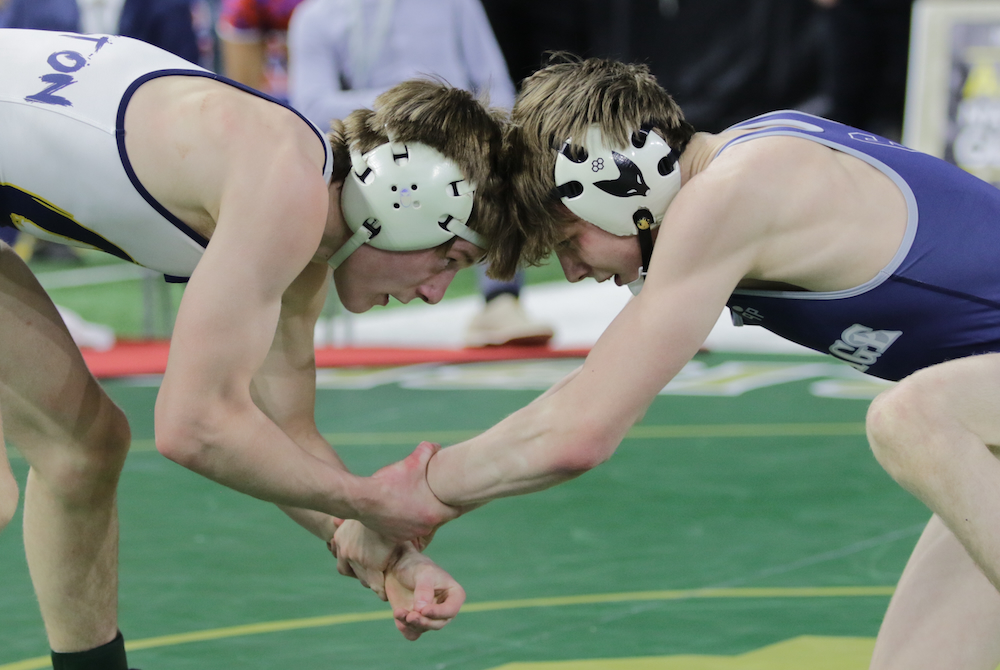
Anderson and Lefevre both advanced through last year’s Division 1 Individual Finals field at 120 pounds to reach the championship match, where they ended up running into … each other.
The two squared off for the title in a battle of teammates, with Anderson earning a 10-8 win in overtime.
“It was pretty cool,” said Anderson, recalling the match during the first day of this season’s Oakland County meet last month. “It was really tough because you know exactly what he was going do. But that was in the past. We are just trying to get better and focusing on improvement.”
Added Lefevre: “I wouldn’t say it was awkward as much it was bittersweet. It was cool that one of us got to win.”
This year, it’s possible both will celebrate Finals championships.
The two started this winter in different weight classes, with Anderson wrestling at 126 pounds and Lefevre at 132.
“Whatever weight is best for the individual, that’s where they are going to go,” Lefevre said. “We just figured out that 126 and 132 was where we were going to be. I just got bigger.”
At the Oakland County tournament, Anderson won the title at 126 pounds, while Lefevre advanced to the championship at 132 pounds before losing to Jace Morgan of Rochester Adams. Morgan was a semifinalist at 126 pounds at last year’s MHSAA Tournament and has signed to wrestle for Michigan State.
Both Anderson and Lefevre look primed to be among the best in the state in their weight classes. They had an active offseason, with both competing among other decorated high school wrestlers at the Super 32 Challenge in North Carolina in October.
“We got some chances at some nationally-ranked wrestlers, so that was fun,” Anderson said.
 Anderson and Lefevre both were voted team captains, and both have embraced the extra responsibility of leading the others on the squad.
“Just trying to get better and we’ve been setting a good example for the underclassmen,” Anderson said.
Of course, that starts with leading by example with how they train with each other every day in practice.
The weight classes might have changed, but the fact that the two are still training partners and go at it regularly hasn’t changed a bit.
It’s all for the best though, where their technique, and physical and mental toughness is honed.
“Iron sharpens iron,” Lefevre said. “We are in there every day scrapping and getting better. Everything gets better. Even your mindset. I got to hate losing.”
Clarkston head coach Brian Gibbs has seen the two push each other in practice ever since they were freshmen, and it will obviously be a strange sight not to see them do so in the Clarkston wrestling room once they graduate.
“They have been true competitors year over year and continually work on refining their craft,” Gibbs said. “The fact they finally wrestled each other in the state finals has only increased their competitiveness and drive to be better. They are great friends and drill partners. Both of them have done tremendous things for this program, and I’m extremely grateful to have them with us.”
Having two of the state’s top wrestlers in the lower weights is an advantage many teams don’t have, and both Anderson and Lefevre hope that means they’ll take Clarkston to a place the Wolves haven’t been during their high school careers – the Team Finals in Kalamazoo.
“It’s been a goal of ours to make states because we haven’t done it,” he said. “That’s always been a goal.”
Whether or not Clarkston is in Kalamazoo as a team, expectations are Anderson and Lefevre will once again be center stage at Ford Field for the Individual Finals.
This time though, the plan is for both to be raising an arm in victory after the championship match.
 Keith Dunlap has served in Detroit-area sports media for more than two decades, including as a sportswriter at the Oakland Press from 2001-16 primarily covering high school sports but also college and professional teams. His bylines also have appeared in USA Today, the Washington Post, the Detroit Free Press, the Houston Chronicle and the Boston Globe. He served as the administrator for the Oakland Activities Association’s website from 2017-2020. Contact him at [email protected] with story ideas for Oakland, Macomb and Wayne counties.
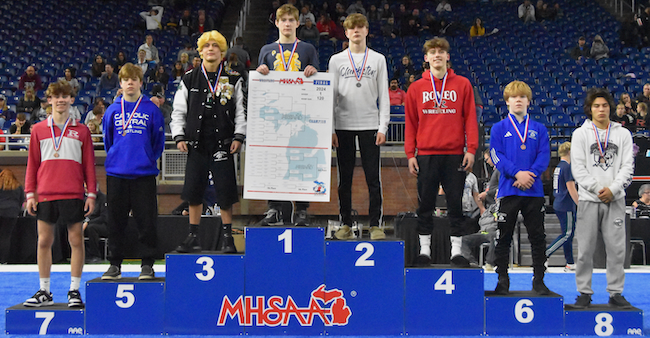
PHOTOS (Top) Clarkston teammates Archer Anderson (left) and Preston Lefevre compete against each other for the Division 1 championship at 120 pounds last season. (Middle) Archer and Lefevre top the awards podium at Ford Field. (Click for more from High School Sports Scene.)