


Add, Subtract, Divide, Multiply: MHSAA Not Alone
July 25, 2017
By Rob Kaminski
MHSAA benchmarks editor
This is the third part in a series on MHSAA tournament classification, past and present, that will be published over the next two weeks. This series originally ran in this spring's edition of MHSAA benchmarks.
As the MHSAA faces its most recent classification task with 8-Player Football, and opinions continue to swirl about as to the method, timeframe, location and other procedures, a look around the country provides plenty of company among state association brethren factoring variables into their own equations.
In the Pacific Northwest, the Oregon School Activities Association Football Playoffs are under public scrutiny as leadership ponders a five or six classification format beginning with the 2018-19 school year.
The OSAA has crowned six champions on the gridiron since 2006-07. Many of the state’s smaller schools would like to keep it that way, while larger schools lean toward a five-classification system, citing larger leagues, ease of travel and credibility to state championships as the advantages.
Still others would prefer more than six classes, pointing to safety issues and the opportunity to increase participation numbers as positives.
Moving southeast of Oregon, the Nevada Interscholastic Activities Association recently voted to hold serve on a classification proposal that was volleyed to the membership.
However, changes still could be forthcoming by as early as the 2018-19 season which would add a fifth classification in more populated southern Nevada while allowing northern schools to participate in four classifications. Such divisions could mean no state championship for the fifth class in southern Nevada.
Because of that, the NIAA wants equal numbers of schools in each classification on both ends of the state. Complicating the issue is the fact that the 24 largest schools in the state, by enrollment, are all in Clark County in Southern Nevada.
Across Nevada’s border into Arizona, charter schools are asking the Arizona Interscholastic Association to reconsider classification that was voted upon and approved in September 2015. That agreement called for the largest 33 percent of charter schools by enrollment to be placed in the state’s largest school classification, 3A, the middle 33 percent into 2A, and the smallest 33 percent into 1A.
Less than two years later the charter schools have had a change of heart and have asked to be considered the same as other Arizona public schools and be placed appropriately by enrollment beginning with the 2018-19 school year.
The situation in Arizona further illustrates how the public/private debate that all state associations have faced throughout existence now has the added dynamic of rapidly growing charter schools in today’s educational system, along with virtual school enrollment.
In the nation’s heartland, Nebraska has retooled its football classifications by using enrollment of boys students only in its schools rather than total enrollment. The Nebraska School Activities Association football-playing schools will kick off the 2018 season using this alignment.
Nebraska has three classes of 11-player football, with the smallest class divided in two, Class C-1 and C-2. The state also will have 8-player football for boys enrollments under 47, and the NSAA will sponsor a new 6-player tournament in 2018 for schools with 27 or fewer boys.
“This is a good proposal because some schools have a sizable imbalance between the number of boys and girls, and there’s a large gap (in enrollment) between the largest and smallest schools in Classes A and B,” NSAA executive director Jim Tenopir said. “I think this addresses both of those concerns.”
Swimmers in Georgia, meanwhile, will feel like they are moving with the current, rather than upstream in 2017-18, as the Georgia High School Association recently doubled the number of team championship events from two to four.
Swim enthusiasts can also count on longer days at the finals, as the top 30 finishers from the prelims will advance to the finals instead of 20, and all championship events will have three heats versus two.
No Slowing Down For Oxford's Krajcarski After Championship Finish
By
Keith Dunlap
Special for MHSAA.com
December 12, 2024
OXFORD — A championship was won, school history was made, and the accolades have been constant and deserved for Oxford senior Tristan Krajcarski.
 But despite all of that, rest and taking it easy certainly hasn’t been on the itinerary for Krajcarski ever since she won the diving competition at the MHSAA Lower Peninsula Division 1 Finals on Nov. 23 – even though her high school athletic diving career is technically over.
“The most time I took off was two days,” Krajcarski said. “But I’ve been in the pool pretty much every day with the boys team working on 1 and 3-meter (dives).”
Next up for Krajcarski is a collegiate career at Buffalo, and in her words, there is “so much more” to achieve in the sport even after a terrific high school career.
Krajcarski qualified for the Finals three out of her four years at Oxford, finishing third as a junior with an All-American score of 329.05 before having a dominant senior season.
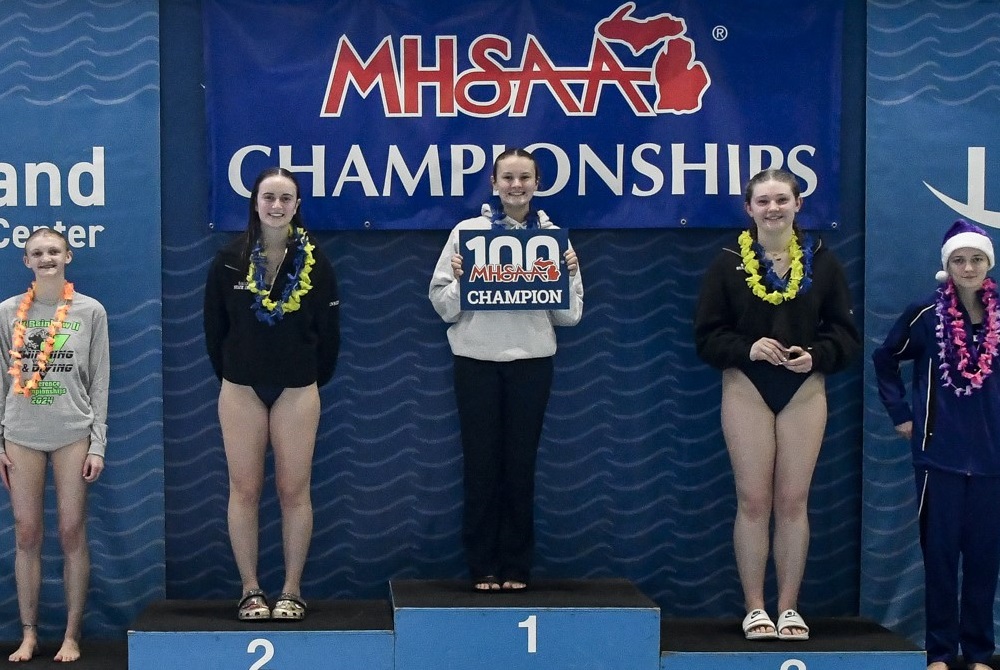
Krajcarski won every event she competed in this fall, highlighted by becoming the first diver — boys or girls — from Oxford to win a Finals title when she accumulated 432.60 points, nearly 40 points more than runner-up Lindi Jenkins of Saline.
What drove Krajcarski to the top of the state and what still drives her to do more was her greatest disappointment, which occurred during her sophomore year.
After qualifying for the Finals as a freshman, Krajcarski had a disappointing 2022 Regional and didn’t advance. She rallied behind teammates and supported them during their championship events in Holland, but not competing herself there became a rallying cry.
 “It was very hard to not have that expectation of (making the Finals) met when the people around me did,” she said. “I felt kind of defeated, and it motivated me to do more.
“It was kind of scary to do more, but I knew I wasn’t going to let it happen again. Just how I worked and how I viewed diving changed. Now I always have this motivation to always keep going, and it’s become my expectation. I don’t really like taking time off — even though I probably should — but I just feel like I can constantly get better to not be let down again.”
Krajcarski certainly wasn’t disappointed with her junior and senior years, which featured the third-place finish as a junior, the Finals championship this year and a trip to Rome, Italy, this past summer as a representative of the AAU U.S. national team, which competed in the same venue used for the 1960 Summer Olympics.
John Pearson, the diving coach for both Oxford and Lake Orion, said Krajcarski easily could have scored even higher at the Finals, but that more difficult dives simply weren’t necessary.
“She was already outscoring everybody by 40 points with a tuck position instead of a pike position,” he said. “At the state meet, we decided to stay with what she was comfortable with. To me, it was more important at that meet to be comfortable. All Tristan had to do at the state meet was be herself and get up and down 11 times. I was confident that if she did that and if she did her best, nobody could catch her.”
Not too shabby for someone who didn’t even get into diving until the spring of her eighth grade year.
Krajcarski originally was a gymnast but said after a while she got burned out in that sport before discovering a love for diving.
“I’ve always loved the water and I always liked swimming, but I wasn’t very good at swimming itself,” she said. “Combining what I’d already known of gymnastics with the water, it made me very happy. People think it’s really similar to gymnastics, but you have to learn a whole new set of techniques. I thought it was cool to go through the process of learning something new while still having the experience from gymnastics.”
It was obviously a successful switch, and now nothing is slowing her passion to get better at diving every day.
As the last couple of weeks have shown, not even a championship has made Krajcarski complacent.
“I can get way better,” she said.
 Keith Dunlap has served in Detroit-area sports media for more than two decades, including as a sportswriter at the Oakland Press from 2001-16 primarily covering high school sports but also college and professional teams. His bylines also have appeared in USA Today, the Washington Post, the Detroit Free Press, the Houston Chronicle and the Boston Globe. He served as the administrator for the Oakland Activities Association’s website from 2017-2020. Contact him at [email protected] with story ideas for Oakland, Macomb and Wayne counties.
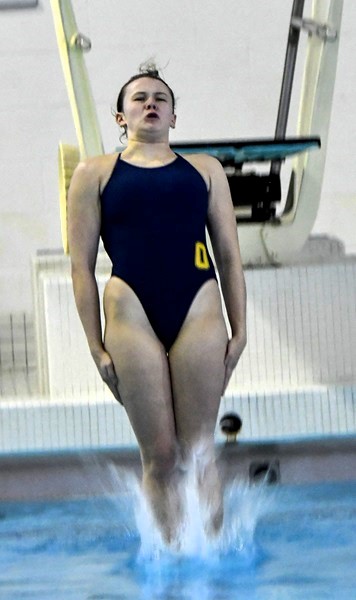
PHOTOS (Top) Oxford senior Tristan Krajcarski, holding the “champion” sign, stands atop the podium after receiving her medal for winning the Division 1 diving competition last month. (Middle) Krajcarski reaches the water on a dive during the Finals. (Click for more from High School Sports Scene.)