

Add, Subtract, Divide, Multiply: MHSAA Not Alone
July 25, 2017
By Rob Kaminski
MHSAA benchmarks editor
This is the third part in a series on MHSAA tournament classification, past and present, that will be published over the next two weeks. This series originally ran in this spring's edition of MHSAA benchmarks.
As the MHSAA faces its most recent classification task with 8-Player Football, and opinions continue to swirl about as to the method, timeframe, location and other procedures, a look around the country provides plenty of company among state association brethren factoring variables into their own equations.
In the Pacific Northwest, the Oregon School Activities Association Football Playoffs are under public scrutiny as leadership ponders a five or six classification format beginning with the 2018-19 school year.
The OSAA has crowned six champions on the gridiron since 2006-07. Many of the state’s smaller schools would like to keep it that way, while larger schools lean toward a five-classification system, citing larger leagues, ease of travel and credibility to state championships as the advantages.
Still others would prefer more than six classes, pointing to safety issues and the opportunity to increase participation numbers as positives.
Moving southeast of Oregon, the Nevada Interscholastic Activities Association recently voted to hold serve on a classification proposal that was volleyed to the membership.
However, changes still could be forthcoming by as early as the 2018-19 season which would add a fifth classification in more populated southern Nevada while allowing northern schools to participate in four classifications. Such divisions could mean no state championship for the fifth class in southern Nevada.
Because of that, the NIAA wants equal numbers of schools in each classification on both ends of the state. Complicating the issue is the fact that the 24 largest schools in the state, by enrollment, are all in Clark County in Southern Nevada.
Across Nevada’s border into Arizona, charter schools are asking the Arizona Interscholastic Association to reconsider classification that was voted upon and approved in September 2015. That agreement called for the largest 33 percent of charter schools by enrollment to be placed in the state’s largest school classification, 3A, the middle 33 percent into 2A, and the smallest 33 percent into 1A.
Less than two years later the charter schools have had a change of heart and have asked to be considered the same as other Arizona public schools and be placed appropriately by enrollment beginning with the 2018-19 school year.
The situation in Arizona further illustrates how the public/private debate that all state associations have faced throughout existence now has the added dynamic of rapidly growing charter schools in today’s educational system, along with virtual school enrollment.
In the nation’s heartland, Nebraska has retooled its football classifications by using enrollment of boys students only in its schools rather than total enrollment. The Nebraska School Activities Association football-playing schools will kick off the 2018 season using this alignment.
Nebraska has three classes of 11-player football, with the smallest class divided in two, Class C-1 and C-2. The state also will have 8-player football for boys enrollments under 47, and the NSAA will sponsor a new 6-player tournament in 2018 for schools with 27 or fewer boys.
“This is a good proposal because some schools have a sizable imbalance between the number of boys and girls, and there’s a large gap (in enrollment) between the largest and smallest schools in Classes A and B,” NSAA executive director Jim Tenopir said. “I think this addresses both of those concerns.”
Swimmers in Georgia, meanwhile, will feel like they are moving with the current, rather than upstream in 2017-18, as the Georgia High School Association recently doubled the number of team championship events from two to four.
Swim enthusiasts can also count on longer days at the finals, as the top 30 finishers from the prelims will advance to the finals instead of 20, and all championship events will have three heats versus two.
Flashback 100: Coleman's Legendary Heroics Carry Harrison Through Repeat
December 6, 2024
Jackson Lumen Christi's victory in last weekend's 11-Player Division 6 Football Final marked the school’s 14th championship, sending the Titans past Farmington Hills Harrison for the most football state titles in MHSAA history.
Harrison, which closed in 2019, won 13 over a 30-year period from 1981 to 2010, all under the guidance of legendary coach John Herrington.
The third and fourth championships came with Mill Coleman at quarterback. If not for his thrilling playmaking, the fourth title might not have been possible.
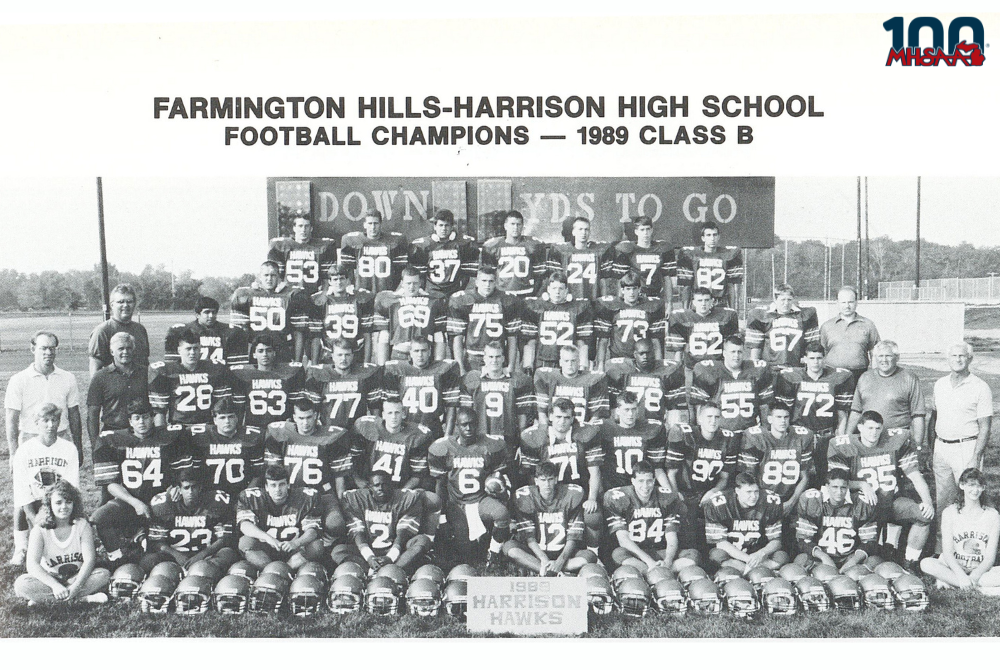
In 1989, one year after leading Harrison to the 1988 Class B championship, Coleman and his team found themselves trailing DeWitt by double digits in the second quarter of the Class B title game and by six with fewer than two minutes to play.
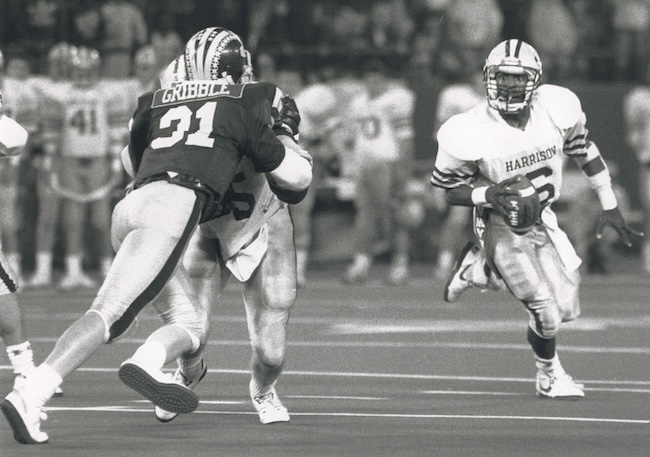
But Coleman’s heroics led Harrison to a 28-27 victory, as he scored two touchdown runs in the fourth quarter, the last coming with 1:34 remaining. He finished with 208 passing yards and 89 rushing yards in the win. In the 1988 title game, Coleman had thrown for 238 yards and three touchdowns in a dominant 44-9 victory over St. Joseph.
 Over his three years as Harrison’s starting quarterback, Coleman amassed a 37-2 record, with both losses coming during his sophomore season in 1987. The last team to defeat Coleman was Grand Rapids Catholic Central in the 1987 Class B Final.
After his high school career, Coleman excelled at Michigan State, playing quarterback, running back, receiver, and returning kicks. He also spent two years with the Montreal Alouettes in the Canadian Football League, where he scored six touchdowns during his pro career.
Coleman’s son, Mill Coleman III, won a state title in 2023 with Grand Rapids Catholic Central – the school which last defeated the older Coleman. The younger Coleman contributed with five tackles and an interception as the Cougars defeated Corunna 21-7 to claim the Division 5 title.
Previous "Flashback 100" Features
Nov. 29: Harbaugh Brothers' Football Roots Planted in Part at Pioneer - Read
Nov. 22: 8-Player Football Finals Right at Home at Superior Dome - Read
Nov. 15: Leland Career Helps Set Stage for Glass' International Stardom - Read
Nov. 8: Future Baseball Pro Led Escanaba's Legendary Football Title Run - Read
Nov. 1: Michigan High School Baseball Trio Provide World Series Voices - Read
Oct. 25: Before Leading Free World, Ford Starred for Champion GR South - Read
Oct. 18: Mercy Links Legend Becomes World Golf Hall of Famer - Read
Oct. 11: Fisher Races to Finals Stardom on Way to U.S. Olympic First - Read
Oct. 4: Lalas Leaves High School Legacies on Ice & Pitch - Read
Sept. 27: Tamer's History-Making Run Starts in Dexter, Continues to Paris - Read
Sept. 20: Todd Martin’s Road to Greatness Starts at East Lansing - Read
Sept. 13: James Earl Jones, Dickson High Hoops to Hollywood Legend - Read
Sept. 6: Pioneers' Unstoppable Streak Stretches 9 Seasons - Read
Aug. 30: Detroit dePorres Rushes to 1995 Class CC Football Championship - Read
PHOTOS (Top) The Farmington Hills Harrison 1989 Class B championship football team. (Middle) Harrison's Mill Coleman (6) looks for an open receiver during the 1989 Class B Final against DeWitt. (MHSAA archives)