

Add, Subtract, Divide, Multiply: MHSAA Not Alone
July 25, 2017
By Rob Kaminski
MHSAA benchmarks editor
This is the third part in a series on MHSAA tournament classification, past and present, that will be published over the next two weeks. This series originally ran in this spring's edition of MHSAA benchmarks.
As the MHSAA faces its most recent classification task with 8-Player Football, and opinions continue to swirl about as to the method, timeframe, location and other procedures, a look around the country provides plenty of company among state association brethren factoring variables into their own equations.
In the Pacific Northwest, the Oregon School Activities Association Football Playoffs are under public scrutiny as leadership ponders a five or six classification format beginning with the 2018-19 school year.
The OSAA has crowned six champions on the gridiron since 2006-07. Many of the state’s smaller schools would like to keep it that way, while larger schools lean toward a five-classification system, citing larger leagues, ease of travel and credibility to state championships as the advantages.
Still others would prefer more than six classes, pointing to safety issues and the opportunity to increase participation numbers as positives.
Moving southeast of Oregon, the Nevada Interscholastic Activities Association recently voted to hold serve on a classification proposal that was volleyed to the membership.
However, changes still could be forthcoming by as early as the 2018-19 season which would add a fifth classification in more populated southern Nevada while allowing northern schools to participate in four classifications. Such divisions could mean no state championship for the fifth class in southern Nevada.
Because of that, the NIAA wants equal numbers of schools in each classification on both ends of the state. Complicating the issue is the fact that the 24 largest schools in the state, by enrollment, are all in Clark County in Southern Nevada.
Across Nevada’s border into Arizona, charter schools are asking the Arizona Interscholastic Association to reconsider classification that was voted upon and approved in September 2015. That agreement called for the largest 33 percent of charter schools by enrollment to be placed in the state’s largest school classification, 3A, the middle 33 percent into 2A, and the smallest 33 percent into 1A.
Less than two years later the charter schools have had a change of heart and have asked to be considered the same as other Arizona public schools and be placed appropriately by enrollment beginning with the 2018-19 school year.
The situation in Arizona further illustrates how the public/private debate that all state associations have faced throughout existence now has the added dynamic of rapidly growing charter schools in today’s educational system, along with virtual school enrollment.
In the nation’s heartland, Nebraska has retooled its football classifications by using enrollment of boys students only in its schools rather than total enrollment. The Nebraska School Activities Association football-playing schools will kick off the 2018 season using this alignment.
Nebraska has three classes of 11-player football, with the smallest class divided in two, Class C-1 and C-2. The state also will have 8-player football for boys enrollments under 47, and the NSAA will sponsor a new 6-player tournament in 2018 for schools with 27 or fewer boys.
“This is a good proposal because some schools have a sizable imbalance between the number of boys and girls, and there’s a large gap (in enrollment) between the largest and smallest schools in Classes A and B,” NSAA executive director Jim Tenopir said. “I think this addresses both of those concerns.”
Swimmers in Georgia, meanwhile, will feel like they are moving with the current, rather than upstream in 2017-18, as the Georgia High School Association recently doubled the number of team championship events from two to four.
Swim enthusiasts can also count on longer days at the finals, as the top 30 finishers from the prelims will advance to the finals instead of 20, and all championship events will have three heats versus two.
SMCC's Windhams Agree to Coach Together - 'Us or Nothing' - Then Win It All
By
Doug Donnelly
Special for MHSAA.com
November 26, 2024
When Monroe St. Mary Catholic Central was down to needing just one point to clinch the Division 3 volleyball championship Saturday, assistant coach Randy Windham was fighting back tears.
 “Just because I’m crying doesn’t mean this match is over,” Randy said in the huddle.
A few seconds later, it was over. SMCC had clinched the championship, and Randy had a front row seat to watch his wife, head coach Kim Windham, accept the trophy.
“I always call her the best coach in the family,” Randy said.
The Windhams are a coaching couple. They have been married since 1992, operate a business in Monroe together and this fall, for the first time, coached together.
It clearly was a winning combination.
When Kim was approached about coaching SMCC prior to the season, she said Randy – who has been the head boys basketball coach at SMCC since 2009 – talked her into taking the job.
“I said, ‘I’ll take it if you’ll coach,’” she said. “’If you want me to coach, then obviously you are going to coach along with me. It’s us or nothing.’ He was all in from the get-go.’”
Randy, she thought, would bring an extra element to the bench that the Kestrels needed.
“He’s so good with the mental side of things with kids,” Kim said. “I knew how much he could contribute with that. All I wanted to do was coach. I wanted to do the Xs and Os, the practice plans and teaching and let him do the rest. He’s been absolutely fabulous.”
She said having Randy near helped her, too.
“Before every match, he’s my calming force. I lean on him a lot.”
During matches, Kim said Randy was often the person talking during the huddles.
“With volleyball you only have only three minutes between sets,” she said. “You have to figure out the rotations, who is going to start, what we are going to do … so as I’m at the table figuring that out, he’s talking to the group about what just happened or what we are going to do next.
 “It’s good to know he’s there taking care of things, saying the things the way I know I would want them to be said.”
While SMCC has had several deep MHSAA Tournament runs in recent years and an outstanding volleyball tradition, this year’s team did lack experience coming into the season. Windham was named head coach in May.
“We only really had three returning starters coming back,” she said. “When we started the season, the question was how we were going to get everyone else up to speed. We knew we had our work cut out for us. We had to figure out how we were going to make the puzzle pieces fit.”
Randy said he was confident Kim could get the job done.
“She’s been known to build programs,” Randy said. “It really isn’t about how good the players are, but what they will buy into. She’ll get them there. We had some good players, but she took them to the next level with her coaching.”
Kim set out to change the culture around an ultra-successful volleyball program. Early in the season, for example, the team focused on the fundamentals.
“We went back to basic fundamentals,” Kim said. “We knew if we wanted to be good, we had to be fundamentally sound first.”
Kim graduated from SMCC in 1990 after an outstanding volleyball career and went on to play two years at the college level. She launched her coaching career in 1996, only a few months after their son Bryce was born.
“I would take him with me to practice in his car seat, set him on the mat and coach,” she said.
Sports have been a common denominator for the Windham family for years.
Randy opened Monroe Sports Varsity Athletic, a screen printing and embroidery business, in 1991, a year before he and Kim were married. An assistant coach at SMCC since the 1990s, he also played professional slow-pitch softball for years. Bailey, a college volleyball player herself after playing at SMCC, lives in Indiana where she is a nurse. Bryce, who was drafted by the Chicago Cubs and played several seasons of Minor League Baseball, is working at the family business and is an assistant basketball coach at SMCC for his dad.
Kim started working full-time at the business in 2003. The day after winning the Kestrels’ most recent championship, the Windhams were back at the shop, working on filling orders.
The family bond is special.
“Randy and I just love spending time together,” Kim said. “Sometimes during basketball season Randy will be gone late or watching film. We almost get more upset when we are not together.”
 Doug Donnelly has served as a sports and news reporter and city editor over 25 years, writing for the Daily Chief-Union in Upper Sandusky, Ohio from 1992-1995, the Monroe Evening News from 1995-2012 and the Adrian Daily Telegram since 2013. He's also written a book on high school basketball in Monroe County and compiles record books for various schools in southeast Michigan. E-mail him at [email protected] with story ideas for Jackson, Washtenaw, Hillsdale, Lenawee and Monroe counties.
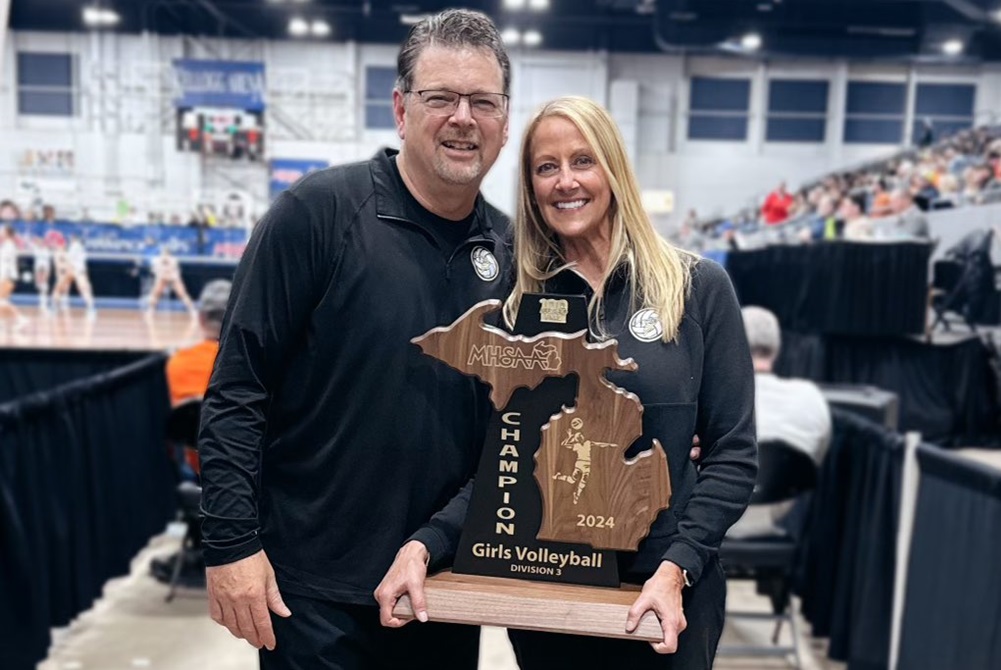
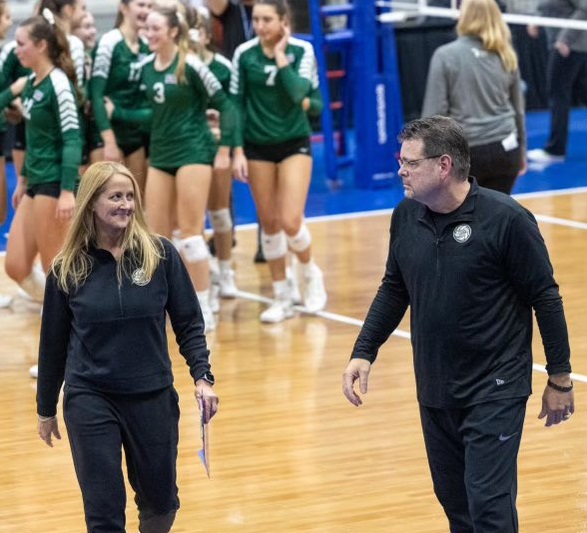
PHOTOS (Top) Monroe St. Mary Catholic Central head volleyball coach Kim Windham, right, and assistant coach/husband Randy hold the program’s latest championship trophy. (Middle) The Windhams exchange a glance on the court at Kellogg Arena. (Top photo courtesy of the Windham family. Middle photo by Stephanie Hawkins.)