

Add, Subtract, Divide, Multiply: MHSAA Not Alone
July 25, 2017
By Rob Kaminski
MHSAA benchmarks editor
This is the third part in a series on MHSAA tournament classification, past and present, that will be published over the next two weeks. This series originally ran in this spring's edition of MHSAA benchmarks.
As the MHSAA faces its most recent classification task with 8-Player Football, and opinions continue to swirl about as to the method, timeframe, location and other procedures, a look around the country provides plenty of company among state association brethren factoring variables into their own equations.
In the Pacific Northwest, the Oregon School Activities Association Football Playoffs are under public scrutiny as leadership ponders a five or six classification format beginning with the 2018-19 school year.
The OSAA has crowned six champions on the gridiron since 2006-07. Many of the state’s smaller schools would like to keep it that way, while larger schools lean toward a five-classification system, citing larger leagues, ease of travel and credibility to state championships as the advantages.
Still others would prefer more than six classes, pointing to safety issues and the opportunity to increase participation numbers as positives.
Moving southeast of Oregon, the Nevada Interscholastic Activities Association recently voted to hold serve on a classification proposal that was volleyed to the membership.
However, changes still could be forthcoming by as early as the 2018-19 season which would add a fifth classification in more populated southern Nevada while allowing northern schools to participate in four classifications. Such divisions could mean no state championship for the fifth class in southern Nevada.
Because of that, the NIAA wants equal numbers of schools in each classification on both ends of the state. Complicating the issue is the fact that the 24 largest schools in the state, by enrollment, are all in Clark County in Southern Nevada.
Across Nevada’s border into Arizona, charter schools are asking the Arizona Interscholastic Association to reconsider classification that was voted upon and approved in September 2015. That agreement called for the largest 33 percent of charter schools by enrollment to be placed in the state’s largest school classification, 3A, the middle 33 percent into 2A, and the smallest 33 percent into 1A.
Less than two years later the charter schools have had a change of heart and have asked to be considered the same as other Arizona public schools and be placed appropriately by enrollment beginning with the 2018-19 school year.
The situation in Arizona further illustrates how the public/private debate that all state associations have faced throughout existence now has the added dynamic of rapidly growing charter schools in today’s educational system, along with virtual school enrollment.
In the nation’s heartland, Nebraska has retooled its football classifications by using enrollment of boys students only in its schools rather than total enrollment. The Nebraska School Activities Association football-playing schools will kick off the 2018 season using this alignment.
Nebraska has three classes of 11-player football, with the smallest class divided in two, Class C-1 and C-2. The state also will have 8-player football for boys enrollments under 47, and the NSAA will sponsor a new 6-player tournament in 2018 for schools with 27 or fewer boys.
“This is a good proposal because some schools have a sizable imbalance between the number of boys and girls, and there’s a large gap (in enrollment) between the largest and smallest schools in Classes A and B,” NSAA executive director Jim Tenopir said. “I think this addresses both of those concerns.”
Swimmers in Georgia, meanwhile, will feel like they are moving with the current, rather than upstream in 2017-18, as the Georgia High School Association recently doubled the number of team championship events from two to four.
Swim enthusiasts can also count on longer days at the finals, as the top 30 finishers from the prelims will advance to the finals instead of 20, and all championship events will have three heats versus two.
Pair of Relay Champs Set Pace as Pioneer Runs Finals Win Streak to 5
By
Dean Holzwarth
Special for MHSAA.com
November 23, 2024
HOLLAND – The end of a high school career couldn’t have been scripted any better for Ann Arbor Pioneer’s Reese Heidenreich.
The senior standout swam the first leg of the final event of her career and set the tone in a 400-yard freestyle relay victory.
It was the exclamation point on a day that saw the Pioneers dominate once again en route to a fifth-straight Lower Peninsula Division 1 swimming & diving championship at Holland Aquatic Center.
"An amazing way to cap off my career,” Heidenreich said. “It’s bittersweet because it's my last year, but I wouldn't want to end it any other way.”
Pioneer finished with an astounding 386 points to finish well ahead of runner-up Jenison (222). Northville (165) placed third and Grand Haven (142) was fourth.
It’s the second-longest title streak in program history behind the 2000-08 teams that won nine consecutive Finals.
 “We were favored coming in and favored all season, but the girls weren't complacent and they didn't take anything for granted,” Pioneer coach Stefanie Kerska said. “They showed up every single day as if they were the underdogs, and I really respect their work ethic and how they conducted themselves in and out of the pool each day.”
Pioneer’s supreme depth was on full display as it didn’t have an individual event winner.
The Pioneers did, however, also win the 200 freestyle relay with the foursome of Heidenreich, Katelyn Van Ryn, Ursula Ott and Meg Pinkerton.
“We really come together in relays, and that’s what makes us our best and that’s where we shine,” Heidenreich said. “We can lean on each other and support each other. The 400 relay at the end was the highlight of the day because it took so much grit and teamwork to pull that out.”
Ott said the team takes pride in continuing to live up to the tradition of Pioneer swimming.
“It just pushes us to be better and get more and more state titles under our belt,” she said. “This team is truly amazing, and I love everyone on it. I think just the closeness is what drives us to be our best. We just always come together and support each other, and it's just really sweet and amazing to see.”
In addition to its three relays and three divers, Pioneer had 26 individual entries seeded to score (among the top 16 in their events).
“I’ve been doing this for a really long time and I can't remember a more fun or functional team that I've worked with,” Kerska said. “It’s the culture, it's the tradition and it’s the senior leadership. They just want it for each other so badly, and it's never about them. It’s only about the team and the program, and you go a long way when you have kids like that.”
The win was a culmination of a work ethic that is second to none.
“This victory is just a testament to the hard work of every single person on this team as well as the coaches that pour so much effort and energy into this program,” Heidenreich said. “To see us come out on top again just really validates all the hard work.”
Jenison tied for its highest finish in school history after also placing runner-up in Division 2 two years ago.
 “To come up a division and be second here is just a testament to how awesome these girls swam and dove the last two days,” Jenison coach Kyle Stumpf said. “This was the best Day 2 I’ve been a part of in 10 years, and every single spot was held or moved up.
“We knew Pioneer was going to be loaded and have lots of depth, so you can only control what you can control. And I told the girls we can't control how other teams swim, so let's just swim and dive the best we can and see where the chips fall. It was awesome to see their hard work all season pay off, and this was a great team to coach.”
Senior Sophia Umstead led the Wildcats and capped a stellar high school career with two more individual titles, in the 200 individual medley (1:59.98) and 100 breaststroke (1:00.72).
She also was a member of the winning 200 medley relay and finished her career with six individual and five relay championships.
“It’s been an amazing four years, and I’ve had such a great experience swimming with this team,” Umstead said. “I don't know what I would've done without Jenison swimming, and I’m very happy to come out here and swim fast with my team. It was a great experience.”
West Bloomfield junior Elizabeth Eichbrecht repeated as champion in the 200 freestyle (1:48:48) and 500 freestyle (4:51.87) events, while Zeeland junior Madison Ensing won the 50 freestyle (22.94) and 100 freestyle (50.11).
West Ottawa’s Mackenzie Baldwin took top honors in the 100 backstroke, while Kalamazoo Central’s Maggie Spybrook finished first in the 100 butterfly.
Oxford senior Tristan Krajcarski won the diving portion of the meet with a final score of 432.60.
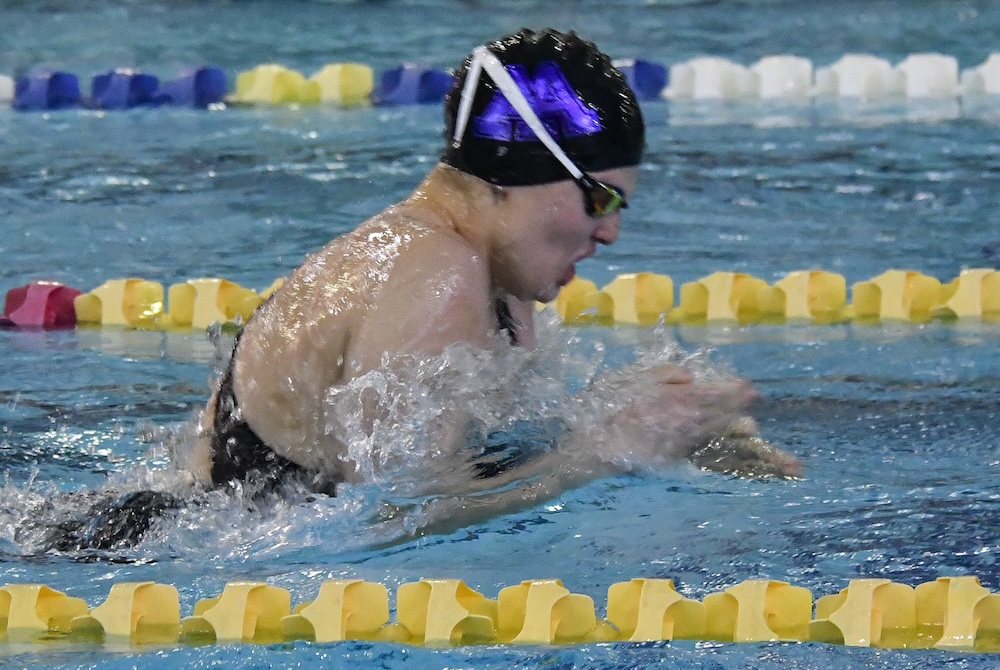
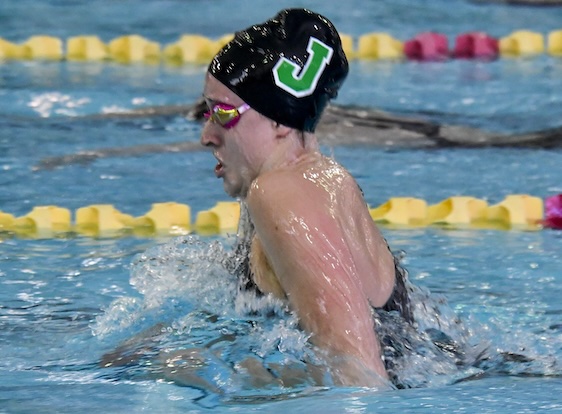
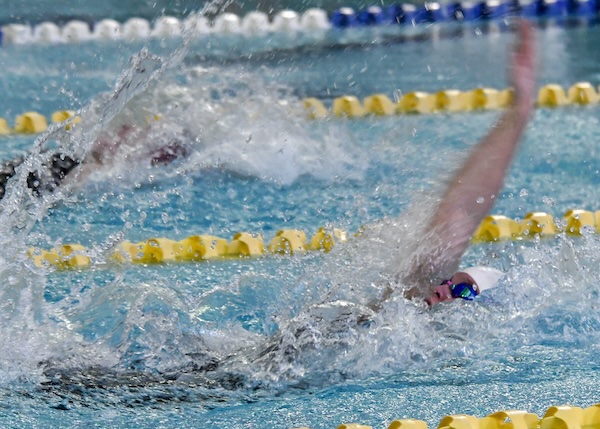
PHOTOS (Top) Ann Arbor Pioneer’s Ursula Ott swims the breaststroke during Saturday’s Division 1 Finals at Holland Aquatic Center. (Middle) A Jenison swimmer competes during the 200 medley relay. (Below) Racers power through the backstroke Saturday. (Click for more from High School Sports Scene.)