

Add, Subtract, Divide, Multiply: MHSAA Not Alone
July 25, 2017
By Rob Kaminski
MHSAA benchmarks editor
This is the third part in a series on MHSAA tournament classification, past and present, that will be published over the next two weeks. This series originally ran in this spring's edition of MHSAA benchmarks.
As the MHSAA faces its most recent classification task with 8-Player Football, and opinions continue to swirl about as to the method, timeframe, location and other procedures, a look around the country provides plenty of company among state association brethren factoring variables into their own equations.
In the Pacific Northwest, the Oregon School Activities Association Football Playoffs are under public scrutiny as leadership ponders a five or six classification format beginning with the 2018-19 school year.
The OSAA has crowned six champions on the gridiron since 2006-07. Many of the state’s smaller schools would like to keep it that way, while larger schools lean toward a five-classification system, citing larger leagues, ease of travel and credibility to state championships as the advantages.
Still others would prefer more than six classes, pointing to safety issues and the opportunity to increase participation numbers as positives.
Moving southeast of Oregon, the Nevada Interscholastic Activities Association recently voted to hold serve on a classification proposal that was volleyed to the membership.
However, changes still could be forthcoming by as early as the 2018-19 season which would add a fifth classification in more populated southern Nevada while allowing northern schools to participate in four classifications. Such divisions could mean no state championship for the fifth class in southern Nevada.
Because of that, the NIAA wants equal numbers of schools in each classification on both ends of the state. Complicating the issue is the fact that the 24 largest schools in the state, by enrollment, are all in Clark County in Southern Nevada.
Across Nevada’s border into Arizona, charter schools are asking the Arizona Interscholastic Association to reconsider classification that was voted upon and approved in September 2015. That agreement called for the largest 33 percent of charter schools by enrollment to be placed in the state’s largest school classification, 3A, the middle 33 percent into 2A, and the smallest 33 percent into 1A.
Less than two years later the charter schools have had a change of heart and have asked to be considered the same as other Arizona public schools and be placed appropriately by enrollment beginning with the 2018-19 school year.
The situation in Arizona further illustrates how the public/private debate that all state associations have faced throughout existence now has the added dynamic of rapidly growing charter schools in today’s educational system, along with virtual school enrollment.
In the nation’s heartland, Nebraska has retooled its football classifications by using enrollment of boys students only in its schools rather than total enrollment. The Nebraska School Activities Association football-playing schools will kick off the 2018 season using this alignment.
Nebraska has three classes of 11-player football, with the smallest class divided in two, Class C-1 and C-2. The state also will have 8-player football for boys enrollments under 47, and the NSAA will sponsor a new 6-player tournament in 2018 for schools with 27 or fewer boys.
“This is a good proposal because some schools have a sizable imbalance between the number of boys and girls, and there’s a large gap (in enrollment) between the largest and smallest schools in Classes A and B,” NSAA executive director Jim Tenopir said. “I think this addresses both of those concerns.”
Swimmers in Georgia, meanwhile, will feel like they are moving with the current, rather than upstream in 2017-18, as the Georgia High School Association recently doubled the number of team championship events from two to four.
Swim enthusiasts can also count on longer days at the finals, as the top 30 finishers from the prelims will advance to the finals instead of 20, and all championship events will have three heats versus two.
Central Montcalm's Hoffman Pulls Away, Lansing Catholic Claims Close Race
November 2, 2024
BROOKLYN — Kyah Hoffman was winning cross country races for the first four weeks of the season, but wasn’t satisfied with her performances.
As much as coaches stress that it’s place, not time, that matters in cross country, kids are still motivated by lowering their personal records.
Through six meets, Hoffman won five times — taking sixth in the Spartan Elite race against mostly Division 1 runners — but her times were nowhere near where she finished her junior year at Central Montcalm.
Her breakthrough moment came Sept. 28 in Shepherd where she took third against another loaded field in 17 minutes, 40.4 seconds, shaving 0.4 seconds off her fastest time from last season.
Hoffman’s confidence was restored.
She would break 18 minutes four more times this season, the last being a 17:31.6 performance which was good for first place in the MHSAA Lower Peninsula Division 3 Final on Saturday at Michigan International Speedway.
Hoffman won 11 of 13 races this season, her fastest time being 17:25.3 on Oct. 19 in the Northern Michigan Meet of Champions.
“It’s been ups and downs,” Hoffman said. “At first, I was super scared because I was like, ‘I haven’t PR’d. I’ve barely reached the 17s. I don’t know if I’m going to PR this year.’ I was so nervous until I ran at Shepherd and broke my record by .4, which is better than nothing, for sure.
“At Cadillac, I bumped that all the way down to 17:25. I was like, ‘Oh, wow, I am improving. It’s not just a fluke. I’m doing well.’ I knew I could do it. I just had to tell myself I could do it and it was going to happen.”
Hoffman made it happen by putting in a surge in the second mile after her and Emmry Ross of Onsted reached the mile mark in 5:38.8. At the two-mile mark, Hoffman’s lead increased to 9.1 seconds over Ross.
From there, it was just a matter of holding it together over the final 1.1 miles. Hoffman wouldn’t let herself feel comfortable, even if spectators near the finish could see she had a large lead.
“To be honest, I thought there was someone behind me the whole time,” said Hoffman, a four-time all-stater who was third in Division 3 last year. “I was like, ‘I didn’t go this far just to get second.’ I wanted it really badly, so after I passed her at the mile I had to get a gap.
 “I can always hear someone being like, ‘Woo, woo! Go so-and-so!’ But they could be a couple ways away from me or they could be screaming early because they see them coming. It’s just a mystery. Somebody at the very end said, ‘You have 60 meters.’ I knew I’ve got this. I might as well just keep dying.”
The team race was about as close as it gets, with four teams in the hunt heading into the final mile.
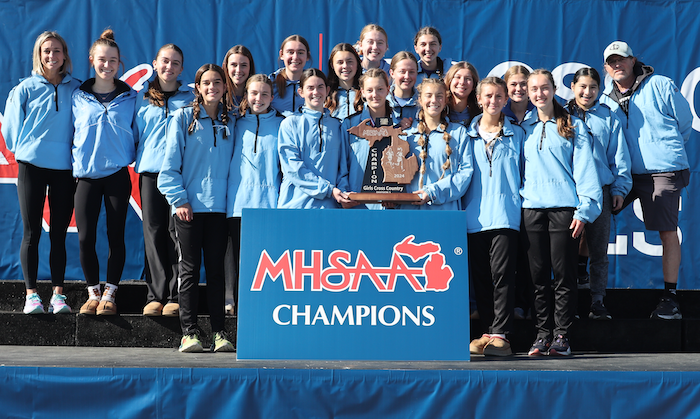
Only 23 points separated the top four, with Lansing Catholic emerging from the fray with its second Finals championship by a 136-147 margin over Pewamo-Westphalia. The Cougars were Division 2 champions in 2017.
Central Montcalm was third with 157 points, and Traverse City St. Francis was fourth with 159.
Lansing Catholic became champion after a seventh-place finish last year, despite graduating sixth-place individual Tessa Roe. The Cougars returned four runners from that team and benefited from an infusion of three freshmen who made the varsity lineup.
One of those ninth-graders, Josie Bishop, led the Cougars by placing 20th in 19:01.8. She was the team’s only all-state finisher, but Lansing Catholic got its five scoring runners across the line among the first 38 places in the team race and first 60 overall.
Sophomore Grace Wonch was 32nd in 19:21.0, missing all-state by two places. Junior Frances Melinn was 42nd in 19:43.6, freshman Isabelle Currie 58th in 20:05.3 and sophomore Avery Miller 60th in 20:10.5.
Pewamo-Westphalia had an 11th-place finisher in senior Whitney Werner (18:17.3) and 14th-place finisher in sophomore Alyssa Kramer (18:39.3), but Lansing Catholic had five runners across before the Pirates had four.
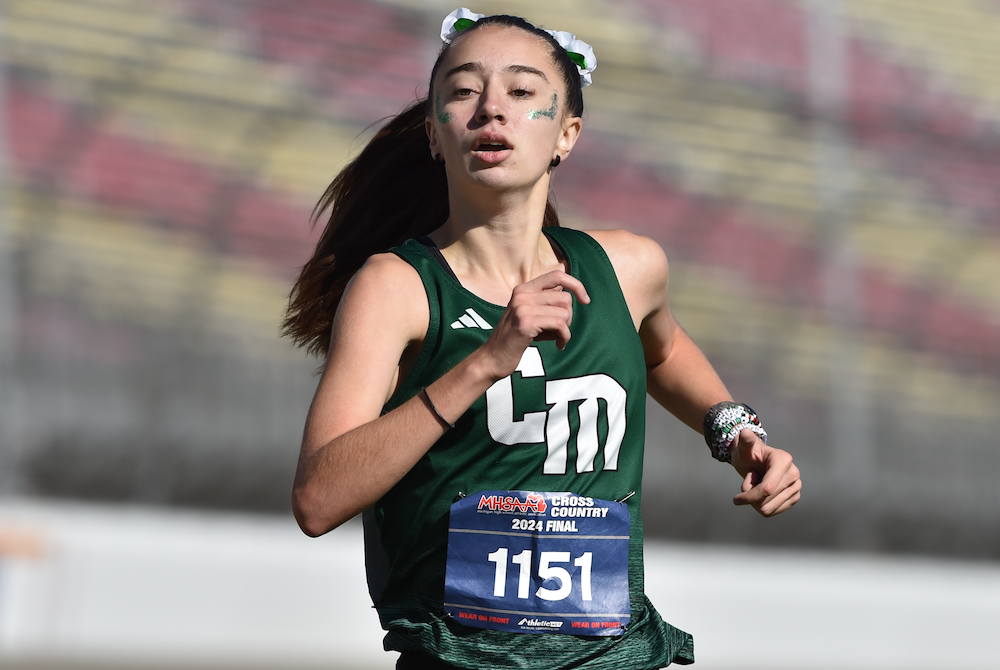
PHOTOS (Top) Central Montcalm’s Kyah Hoffman finishes her Division 3 championship run Saturday at Michigan International Speedway. (Middle) Lansing Catholic holds up its team title trophy. (Click for more from RunMichigan.com; top photo by Dave McCauley and team photo by Carter Sherline.)