


Add, Subtract, Divide, Multiply: MHSAA Not Alone
July 25, 2017
By Rob Kaminski
MHSAA benchmarks editor
This is the third part in a series on MHSAA tournament classification, past and present, that will be published over the next two weeks. This series originally ran in this spring's edition of MHSAA benchmarks.
As the MHSAA faces its most recent classification task with 8-Player Football, and opinions continue to swirl about as to the method, timeframe, location and other procedures, a look around the country provides plenty of company among state association brethren factoring variables into their own equations.
In the Pacific Northwest, the Oregon School Activities Association Football Playoffs are under public scrutiny as leadership ponders a five or six classification format beginning with the 2018-19 school year.
The OSAA has crowned six champions on the gridiron since 2006-07. Many of the state’s smaller schools would like to keep it that way, while larger schools lean toward a five-classification system, citing larger leagues, ease of travel and credibility to state championships as the advantages.
Still others would prefer more than six classes, pointing to safety issues and the opportunity to increase participation numbers as positives.
Moving southeast of Oregon, the Nevada Interscholastic Activities Association recently voted to hold serve on a classification proposal that was volleyed to the membership.
However, changes still could be forthcoming by as early as the 2018-19 season which would add a fifth classification in more populated southern Nevada while allowing northern schools to participate in four classifications. Such divisions could mean no state championship for the fifth class in southern Nevada.
Because of that, the NIAA wants equal numbers of schools in each classification on both ends of the state. Complicating the issue is the fact that the 24 largest schools in the state, by enrollment, are all in Clark County in Southern Nevada.
Across Nevada’s border into Arizona, charter schools are asking the Arizona Interscholastic Association to reconsider classification that was voted upon and approved in September 2015. That agreement called for the largest 33 percent of charter schools by enrollment to be placed in the state’s largest school classification, 3A, the middle 33 percent into 2A, and the smallest 33 percent into 1A.
Less than two years later the charter schools have had a change of heart and have asked to be considered the same as other Arizona public schools and be placed appropriately by enrollment beginning with the 2018-19 school year.
The situation in Arizona further illustrates how the public/private debate that all state associations have faced throughout existence now has the added dynamic of rapidly growing charter schools in today’s educational system, along with virtual school enrollment.
In the nation’s heartland, Nebraska has retooled its football classifications by using enrollment of boys students only in its schools rather than total enrollment. The Nebraska School Activities Association football-playing schools will kick off the 2018 season using this alignment.
Nebraska has three classes of 11-player football, with the smallest class divided in two, Class C-1 and C-2. The state also will have 8-player football for boys enrollments under 47, and the NSAA will sponsor a new 6-player tournament in 2018 for schools with 27 or fewer boys.
“This is a good proposal because some schools have a sizable imbalance between the number of boys and girls, and there’s a large gap (in enrollment) between the largest and smallest schools in Classes A and B,” NSAA executive director Jim Tenopir said. “I think this addresses both of those concerns.”
Swimmers in Georgia, meanwhile, will feel like they are moving with the current, rather than upstream in 2017-18, as the Georgia High School Association recently doubled the number of team championship events from two to four.
Swim enthusiasts can also count on longer days at the finals, as the top 30 finishers from the prelims will advance to the finals instead of 20, and all championship events will have three heats versus two.
Onsted's Hiatt Completes Title Climb, St. Francis Repeats as Team Champ
November 2, 2024
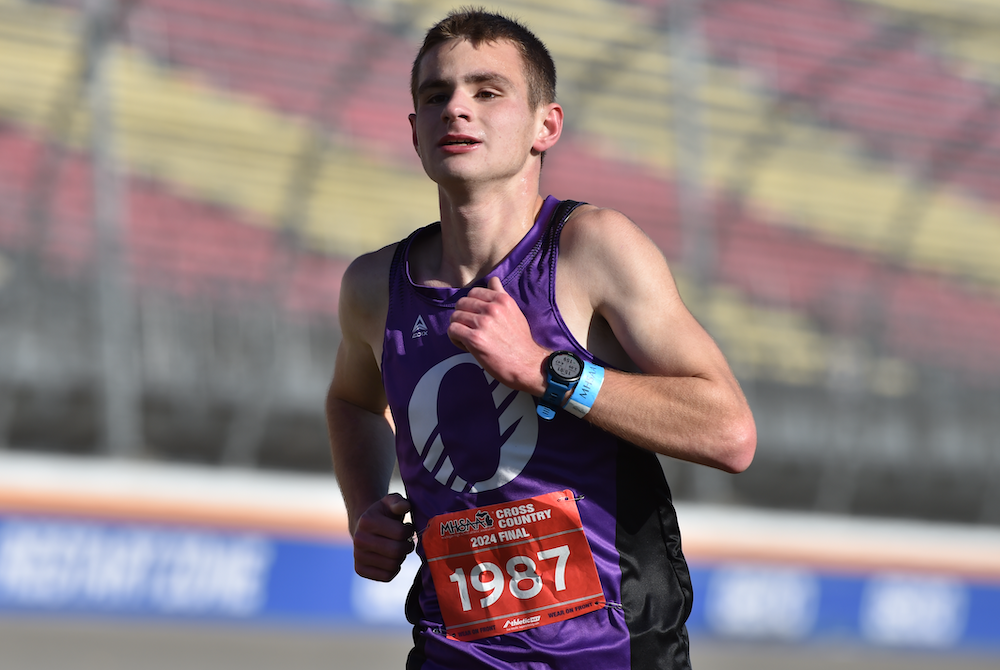
BROOKLYN — When Brody Amthor moved to Onsted from Lawrence in 2021, it gave the Wildcats a solid No. 1 runner who had experience in two MHSAA Division 4 Finals.
For then-freshman Mitchell Hiatt, the addition of Amthor provided a role model.
Hiatt’s fastest time in ninth grade was 19 minutes, 0.7 seconds. He was a long way from even getting to Michigan International Speedway, finishing 54th at Regionals in 20:02.9.
But the process that would eventually make him an MHSAA Finals champion had begun.
“When I was a freshman, I only ran 19 minutes,” Hiatt said after winning the MHSAA Lower Peninsula Division 3 Final in 15:15.5 on Saturday at MIS. “I didn’t think I’d be able to be a state champ. It took a lot of running. I had so many people that helped me get to this point. It’s good to see hard work pay off.”
One of those people was Amthor, who was a junior when Hiatt was a freshman.
“I ran in middle school, but I wasn’t that fast,” Hiatt said. “There was somebody my freshman year who moved to our school. His name was Brody Amthor. He was the person who got me into running and got me to actually start training. He helped me a lot, and so did my coaches.”
Reed City senior August Rohde came into the meet with the fastest time in Division 3, winning Regionals one week earlier in 14:58.7 on a Benzie Central course known for yielding personal bests.
 Rohde liked the position he was in when he and Hiatt reached the mile mark in 4:52. Separation began in the second mile, with Hiatt hitting the two-mile mark in 9:49.3 and Rohde in 9:57.9.
“It was fine until after one mile,” Rohde said. “I got out how I wanted to. I tried to have him run my race. He dropped me. He ran a great race. Our second mile was slower than the first, so I think he was just maintaining the pace better than I did.”
As he made his way down the long straightaway at MIS, Hiatt had a large lead over Rohde, but he ran like he could be caught at any moment. He wouldn’t allow himself to make the final couple hundred yards a victory lap.
“Oh, I didn’t know where he was,” Hiatt said. “I thought he was still close to me. Whenever I have races like that, to be completely honest, I get scared to lose. It just makes me try to go faster and keep pushing the pace.”
Hiatt, who was sixth in Division 3 last year, became the first Onsted runner to win the overall championship at the Finals since Eric Ramsey ran the fastest Class C time of the day in 1987 when there were team and individual races. In 1990, Michael Vischer of Onsted won the Class C team race in 16:05, but Michael Ball of Hudson ran 15:57 to win the individual race.
“I came into this race telling myself that if I put myself in a good position in the start and I don’t get boxed in, then I think I’d be able to win it,” Hiatt said. “That’s what happened.”
Traverse City St. Francis repeated as the team champion by an 86-177 margin over Saugatuck, putting four runners on the all-state podium.
Senior Riley Pattinson was 10th in 15:51.9, sophomore William Ready 11th in 15:52.2, senior Owen Read 22nd in 16:03.7, senior Robby Myler 27th in 16:13.2 and senior Josh Slocum 39th in 16:26.3.
The Gladiators had four runners across the line before Saugatuck’s first finisher.
St. Francis returned five runners from last year’s championship lineup — Pattinson, Read, Myler, Slocum and senior sixth runner Lewis Walter.
St. Francis has finished in the top six for six consecutive seasons.
PHOTOS (Top) Onsted’s Mitchell Hiatt charges toward the finish Saturday at Michigan International Speedway. (Middle) Riley Pattinson (970) emerges from a pack to lead St. Francis’ finishers. (Click for more from Dave McCauley/RunMichigan.com.)