

Add, Subtract, Divide, Multiply: MHSAA Not Alone
July 25, 2017
By Rob Kaminski
MHSAA benchmarks editor
This is the third part in a series on MHSAA tournament classification, past and present, that will be published over the next two weeks. This series originally ran in this spring's edition of MHSAA benchmarks.
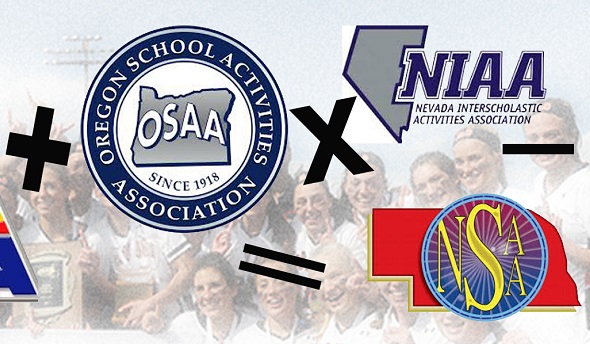
As the MHSAA faces its most recent classification task with 8-Player Football, and opinions continue to swirl about as to the method, timeframe, location and other procedures, a look around the country provides plenty of company among state association brethren factoring variables into their own equations.
In the Pacific Northwest, the Oregon School Activities Association Football Playoffs are under public scrutiny as leadership ponders a five or six classification format beginning with the 2018-19 school year.
The OSAA has crowned six champions on the gridiron since 2006-07. Many of the state’s smaller schools would like to keep it that way, while larger schools lean toward a five-classification system, citing larger leagues, ease of travel and credibility to state championships as the advantages.
Still others would prefer more than six classes, pointing to safety issues and the opportunity to increase participation numbers as positives.
Moving southeast of Oregon, the Nevada Interscholastic Activities Association recently voted to hold serve on a classification proposal that was volleyed to the membership.
However, changes still could be forthcoming by as early as the 2018-19 season which would add a fifth classification in more populated southern Nevada while allowing northern schools to participate in four classifications. Such divisions could mean no state championship for the fifth class in southern Nevada.
Because of that, the NIAA wants equal numbers of schools in each classification on both ends of the state. Complicating the issue is the fact that the 24 largest schools in the state, by enrollment, are all in Clark County in Southern Nevada.
Across Nevada’s border into Arizona, charter schools are asking the Arizona Interscholastic Association to reconsider classification that was voted upon and approved in September 2015. That agreement called for the largest 33 percent of charter schools by enrollment to be placed in the state’s largest school classification, 3A, the middle 33 percent into 2A, and the smallest 33 percent into 1A.
Less than two years later the charter schools have had a change of heart and have asked to be considered the same as other Arizona public schools and be placed appropriately by enrollment beginning with the 2018-19 school year.
The situation in Arizona further illustrates how the public/private debate that all state associations have faced throughout existence now has the added dynamic of rapidly growing charter schools in today’s educational system, along with virtual school enrollment.
In the nation’s heartland, Nebraska has retooled its football classifications by using enrollment of boys students only in its schools rather than total enrollment. The Nebraska School Activities Association football-playing schools will kick off the 2018 season using this alignment.
Nebraska has three classes of 11-player football, with the smallest class divided in two, Class C-1 and C-2. The state also will have 8-player football for boys enrollments under 47, and the NSAA will sponsor a new 6-player tournament in 2018 for schools with 27 or fewer boys.
“This is a good proposal because some schools have a sizable imbalance between the number of boys and girls, and there’s a large gap (in enrollment) between the largest and smallest schools in Classes A and B,” NSAA executive director Jim Tenopir said. “I think this addresses both of those concerns.”
Swimmers in Georgia, meanwhile, will feel like they are moving with the current, rather than upstream in 2017-18, as the Georgia High School Association recently doubled the number of team championship events from two to four.
Swim enthusiasts can also count on longer days at the finals, as the top 30 finishers from the prelims will advance to the finals instead of 20, and all championship events will have three heats versus two.

Flashback 100: Michigan High School Baseball Trio Provide World Series Voices
November 1, 2024
The 2024 Major League Baseball World Series showcased a distinct Michigan flair during its television broadcasts these last few weeks.
The Los Angeles Dodgers triumphed over the New York Yankees in five games, with viewers treated to the commentary of Joe Davis and John Smoltz, while Derek Jeter made appearances on the pre- and postgame shows. Notably, all three athletes hail from Michigan and have left their mark on the sports field.
Davis graduated from Potterville High School in 2006, where he earned honorable mention all-state honors as a quarterback while playing football for his father, Paul. He played four years of baseball at Potterville, too. After high school, he continued his football career at Beloit College in Wisconsin before transitioning to broadcasting. Today, he serves as the television voice of the Dodgers and covers both MLB and NFL national games for Fox.
John Smoltz, a graduate of Lansing Waverly in 1985, made his mark as an all-state basketball player but gained fame on the baseball diamond. During his senior year, he hit a game-winning home run in the championship game of the Greater Lansing Diamond Classic after pitching in the semifinal. Drafted by the Detroit Tigers out of high school, Smoltz enjoyed a remarkable 21-year career in Major League Baseball, spending 20 seasons with the Atlanta Braves. He holds the unique distinction of being the only pitcher in history to record 200 wins and 150 saves.
Derek Jeter graduated from Kalamazoo Central in 1992, where he was named the Gatorade High School Player of the Year after an impressive third consecutive season with a batting average exceeding .500. In addition to baseball, he also excelled in cross country and basketball. Jeter was selected in the first round of the 1992 MLB Draft by the New York Yankees, where he went on to win five World Series championships during his illustrious 20-year career.
Both Jeter and Smoltz are members of the MLB Hall of Fame, representing two of only six inductees who played high school baseball in Michigan.
Previous "Flashback 100" Features
Oct. 25: Flashback 100: Before Leading Free World, Ford Starred for Champion GR South - Read
Oct. 18: Mercy Links Legend Becomes World Golf Hall of Famer - Read
Oct. 11: Fisher Races to Finals Stardom on Way to U.S. Olympic First - Read
Oct. 4: Lalas Leaves High School Legacies on Ice & Pitch - Read
Sept. 27: Tamer's History-Making Run Starts in Dexter, Continues to Paris - Read
Sept. 20: Todd Martin’s Road to Greatness Starts at East Lansing - Read
Sept. 13: James Earl Jones, Dickson High Hoops to Hollywood Legend - Read
Sept. 6: Pioneers' Unstoppable Streak Stretches 9 Seasons - Read
Aug. 30: Detroit dePorres Rushes to 1995 Class CC Football Championship - Read
PHOTOS Top row, from left: Fox Sports broadcasters Joe Davis, John Smoltz and Derek Jeter. Bottom row from left, Davis as a student at Potterville, Smoltz pitching for Lansing Waverly and Jeter playing infield for Kalamazoo Central. (Current photos courtesy of Fox Sports. Past photos courtesy of Potterville High School, the Lansing State Journal and the Detroit Free Press, respectively.)