


Add, Subtract, Divide, Multiply: MHSAA Not Alone
July 25, 2017
By Rob Kaminski
MHSAA benchmarks editor
This is the third part in a series on MHSAA tournament classification, past and present, that will be published over the next two weeks. This series originally ran in this spring's edition of MHSAA benchmarks.
As the MHSAA faces its most recent classification task with 8-Player Football, and opinions continue to swirl about as to the method, timeframe, location and other procedures, a look around the country provides plenty of company among state association brethren factoring variables into their own equations.
In the Pacific Northwest, the Oregon School Activities Association Football Playoffs are under public scrutiny as leadership ponders a five or six classification format beginning with the 2018-19 school year.
The OSAA has crowned six champions on the gridiron since 2006-07. Many of the state’s smaller schools would like to keep it that way, while larger schools lean toward a five-classification system, citing larger leagues, ease of travel and credibility to state championships as the advantages.
Still others would prefer more than six classes, pointing to safety issues and the opportunity to increase participation numbers as positives.
Moving southeast of Oregon, the Nevada Interscholastic Activities Association recently voted to hold serve on a classification proposal that was volleyed to the membership.
However, changes still could be forthcoming by as early as the 2018-19 season which would add a fifth classification in more populated southern Nevada while allowing northern schools to participate in four classifications. Such divisions could mean no state championship for the fifth class in southern Nevada.
Because of that, the NIAA wants equal numbers of schools in each classification on both ends of the state. Complicating the issue is the fact that the 24 largest schools in the state, by enrollment, are all in Clark County in Southern Nevada.
Across Nevada’s border into Arizona, charter schools are asking the Arizona Interscholastic Association to reconsider classification that was voted upon and approved in September 2015. That agreement called for the largest 33 percent of charter schools by enrollment to be placed in the state’s largest school classification, 3A, the middle 33 percent into 2A, and the smallest 33 percent into 1A.
Less than two years later the charter schools have had a change of heart and have asked to be considered the same as other Arizona public schools and be placed appropriately by enrollment beginning with the 2018-19 school year.
The situation in Arizona further illustrates how the public/private debate that all state associations have faced throughout existence now has the added dynamic of rapidly growing charter schools in today’s educational system, along with virtual school enrollment.
In the nation’s heartland, Nebraska has retooled its football classifications by using enrollment of boys students only in its schools rather than total enrollment. The Nebraska School Activities Association football-playing schools will kick off the 2018 season using this alignment.
Nebraska has three classes of 11-player football, with the smallest class divided in two, Class C-1 and C-2. The state also will have 8-player football for boys enrollments under 47, and the NSAA will sponsor a new 6-player tournament in 2018 for schools with 27 or fewer boys.
“This is a good proposal because some schools have a sizable imbalance between the number of boys and girls, and there’s a large gap (in enrollment) between the largest and smallest schools in Classes A and B,” NSAA executive director Jim Tenopir said. “I think this addresses both of those concerns.”
Swimmers in Georgia, meanwhile, will feel like they are moving with the current, rather than upstream in 2017-18, as the Georgia High School Association recently doubled the number of team championship events from two to four.
Swim enthusiasts can also count on longer days at the finals, as the top 30 finishers from the prelims will advance to the finals instead of 20, and all championship events will have three heats versus two.

Dexter's Manning Takes Next Step, Walker Steps In to Key Mercy 3-Peat
By
Dean Holzwarth
Special for MHSAA.com
October 19, 2024
ALLENDALE – Farmington Hills Mercy brought a senior-laden team with extensive experience to this weekend’s Lower Peninsula Division 2 Final.
However, one senior in particular made the biggest difference during Saturday’s closing round at The Meadows at Grand Valley State.
Senior Emily Walker provided a major contribution in helping Mercy complete a three-peat as the Marlins fended off a late comeback from runner-up Dexter to win by five strokes with a two-day total of 677.
Seniors Maeve Casey and Lila Polakowski led the Marlins as a consistent tandem at the top of the lineup, placing fourth and 20th, respectively, on the individual leaderboard. But Watson, who didn’t play on Friday, proved to be the unsung hero with a second-round 83, the team’s second-best score of the final round and her career-low.
“We have a mix of players, so today we inserted Emily Walker and she had the score of her life,” Mercy coach Vicky Kowalski said. “And that’s why we’re standing here with the three-peat.”
“If she didn’t shoot the round of her life today, then we wouldn't be standing here with a win,” Polakowski added. “We are so thankful that she pulled through here today and continued to support everyone else.”
 Casey’s fourth place individual finish came from rounds of 73 and 79. She and Polakowski concluded their careers with a fourth-place team finish as freshmen and three straight wins at the Finals.
“It feels amazing to three-peat, but I’m really proud of the team for battling through the adversity that we had to experience on the course today,” Casey said. “But we got it done, and I’ve had some great experiences the last four years with this team. We’ve meshed really well on and off the course.”
Polakowski finished with a two-day 169, while senior Macy Morphew shot 179 and sophomore Megan Guerrera had a 186.
“It was a crazy day today,” Kowalski said. “The scores were bouncing up and down, and girls were having their good holes and bad holes and at one point we were down by one.
“And then Lowell kinda faded, but then Dexter shot lights out today. We are very fortunate to be able to do this three-peat, and it’s a great team. I've enjoyed coaching these young ladies.”
Mercy led by eight strokes over Lowell after the first round.
“I was feeling pretty good because we still had a lead early, and it got iffy, but I had all the confidence in the world in them and I knew they could do this,” Kowalski said. “They really wanted it, and they came through in the end.”
Polakowski said the team was confident despite the slew of others chasing them.
“We were a little worried because there were a lot of good teams here, but we knew we had the potential,” she said. “We felt like we had the opportunity to win it again, and we had positive vibes coming in.”
Dexter junior Avery Manning claimed the medalist honor with a 1-under-par 141. She finished ahead of Spring Lake’s Zoe Dull, who shot 146.
 Manning fired a 3-under-par 69 on Friday and followed with an even-par 72. She placed runner-up at last year’s Final.
“If I came in second last year, then I can’t drop, right?,” Manning said with a small grin. “As a team we knew we had a chance to win, but individually I knew I had to have it. I just tried my best, I didn’t look at the leaderboard at all and I just went with the flow.
“It was just two great rounds overall. I think being able to do well on the same holes as the first day and to be able to tie my score or do better on those holes was important.”
Manning led by four strokes after the opening round.
“I told myself that if I maintained where I was then everything would work out, and it did,” Manning said. “My short game, especially my putting, and my approach shots were key for me.”
Dexter, which entered the final round in third place and 14 strokes back, posted its best finish since winning back-to-back Finals titles in the spring and fall of 2007.
“I think the girls did an amazing job,” said Dreadnaughts coach Greg Palkowksi, whose team placed seventh last year. “They stayed focused the entire 36 holes, and to play like they did today and come back from (Friday) and make up that difference was amazing. I just wanted them to go out and play and have fun and shoot the best they can. It was fun to watch.”
In addition to Manning, Dexter was led by junior Millie Triesdell (174) and freshman Maddy Manning (175).
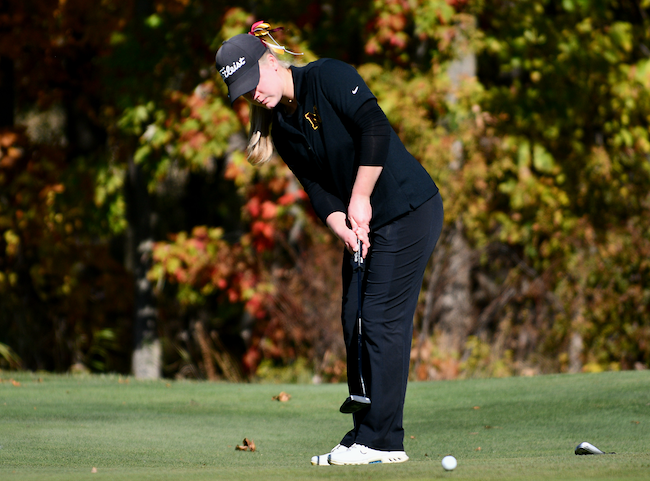
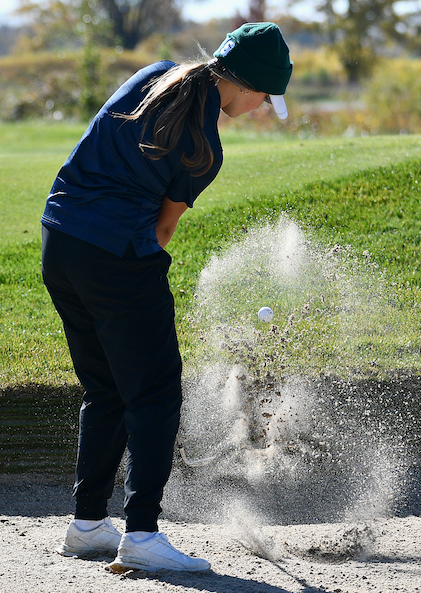
PHOTOS (Top) Dexter’s Avery Manning sends an approach shot during Saturday’s second round at The Meadows. (Middle) Farmington Hills Mercy’s Macy Morphew watches one of her putts roll toward the hole. (Below) A competitor launches a shot from the sand. (Click for more from High School Sports Scene.)