

Add, Subtract, Divide, Multiply: MHSAA Not Alone
July 25, 2017
By Rob Kaminski
MHSAA benchmarks editor
This is the third part in a series on MHSAA tournament classification, past and present, that will be published over the next two weeks. This series originally ran in this spring's edition of MHSAA benchmarks.
As the MHSAA faces its most recent classification task with 8-Player Football, and opinions continue to swirl about as to the method, timeframe, location and other procedures, a look around the country provides plenty of company among state association brethren factoring variables into their own equations.
In the Pacific Northwest, the Oregon School Activities Association Football Playoffs are under public scrutiny as leadership ponders a five or six classification format beginning with the 2018-19 school year.
The OSAA has crowned six champions on the gridiron since 2006-07. Many of the state’s smaller schools would like to keep it that way, while larger schools lean toward a five-classification system, citing larger leagues, ease of travel and credibility to state championships as the advantages.
Still others would prefer more than six classes, pointing to safety issues and the opportunity to increase participation numbers as positives.
Moving southeast of Oregon, the Nevada Interscholastic Activities Association recently voted to hold serve on a classification proposal that was volleyed to the membership.
However, changes still could be forthcoming by as early as the 2018-19 season which would add a fifth classification in more populated southern Nevada while allowing northern schools to participate in four classifications. Such divisions could mean no state championship for the fifth class in southern Nevada.
Because of that, the NIAA wants equal numbers of schools in each classification on both ends of the state. Complicating the issue is the fact that the 24 largest schools in the state, by enrollment, are all in Clark County in Southern Nevada.
Across Nevada’s border into Arizona, charter schools are asking the Arizona Interscholastic Association to reconsider classification that was voted upon and approved in September 2015. That agreement called for the largest 33 percent of charter schools by enrollment to be placed in the state’s largest school classification, 3A, the middle 33 percent into 2A, and the smallest 33 percent into 1A.
Less than two years later the charter schools have had a change of heart and have asked to be considered the same as other Arizona public schools and be placed appropriately by enrollment beginning with the 2018-19 school year.
The situation in Arizona further illustrates how the public/private debate that all state associations have faced throughout existence now has the added dynamic of rapidly growing charter schools in today’s educational system, along with virtual school enrollment.
In the nation’s heartland, Nebraska has retooled its football classifications by using enrollment of boys students only in its schools rather than total enrollment. The Nebraska School Activities Association football-playing schools will kick off the 2018 season using this alignment.
Nebraska has three classes of 11-player football, with the smallest class divided in two, Class C-1 and C-2. The state also will have 8-player football for boys enrollments under 47, and the NSAA will sponsor a new 6-player tournament in 2018 for schools with 27 or fewer boys.
“This is a good proposal because some schools have a sizable imbalance between the number of boys and girls, and there’s a large gap (in enrollment) between the largest and smallest schools in Classes A and B,” NSAA executive director Jim Tenopir said. “I think this addresses both of those concerns.”
Swimmers in Georgia, meanwhile, will feel like they are moving with the current, rather than upstream in 2017-18, as the Georgia High School Association recently doubled the number of team championship events from two to four.
Swim enthusiasts can also count on longer days at the finals, as the top 30 finishers from the prelims will advance to the finals instead of 20, and all championship events will have three heats versus two.
Century of School Sports: Guided by 4 S's of Educational Athletics
By
Geoff Kimmerly
MHSAA.com senior editor
October 8, 2024
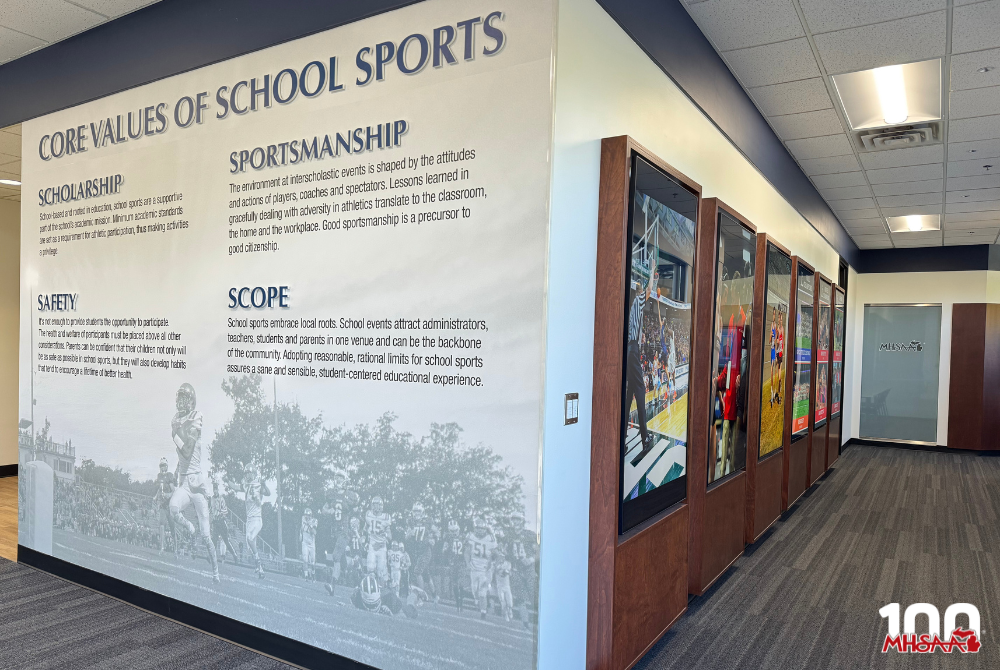
The display above greets visitors at the top of our staircase to the second floor at the MHSAA office in East Lansing – a group of guests that annually numbers well over a 1,000 administrators, student leaders, game officials and several others who are invested in school sports.
We hope these four core values – the MHSAA’s oft-referred to “four S’s” of educational athletics – also lead our guests’ interactions in school sports as they return home to their communities across the state.
They are as follows:
SAFETY
- It's not enough to provide students the opportunity to participate. The health and welfare of participants must be placed above all other considerations. Parents can be confident that their children not only will be as safe as possible in school sports, but they will also develop habits that tend to encourage a lifetime of better health.
SCHOLARSHIP
- School-based and rooted in education, school sports are a supportive part of the school's academic mission. Minimum academic standards are set as a requirement for athletic participation, thus making activities a privilege.
SPORTSMANSHIP
- The environment at interscholastic events is shaped by the attitudes and actions of players, coaches and spectators. Lessons learned in gracefully dealing with adversity in athletics translate to the classroom, the home and the workplace. Good sportsmanship is a precursor to good citizenship.
SCOPE
- School sports embrace local roots. School events attract administrators, teachers, students and parents in one venue and can be the backbone of the community. Adopting reasonable, rational limits for school sports assures a sane and sensible, student-centered educational experience.
These values were coined by John E. “Jack” Roberts, the fourth of now five full-time executive directors who have served the MHSAA during its 100-year history. He introduced them during his first days on the job in 1986 – and as he noted in an installment of his “From the Director” blog in 2015, they’ve stood the test of time.
They drove the Association’s work during his tenure, surely before it, and continue to do so today – and we will delve into all four as we continue our storytelling of a “Century of School Sports” during this 2024-25 school year.
Previous "Century of School Sports" Spotlights
Oct. 1: Michigan Sends 10 to National Hall of Fame - Read
Sept. 25: MHSAA Record Books Filled with 1000s of Achievements - Read
Sept. 18: Why Does the MHSAA Have These Rules? - Read
Sept. 10: Special Medals, Patches to Commemorate Special Year - Read
Sept. 4: Fall to Finish with 50th Football Championships - Read
Aug. 28: Let the Celebration Begin - Read
PHOTO A display on the second floor of the MHSAA office outlines the four core values of educational athletics: safety, scholarship, sportsmanship and scope.