


Add, Subtract, Divide, Multiply: MHSAA Not Alone
July 25, 2017
By Rob Kaminski
MHSAA benchmarks editor
This is the third part in a series on MHSAA tournament classification, past and present, that will be published over the next two weeks. This series originally ran in this spring's edition of MHSAA benchmarks.
As the MHSAA faces its most recent classification task with 8-Player Football, and opinions continue to swirl about as to the method, timeframe, location and other procedures, a look around the country provides plenty of company among state association brethren factoring variables into their own equations.
In the Pacific Northwest, the Oregon School Activities Association Football Playoffs are under public scrutiny as leadership ponders a five or six classification format beginning with the 2018-19 school year.
The OSAA has crowned six champions on the gridiron since 2006-07. Many of the state’s smaller schools would like to keep it that way, while larger schools lean toward a five-classification system, citing larger leagues, ease of travel and credibility to state championships as the advantages.
Still others would prefer more than six classes, pointing to safety issues and the opportunity to increase participation numbers as positives.
Moving southeast of Oregon, the Nevada Interscholastic Activities Association recently voted to hold serve on a classification proposal that was volleyed to the membership.
However, changes still could be forthcoming by as early as the 2018-19 season which would add a fifth classification in more populated southern Nevada while allowing northern schools to participate in four classifications. Such divisions could mean no state championship for the fifth class in southern Nevada.
Because of that, the NIAA wants equal numbers of schools in each classification on both ends of the state. Complicating the issue is the fact that the 24 largest schools in the state, by enrollment, are all in Clark County in Southern Nevada.
Across Nevada’s border into Arizona, charter schools are asking the Arizona Interscholastic Association to reconsider classification that was voted upon and approved in September 2015. That agreement called for the largest 33 percent of charter schools by enrollment to be placed in the state’s largest school classification, 3A, the middle 33 percent into 2A, and the smallest 33 percent into 1A.
Less than two years later the charter schools have had a change of heart and have asked to be considered the same as other Arizona public schools and be placed appropriately by enrollment beginning with the 2018-19 school year.
The situation in Arizona further illustrates how the public/private debate that all state associations have faced throughout existence now has the added dynamic of rapidly growing charter schools in today’s educational system, along with virtual school enrollment.
In the nation’s heartland, Nebraska has retooled its football classifications by using enrollment of boys students only in its schools rather than total enrollment. The Nebraska School Activities Association football-playing schools will kick off the 2018 season using this alignment.
Nebraska has three classes of 11-player football, with the smallest class divided in two, Class C-1 and C-2. The state also will have 8-player football for boys enrollments under 47, and the NSAA will sponsor a new 6-player tournament in 2018 for schools with 27 or fewer boys.
“This is a good proposal because some schools have a sizable imbalance between the number of boys and girls, and there’s a large gap (in enrollment) between the largest and smallest schools in Classes A and B,” NSAA executive director Jim Tenopir said. “I think this addresses both of those concerns.”
Swimmers in Georgia, meanwhile, will feel like they are moving with the current, rather than upstream in 2017-18, as the Georgia High School Association recently doubled the number of team championship events from two to four.
Swim enthusiasts can also count on longer days at the finals, as the top 30 finishers from the prelims will advance to the finals instead of 20, and all championship events will have three heats versus two.
Flynn Continuing to Prove Unique Among State's Best, All-Time Mercy Greats
By
Keith Dunlap
Special for MHSAA.com
October 3, 2024
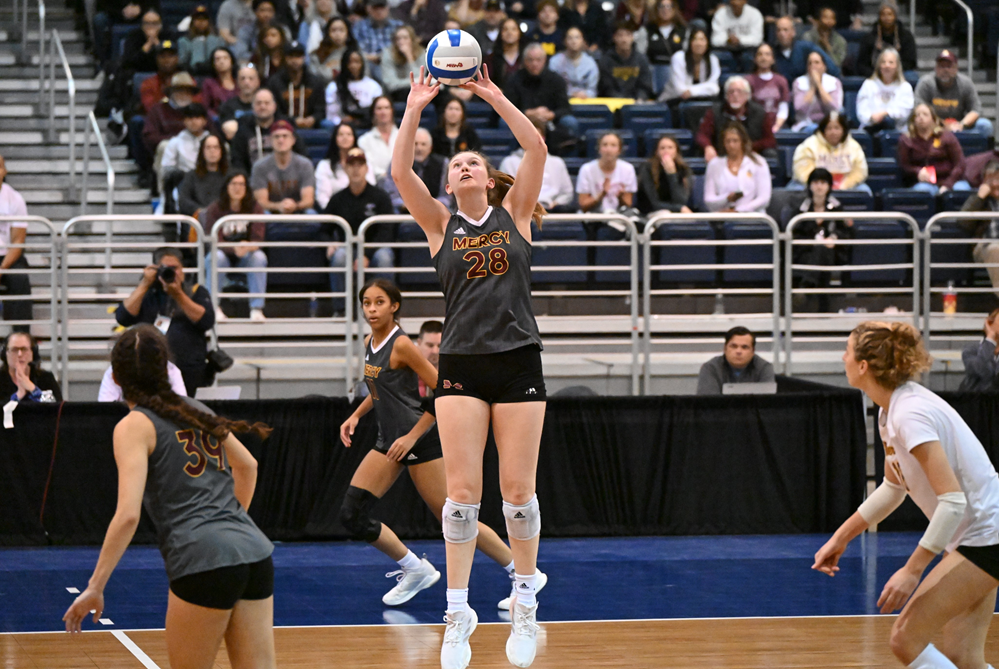
FARMINGTON HILLS — It’s easy to roll one’s eyes when saying the Farmington Hills Mercy volleyball program has a unique talent in senior setter Campbell Flynn – because, well, Mercy is a traditional powerhouse that ALWAYS seems to have great players.
 But even for an accomplished program like Mercy, it will be nearly impossible to see another player like Flynn come through its halls anytime soon, if ever.
Yes, it’s not often that a player is a member of the under-19 and under-21 U.S. national teams, committed to national powerhouse Nebraska and was named the state’s Gatorade Player of the Year as a junior after helping lead her to the Division 1 championship.
But several tangible and intangible attributes make her truly exceptional.
For starters, she is a 6-foot-3 setter, which isn’t common. In high school – and maybe even for many college programs – that height would definitely qualify her as an outside hitter.
“Setters are usually a little smaller,” Flynn said. “I always wanted to be a setter, even when I was little. I knew I was going to be pretty tall, but I didn’t know I’d be this tall. I thought I was going to be around 5-10. I just knew I always wanted to be a setter.”
Mercy head coach Loretta Vogel said that height is noticeable before Flynn even touches the ball.
“She’s deceptively fast,” she said. “She’s 6-4 and she just moves. She just floats over the floor.”
In addition to her height, Flynn is a rarity among setters in that she’s also left-handed.
“It helps (the team) with hitting over on two and dumping,” Flynn said. “That’s definitely an advantage.”
 Being tall and left-handed probably wouldn’t matter as much by themselves. But add the IQ and feel for the game that Campbell has developed since starting to play volleyball at age 5 — and subsequently at an elite national level — and it’s easy to see why she is so acclaimed.
“She has a great touch on the ball,” Vogel said. “Sort of like a quarterback and they know how to release it and do everything with the ball. Campbell is like that version for us in comparison. She understands the game very well. She’s very capable of reading the block and being able to give the ball to individuals who are open. Just that sense of the game helps tremendously.”
In winning the Gatorade award as a junior, Flynn accumulated 533 assists, 137 digs and 124 kills even though she missed 15 matches.
For those who were surprised that Mercy won the Division 1 title last year despite entering the playoffs unranked, consider the run coincided with Flynn becoming fully healthy.
She missed a good portion of last year’s regular season with a minor illness, but once she got healthy and was her dominant self, the Marlins never looked back.
“We just got so much momentum and we played so much as a team at the end of the season,” Flynn said. “It was just carrying us through all the games. We weren’t afraid, and we were pretty confident even though we were underdogs.”
This fall, Flynn is still hungry for more despite already seemingly accomplishing it all in high school volleyball, and with that scholarship to Nebraska in tow.
There might be a Miss Volleyball Award to win now that she’s a senior, and she’s still motivated to bring more team success to Mercy.
“I love my team this year,” she said. “Obviously, we are not the underdogs this season, but I feel we have a lot to prove. I’m really excited to prove to everyone that we can win another state title.”
Whether or not that happens in November, it won’t change the fact that when this season is over, even a powerhouse like Mercy will have a nearly impossible task to replace Flynn.
 Keith Dunlap has served in Detroit-area sports media for more than two decades, including as a sportswriter at the Oakland Press from 2001-16 primarily covering high school sports but also college and professional teams. His bylines also have appeared in USA Today, the Washington Post, the Detroit Free Press, the Houston Chronicle and the Boston Globe. He served as the administrator for the Oakland Activities Association’s website from 2017-2020. Contact him at [email protected] with story ideas for Oakland, Macomb and Wayne counties.
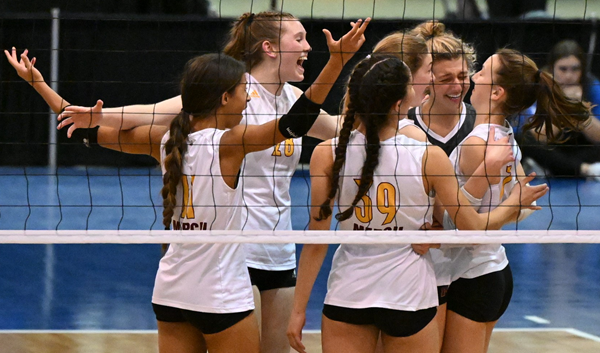
PHOTOS (Top) Campbell Flynn (28) sets Farmington Hills Mercy’s attack during last season’s Division 1 championship win over Grand Rapids Forest Hills Northern. (Middle) Flynn and her teammates enjoy a moment during their Semifinal win over Clarkston.