


Add, Subtract, Divide, Multiply: MHSAA Not Alone
July 25, 2017
By Rob Kaminski
MHSAA benchmarks editor
This is the third part in a series on MHSAA tournament classification, past and present, that will be published over the next two weeks. This series originally ran in this spring's edition of MHSAA benchmarks.
As the MHSAA faces its most recent classification task with 8-Player Football, and opinions continue to swirl about as to the method, timeframe, location and other procedures, a look around the country provides plenty of company among state association brethren factoring variables into their own equations.
In the Pacific Northwest, the Oregon School Activities Association Football Playoffs are under public scrutiny as leadership ponders a five or six classification format beginning with the 2018-19 school year.
The OSAA has crowned six champions on the gridiron since 2006-07. Many of the state’s smaller schools would like to keep it that way, while larger schools lean toward a five-classification system, citing larger leagues, ease of travel and credibility to state championships as the advantages.
Still others would prefer more than six classes, pointing to safety issues and the opportunity to increase participation numbers as positives.
Moving southeast of Oregon, the Nevada Interscholastic Activities Association recently voted to hold serve on a classification proposal that was volleyed to the membership.
However, changes still could be forthcoming by as early as the 2018-19 season which would add a fifth classification in more populated southern Nevada while allowing northern schools to participate in four classifications. Such divisions could mean no state championship for the fifth class in southern Nevada.
Because of that, the NIAA wants equal numbers of schools in each classification on both ends of the state. Complicating the issue is the fact that the 24 largest schools in the state, by enrollment, are all in Clark County in Southern Nevada.
Across Nevada’s border into Arizona, charter schools are asking the Arizona Interscholastic Association to reconsider classification that was voted upon and approved in September 2015. That agreement called for the largest 33 percent of charter schools by enrollment to be placed in the state’s largest school classification, 3A, the middle 33 percent into 2A, and the smallest 33 percent into 1A.
Less than two years later the charter schools have had a change of heart and have asked to be considered the same as other Arizona public schools and be placed appropriately by enrollment beginning with the 2018-19 school year.
The situation in Arizona further illustrates how the public/private debate that all state associations have faced throughout existence now has the added dynamic of rapidly growing charter schools in today’s educational system, along with virtual school enrollment.
In the nation’s heartland, Nebraska has retooled its football classifications by using enrollment of boys students only in its schools rather than total enrollment. The Nebraska School Activities Association football-playing schools will kick off the 2018 season using this alignment.
Nebraska has three classes of 11-player football, with the smallest class divided in two, Class C-1 and C-2. The state also will have 8-player football for boys enrollments under 47, and the NSAA will sponsor a new 6-player tournament in 2018 for schools with 27 or fewer boys.
“This is a good proposal because some schools have a sizable imbalance between the number of boys and girls, and there’s a large gap (in enrollment) between the largest and smallest schools in Classes A and B,” NSAA executive director Jim Tenopir said. “I think this addresses both of those concerns.”
Swimmers in Georgia, meanwhile, will feel like they are moving with the current, rather than upstream in 2017-18, as the Georgia High School Association recently doubled the number of team championship events from two to four.
Swim enthusiasts can also count on longer days at the finals, as the top 30 finishers from the prelims will advance to the finals instead of 20, and all championship events will have three heats versus two.

Longtime Coach Lukens Remembered for Building Champions, Changing Lives
By
Tom Spencer
Special for MHSAA.com
September 27, 2024
The results speak for themselves as there were conference, Regional and MHSAA Finals championship and runner-up finishes.
 But those accomplishments are not necessarily why Don Lukens will be remembered by most. It will be for the lives he touched and successes his student-athletes found after graduation.
Lukens impacted two communities separated by 200 miles during multi-decade coaching tenures for multiple high school programs.
Lukens died Sept. 15 at age 90. He was well-known across the state for his coaching as he spent 27 years teaching at Kalamazoo Loy Norrix, where he coached with Ted Duckett, and 33 years coaching at Traverse City Central with John Lober. Duckett, now 78, and Lober, 82, are still coaching today.
Tico Duckett, one of the most accomplished running backs in Michigan State University football history, is one of thousands of kids Lukens recruited into the running world. Duckett, who went on to play in the National Football League, credits Lukens for recruiting first-time track athletes from challenging life situations and turning them into college scholarship recipients.
Lukens knew how to get the best individual performances out his athletes, recalled Duckett, whose high school running career ended with a hamstring injury sustained during Regional preliminary sprints.
“I can tell story after story of kids that he plucked out of class, and they are successful today,” said the first MSU back to rush three times for more than 1,000 yards. “Between him and my dad, they would take kids that had no direction, no future, no hope and bring them in and teach them track and teach kids what you put into it is what you’re going to get out.”
Lukens had graduated from Western Michigan University where he’d participated in football and track. During his 38 years coaching track, Lukens’ teams posted a dual meet record of 220-24, won 20 conference championships, nine MHSAA Regional championships, a Lower Peninsula Class A title and finished runners-up twice.
Lukens’ cross country teams also were impressive with a record of 198-60 during his 34 years of coaching. They won 14 conference championships and 12 MHSAA Regional titles.
Tico Duckett has memories of being recruited to the sport as a child while his father served as an assistant coach at Loy Norrix.
“Coach Lukens would say, ‘I can’t wait ’til you get here,’” the former MSU star fondly recollected. “Coach Lukens loved track – he breathed and ate track.”
Loy Norrix hosts the highly-competitive Don Lukens Relays every May. Duckett attended this year’s meet as he often does. It was Lukens’ ability to recruit and coach track that made the Knights stand out across the state.
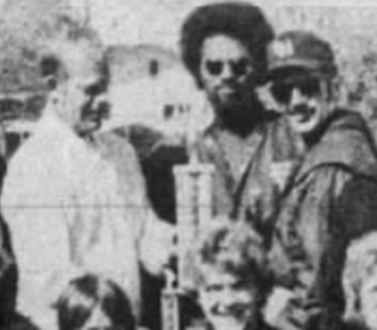 “Loy Norrix track was special,” said Duckett, proudly noting the Knights’ dual-meet dominance. “When we would go places and get off the bus, people would literally say, ‘There’s Loy Norrix,’ and they would literally talk about us, and we would show ’em on the track and we backed it up.”
Inside the halls and walls of Loy Norrix, the Duckett name is engraved on trophies and next to track & field records earned by Tico Duckett and his brother TJ, who also went on to play professional football. Ted Duckett took over the head coaching duties when Lukens retired and moved to Platte Lake in Benzie County.
Word traveled fast that Lukens had arrived in Northern Michigan, and he immediately was asked to help Benzie Central by another legendary coach, Pete Moss, who died in 2019.
Lober ran across Lukens at a meet at Benzie and recruited him to coach distance running at Traverse City Central – which at the time had just five athletes committed to participate in those races.
Central had a prior history of success in sprints and field events, but the Trojans won the 1992 Class A title as their distance runners had become competitive enough to start contributing points at the Finals.
“We started coaching together in 1989, and we had 30-plus glorious years together,” Lober said. “We ended up qualifying right off the bat for the state finals, and we went 16 years in a row.”
Lober too was known for his recruiting to the sport.
“When we talked with kids, I’d be talking in one side of the kid’s ear and Don would be talking in the other,” Lober said with a laugh. “By the time we were done, the kid didn’t have a prayer of not joining the team.”
Lukens continued at Central until 2021, stepping aside as he ended 62 years of coaching.
Cody Inglis, now a senior assistant director for the MHSAA, served as Central’s athletic director while Lukens coached. He was well aware of Lukens’s coaching at Loy Norrix as he grew up a distance runner for nearby Portage Northern.
Inglis noted most of Northern Michigan knew very little of Lukens’ resume prior to his coming north. Inglis was coaching and serving as athletic director at the time for Suttons Bay when Lukens first joined the Trojans.
“People in Traverse City didn’t understand the success he had at Loy Norrix,” Inglis said. “I remember thinking, ‘Oh my gosh, Traverse City Central was good, and they’ll be even better’ and it’s no secret that the reason their cross country program took off was because of Don Lukens.”
Lukens won the inaugural Coaching Legacy Award at the 2019 Traverse City Record-Eagle/John Lober Honor Roll Meet. Going forward, the award will be named after Lukens.
Lukens is survived by his wife Rosinda, daughters Paige Gray of Gladwin, Wendy Pohl of Kalamazoo and Donyelle Hayhoe of Lansing, and five grandchildren: Brynn Rusch, Ian Gray, Westyn Hayhoe, Travis Hayhoe and Lucas Hayhoe.
The Trojans will host a memorial tribute to Lukens the day after next year’s Bayshore Marathon in Traverse City. A graveside service was held for Lukens on Monday at the Benzonia Township Cemetery.
 Tom Spencer is a longtime MHSAA-registered basketball and soccer official, and former softball and baseball official, and he also has coached in the northern Lower Peninsula area. He previously has written for the Saginaw News, Bay County Sports Page and Midland Daily News. He can be reached at [email protected] with story ideas for Manistee, Wexford, Missaukee, Roscommon, Ogemaw, Iosco, Alcona, Oscoda, Crawford, Kalkaska, Grand Traverse, Benzie, Leelanau, Antrim, Otsego, Montmorency, Alpena, Presque Isle, Cheboygan, Charlevoix and Emmet counties.
PHOTOS (Top) Longtime coach Don Lukens, far left, is pictured during the 2015 LP Cross Country Finals with past Traverse City Central runner John Steen (center) and Trojans coach John Lober, with Jane and Jack Steen standings in front. Jane and Jack Steen are current Traverse City Central runners. (Middle) The Niles Daily Star published this 1976 photo of Lukens (back row, second from right) and coach Ted Duckett (back row, center) receiving the championship trophy at the Daily Star Relays from publisher Bill Applebee. (Top photo courtesy of John Lober.)