

Add, Subtract, Divide, Multiply: MHSAA Not Alone
July 25, 2017
By Rob Kaminski
MHSAA benchmarks editor
This is the third part in a series on MHSAA tournament classification, past and present, that will be published over the next two weeks. This series originally ran in this spring's edition of MHSAA benchmarks.
As the MHSAA faces its most recent classification task with 8-Player Football, and opinions continue to swirl about as to the method, timeframe, location and other procedures, a look around the country provides plenty of company among state association brethren factoring variables into their own equations.
In the Pacific Northwest, the Oregon School Activities Association Football Playoffs are under public scrutiny as leadership ponders a five or six classification format beginning with the 2018-19 school year.
The OSAA has crowned six champions on the gridiron since 2006-07. Many of the state’s smaller schools would like to keep it that way, while larger schools lean toward a five-classification system, citing larger leagues, ease of travel and credibility to state championships as the advantages.
Still others would prefer more than six classes, pointing to safety issues and the opportunity to increase participation numbers as positives.
Moving southeast of Oregon, the Nevada Interscholastic Activities Association recently voted to hold serve on a classification proposal that was volleyed to the membership.
However, changes still could be forthcoming by as early as the 2018-19 season which would add a fifth classification in more populated southern Nevada while allowing northern schools to participate in four classifications. Such divisions could mean no state championship for the fifth class in southern Nevada.
Because of that, the NIAA wants equal numbers of schools in each classification on both ends of the state. Complicating the issue is the fact that the 24 largest schools in the state, by enrollment, are all in Clark County in Southern Nevada.
Across Nevada’s border into Arizona, charter schools are asking the Arizona Interscholastic Association to reconsider classification that was voted upon and approved in September 2015. That agreement called for the largest 33 percent of charter schools by enrollment to be placed in the state’s largest school classification, 3A, the middle 33 percent into 2A, and the smallest 33 percent into 1A.
Less than two years later the charter schools have had a change of heart and have asked to be considered the same as other Arizona public schools and be placed appropriately by enrollment beginning with the 2018-19 school year.
The situation in Arizona further illustrates how the public/private debate that all state associations have faced throughout existence now has the added dynamic of rapidly growing charter schools in today’s educational system, along with virtual school enrollment.
In the nation’s heartland, Nebraska has retooled its football classifications by using enrollment of boys students only in its schools rather than total enrollment. The Nebraska School Activities Association football-playing schools will kick off the 2018 season using this alignment.
Nebraska has three classes of 11-player football, with the smallest class divided in two, Class C-1 and C-2. The state also will have 8-player football for boys enrollments under 47, and the NSAA will sponsor a new 6-player tournament in 2018 for schools with 27 or fewer boys.
“This is a good proposal because some schools have a sizable imbalance between the number of boys and girls, and there’s a large gap (in enrollment) between the largest and smallest schools in Classes A and B,” NSAA executive director Jim Tenopir said. “I think this addresses both of those concerns.”
Swimmers in Georgia, meanwhile, will feel like they are moving with the current, rather than upstream in 2017-18, as the Georgia High School Association recently doubled the number of team championship events from two to four.
Swim enthusiasts can also count on longer days at the finals, as the top 30 finishers from the prelims will advance to the finals instead of 20, and all championship events will have three heats versus two.
Century of School Sports: MHSAA Record Books Filled with 1000s of Achievements
By
Geoff Kimmerly
MHSAA.com senior editor
September 25, 2024
Notable achievements cover only one chapter of 100 years of MHSAA history we are celebrating during the 2024-25 school year.
But few states tell this part of their story in as much detail as the MHSAA does through one of the nation’s most robust record books.
The first layers of the MHSAA record book go back to the Association’s early years. Track & Field Finals records from the first quarter-century of championship meets were listed in the appendix of Lewis L. Forsythe’s book “Athletics in Michigan High Schools – The First Hundred Years” published in 1950.
Of course, those were just the start.
The MHSAA record book today, housed on the “Records” pages for each sport of MHSAA.com, is rooted in the work of longtime historian Dick Kishbaugh, who served in that voluntary role until 1994 and after a half-century of compiling data. He was succeeded by current historian Ron Pesch, whose work over the last 40 years has brought significant structure to the record book at it has continued to expand, and whose research continues to fill in otherwise long-lost accomplishments.
All 28 sports for which the MHSAA sponsors postseason play have at least one section of a record book – with plans for adding several more sections as time allows. The amount of data can be mind-boggling. Our softball individual record book alone has more than 3,000 listings. We have team records listings as well for most sports, and several of our head-to-head sports have pages tracking our winningest coaches, and we update those every season. Nearly all of our sports have pages dedicated specifically to records from our Finals events as well – and in fact, some of our sports’ record books are completely derived from championship performances, where we know playing conditions are similar for all (like in track & field, where wind-aided times are not allowed).
As the MHSAA record book continued to evolve, it began to be patterned against the record book produced by the National Federation of State High School Associations (NFHS). That book was printed annually beginning with its 1978-79 edition and through 2010 before the NFHS lists went completely online at NFHS.org. The first NFHS printed record book touted having more than 50,000 listings, and several were from Michigan – including the first two photos, of Central Lake baseball player Doug Smith sliding into third base in 1977 and then the 1962 Grand Haven baseball team. While the MHSAA has added categories from time to time, generally what’s collected in Michigan reflected what’s collected nationally.
The MHSAA has played a significant role in the policy-making for the NFHS record book, primarily through the leadership of longtime communications director John Johnson during his multiple terms on the national record book committee. The criteria for adding records nationally – and by relation, to the MHSAA book – remains the same today.
Every potential record book listing is scrutinized. Almost always, candidates for the record book are submitted by an MHSAA member school. Most fill out an NFHS application linked on every record book page of this website, signed by a school administrator and the athlete involved. All applications must include documentation of the achievement – perhaps a box score for a single-game listing in softball, or the team’s season stats for a single-season accomplishment, or season stats for every season that athlete played for a career record.
Over the last decade, we’ve also received more video clips – often for something like a 99-yard football run – and a few full soccer games have been watched to make sure goalkeeper saves have been counted correctly.
We also will add record book listings based on media reports, which is especially helpful for achievements we hear about from decades ago. Yes, the MHSAA record books are living documents, and we frequently add accomplishments that take several years to get to us.
We are always eager to add to our collection of history. But it’s important to keep in mind that this is not an immediate process.
Submissions stack up quickly. We currently have 108 under consideration, and another 127 requiring additional documentation.
Additions generally are made during offseasons as we are most focused on our sports currently being played during the busiest months of the school year – and on the athletes making history for us to include as our record books continue to grow.
Previous "Century of School Sports" Spotlights
Sept. 18: Why Does the MHSAA Have These Rules? - Read
Sept. 10: Special Medals, Patches to Commemorate Special Year - Read
Sept. 4: Fall to Finish with 50th Football Championships - Read
Aug. 28: Let the Celebration Begin - Read
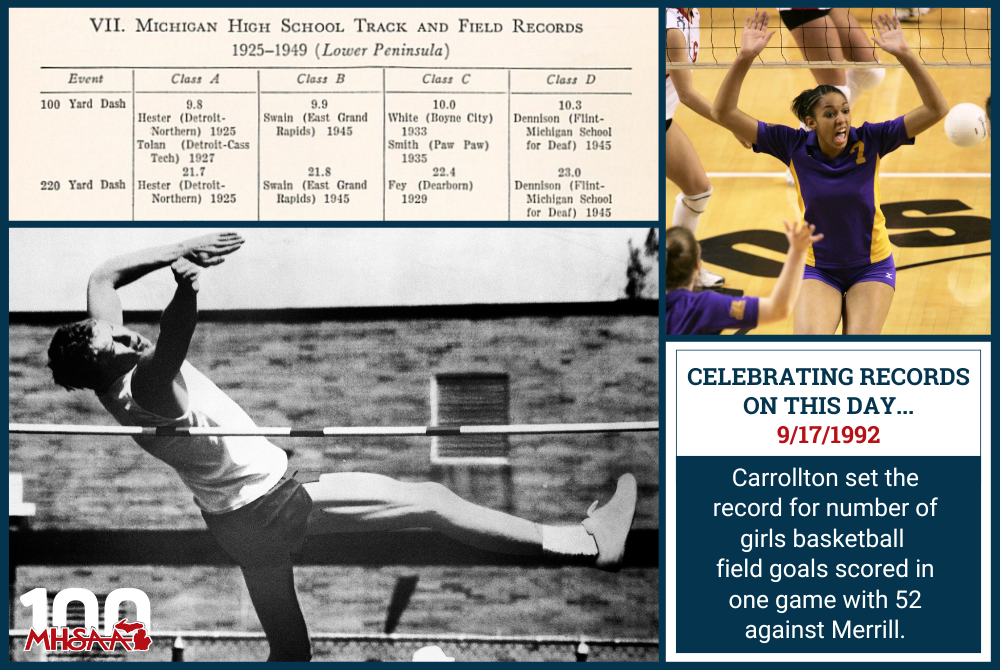
PHOTOS Clockwise from top left: (1) The lead-in to Track & Field Finals records listed in “Athletics in Michigan High Schools – The First Hundred Years” shows a few of the elite performances from our earliest meets. (2) Leland volleyball star Alisha Glass celebrates with her teammates; she still holds four MHSAA records in that sport. (3) Every day this school year, the MHSAA is posting a record on its Instagram and X social media channels, and the great majority took place on that specific day. (4) Brimley’s John Payment still holds the all-Finals record for high jump, 7-foot-1, from 1989. (Glass and Payment photos from MHSAA archives.)