


Add, Subtract, Divide, Multiply: MHSAA Not Alone
July 25, 2017
By Rob Kaminski
MHSAA benchmarks editor
This is the third part in a series on MHSAA tournament classification, past and present, that will be published over the next two weeks. This series originally ran in this spring's edition of MHSAA benchmarks.
As the MHSAA faces its most recent classification task with 8-Player Football, and opinions continue to swirl about as to the method, timeframe, location and other procedures, a look around the country provides plenty of company among state association brethren factoring variables into their own equations.
In the Pacific Northwest, the Oregon School Activities Association Football Playoffs are under public scrutiny as leadership ponders a five or six classification format beginning with the 2018-19 school year.
The OSAA has crowned six champions on the gridiron since 2006-07. Many of the state’s smaller schools would like to keep it that way, while larger schools lean toward a five-classification system, citing larger leagues, ease of travel and credibility to state championships as the advantages.
Still others would prefer more than six classes, pointing to safety issues and the opportunity to increase participation numbers as positives.
Moving southeast of Oregon, the Nevada Interscholastic Activities Association recently voted to hold serve on a classification proposal that was volleyed to the membership.
However, changes still could be forthcoming by as early as the 2018-19 season which would add a fifth classification in more populated southern Nevada while allowing northern schools to participate in four classifications. Such divisions could mean no state championship for the fifth class in southern Nevada.
Because of that, the NIAA wants equal numbers of schools in each classification on both ends of the state. Complicating the issue is the fact that the 24 largest schools in the state, by enrollment, are all in Clark County in Southern Nevada.
Across Nevada’s border into Arizona, charter schools are asking the Arizona Interscholastic Association to reconsider classification that was voted upon and approved in September 2015. That agreement called for the largest 33 percent of charter schools by enrollment to be placed in the state’s largest school classification, 3A, the middle 33 percent into 2A, and the smallest 33 percent into 1A.
Less than two years later the charter schools have had a change of heart and have asked to be considered the same as other Arizona public schools and be placed appropriately by enrollment beginning with the 2018-19 school year.
The situation in Arizona further illustrates how the public/private debate that all state associations have faced throughout existence now has the added dynamic of rapidly growing charter schools in today’s educational system, along with virtual school enrollment.
In the nation’s heartland, Nebraska has retooled its football classifications by using enrollment of boys students only in its schools rather than total enrollment. The Nebraska School Activities Association football-playing schools will kick off the 2018 season using this alignment.
Nebraska has three classes of 11-player football, with the smallest class divided in two, Class C-1 and C-2. The state also will have 8-player football for boys enrollments under 47, and the NSAA will sponsor a new 6-player tournament in 2018 for schools with 27 or fewer boys.
“This is a good proposal because some schools have a sizable imbalance between the number of boys and girls, and there’s a large gap (in enrollment) between the largest and smallest schools in Classes A and B,” NSAA executive director Jim Tenopir said. “I think this addresses both of those concerns.”
Swimmers in Georgia, meanwhile, will feel like they are moving with the current, rather than upstream in 2017-18, as the Georgia High School Association recently doubled the number of team championship events from two to four.
Swim enthusiasts can also count on longer days at the finals, as the top 30 finishers from the prelims will advance to the finals instead of 20, and all championship events will have three heats versus two.
Bentz Adds Next Chapter to Inspirational Story as Novi Christian Athletic Director
By
Keith Dunlap
Special for MHSAA.com
September 24, 2024
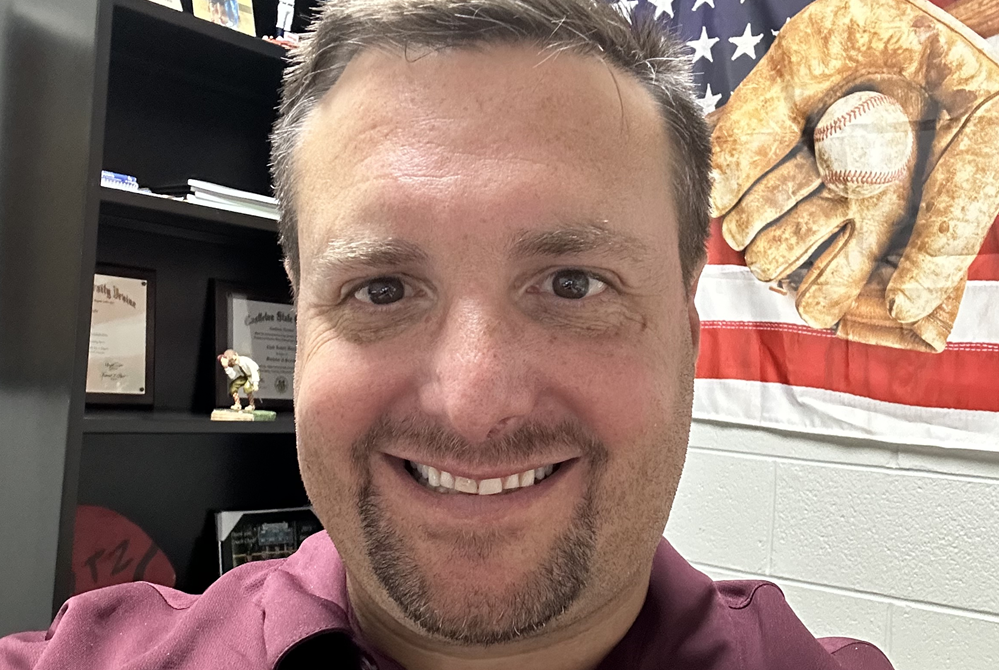
NOVI – For anyone seeking an inspirational speaker, new Novi Christian athletic director Chad Bentz has a story he’d like to tell.
 His includes the value of resilience, proof that improbable dreams can come true, and affirmation that mentors can change lives.
Bentz spent time in Major League Baseball, playing 36 games for the Montreal Expos in 2004 and four games in 2005 for the Miami Marlins as a left-handed relief pitcher.
The chances of making it to the big leagues are slim to begin with, but were even longer considering that Bentz grew up in Alaska.
On top of that, Bentz has a deformed right hand. When he debuted with the Expos, he followed in the footsteps of Jim Abbott, who also has a deformed right hand and starred at Flint Central and University of Michigan on the way to pitching for four MLB teams across 10 seasons.
Bentz was certainly a case of beating improbable odds, and watching Abbott while growing up was a big reason why.
“Everybody has their favorite players, but Jim was more than that to me,” Bentz said. “He gave me confidence to try things. I was always the kid with the weird hand. I always kept my hand in my pocket and was always self-conscious about it. Then I saw Jim pitching. He gave me confidence to try things, and thank goodness he did. When I tried things, I discovered I was good at it and got more confidence.”
It got even better for Bentz as a college freshman playing for Long Beach State, when he got to meet Abbott in during an unexpected visit.
“Meeting him was by far the most star-struck I’ve ever been,” he said. “We both stuck out our left hands to shake and it was the first time ever where it wasn’t that awkward. It was everything I thought it was going to be. He was incredibly nice, funny and just a good dude. That was one of my favorite moments. Kids being born, wedding and Jim.”
A big part of Bentz’ baseball development occurred in Michigan. Although he grew up in Alaska — he said he could’ve been a “Hall of Famer pitching inside of a gym” — Bentz would spend his summers in Michigan with family members in the Grand Rapids area.
He ended up hooking up with a travel ball team in the area, the Grand Rapids A’s, which was a step up from competition he saw in Alaska.
“I went down to Michigan, and I said, ‘OK, there are a lot of players in this country, and I am not as good as I thought I was,’” he said. “After my freshman year here (playing summer ball), I went back (to Alaska), and I started lifting and I didn’t stop. I kept working.”
Bentz eventually was drafted out of high school in the 34th round by the New York Yankees, played at Long Beach State and then was drafted in the seventh round by the Expos in 2001. In choosing baseball, he turned down opportunities to play football at Division I schools in what was then the PAC-10.
Bentz had been a standout linebacker and fullback, and when his baseball career was done, he began a college football career at age 30 playing for Castleton State College in Vermont.
“Playing college football at age 30 kind of gave me a taste of it, and that taste was that you should have done this 10 years ago,” Bentz quipped. “Not at 30. I was in slings every single Sunday. I couldn’t move. My arms were in slings. Both of them. But it was worth it. I loved and was thankful I had that opportunity. It filled that ‘what if’ type of thing.”
A husband and father of three, including 2-year-old twin boys, Bentz jumped on the chance to become the athletic director at Novi Christian and move to Michigan to not only be closer to family but give his kids a chance to be more active.
“Alaska is great, but it’s limiting,” Bentz said. “I told people that the grass isn’t going to be greener, but it’s just going to be a bigger yard and more swings for them to play on. We just wanted a little bit more opportunity.”
Bentz also said he would love the opportunity to speak in front of groups of people and share his journey in hopes of inspiring others, something he did regularly when he was in Major League Baseball at various ballparks.
"I was able to meet a lot of people of all ages who had any types of disabilities or anything,” he said. “I just know the kind of impact it can have. If I can do that and do a tiny bit of what Jim gave me, I’d like to pay it forward as much as possible.”
 Keith Dunlap has served in Detroit-area sports media for more than two decades, including as a sportswriter at the Oakland Press from 2001-16 primarily covering high school sports but also college and professional teams. His bylines also have appeared in USA Today, the Washington Post, the Detroit Free Press, the Houston Chronicle and the Boston Globe. He served as the administrator for the Oakland Activities Association’s website from 2017-2020. Contact him at [email protected] with story ideas for Oakland, Macomb and Wayne counties.
PHOTO courtesy of Chad Bentz.