

Add, Subtract, Divide, Multiply: MHSAA Not Alone
July 25, 2017
By Rob Kaminski
MHSAA benchmarks editor
This is the third part in a series on MHSAA tournament classification, past and present, that will be published over the next two weeks. This series originally ran in this spring's edition of MHSAA benchmarks.
As the MHSAA faces its most recent classification task with 8-Player Football, and opinions continue to swirl about as to the method, timeframe, location and other procedures, a look around the country provides plenty of company among state association brethren factoring variables into their own equations.
In the Pacific Northwest, the Oregon School Activities Association Football Playoffs are under public scrutiny as leadership ponders a five or six classification format beginning with the 2018-19 school year.
The OSAA has crowned six champions on the gridiron since 2006-07. Many of the state’s smaller schools would like to keep it that way, while larger schools lean toward a five-classification system, citing larger leagues, ease of travel and credibility to state championships as the advantages.
Still others would prefer more than six classes, pointing to safety issues and the opportunity to increase participation numbers as positives.
Moving southeast of Oregon, the Nevada Interscholastic Activities Association recently voted to hold serve on a classification proposal that was volleyed to the membership.
However, changes still could be forthcoming by as early as the 2018-19 season which would add a fifth classification in more populated southern Nevada while allowing northern schools to participate in four classifications. Such divisions could mean no state championship for the fifth class in southern Nevada.
Because of that, the NIAA wants equal numbers of schools in each classification on both ends of the state. Complicating the issue is the fact that the 24 largest schools in the state, by enrollment, are all in Clark County in Southern Nevada.
Across Nevada’s border into Arizona, charter schools are asking the Arizona Interscholastic Association to reconsider classification that was voted upon and approved in September 2015. That agreement called for the largest 33 percent of charter schools by enrollment to be placed in the state’s largest school classification, 3A, the middle 33 percent into 2A, and the smallest 33 percent into 1A.
Less than two years later the charter schools have had a change of heart and have asked to be considered the same as other Arizona public schools and be placed appropriately by enrollment beginning with the 2018-19 school year.
The situation in Arizona further illustrates how the public/private debate that all state associations have faced throughout existence now has the added dynamic of rapidly growing charter schools in today’s educational system, along with virtual school enrollment.
In the nation’s heartland, Nebraska has retooled its football classifications by using enrollment of boys students only in its schools rather than total enrollment. The Nebraska School Activities Association football-playing schools will kick off the 2018 season using this alignment.
Nebraska has three classes of 11-player football, with the smallest class divided in two, Class C-1 and C-2. The state also will have 8-player football for boys enrollments under 47, and the NSAA will sponsor a new 6-player tournament in 2018 for schools with 27 or fewer boys.
“This is a good proposal because some schools have a sizable imbalance between the number of boys and girls, and there’s a large gap (in enrollment) between the largest and smallest schools in Classes A and B,” NSAA executive director Jim Tenopir said. “I think this addresses both of those concerns.”
Swimmers in Georgia, meanwhile, will feel like they are moving with the current, rather than upstream in 2017-18, as the Georgia High School Association recently doubled the number of team championship events from two to four.
Swim enthusiasts can also count on longer days at the finals, as the top 30 finishers from the prelims will advance to the finals instead of 20, and all championship events will have three heats versus two.
Rodammer Stacks 44 Years, 451 Games Tracking Frankenmuth's Football Numbers
By
Steve Vedder
Special for MHSAA.com
September 20, 2024
While Al Rodammer's abbreviated scouting career may have lasted all of one night, it didn't take him long to figure out how he'd spend Friday evenings for the next 44 years.
Rodammer remembers being asked by former Eagles football coach Ralph Munger to drive to Bullock Creek to scout an upcoming playoff opponent. But Rodammer and fellow scout Jeff Reinbold wound up getting lost en route and missed most of the first quarter.
The mix-up didn't sit well with Munger, who "reassigned" Rodammer to a different task: keeping stats for the program.
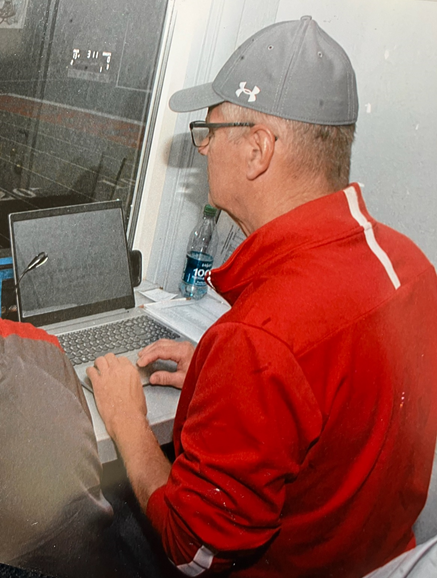
Instead of fretting about the switch, Rodammer, a former baseball and basketball player at Frankenmuth, embraced the move. Four and a half decades later, Rodammer has kept track of virtually every football stat you can imagine for 451 Eagles games. Starting in 1981, Rodammer has dragged, at first, his trusty pencil and paper, and now laptop to hundreds of cramped press boxes, unsteady roof tops, chilly sidelines or whatever dinky corner space may have been available.
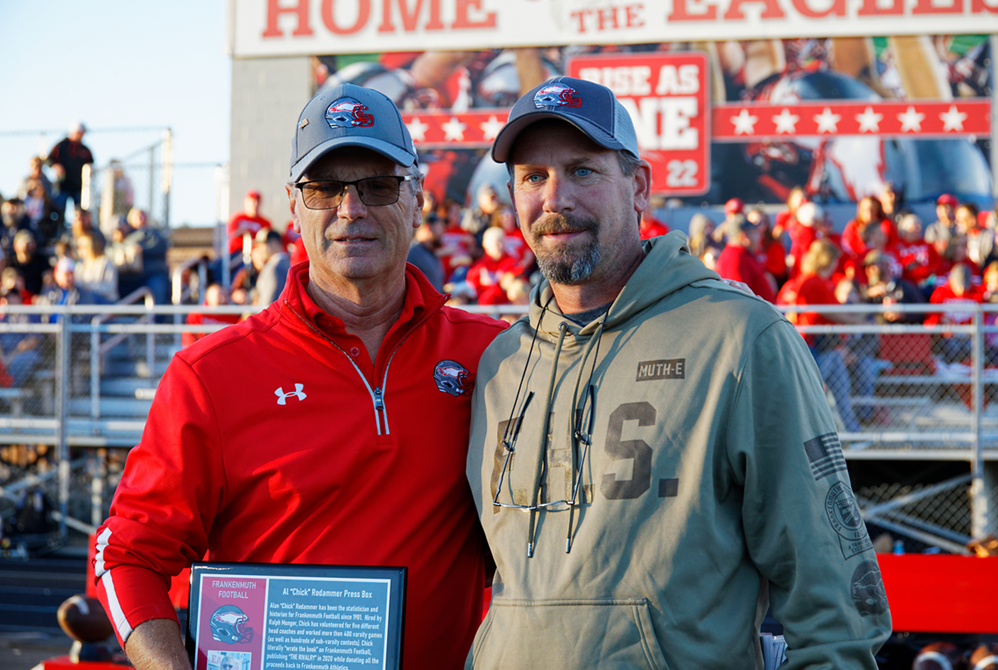
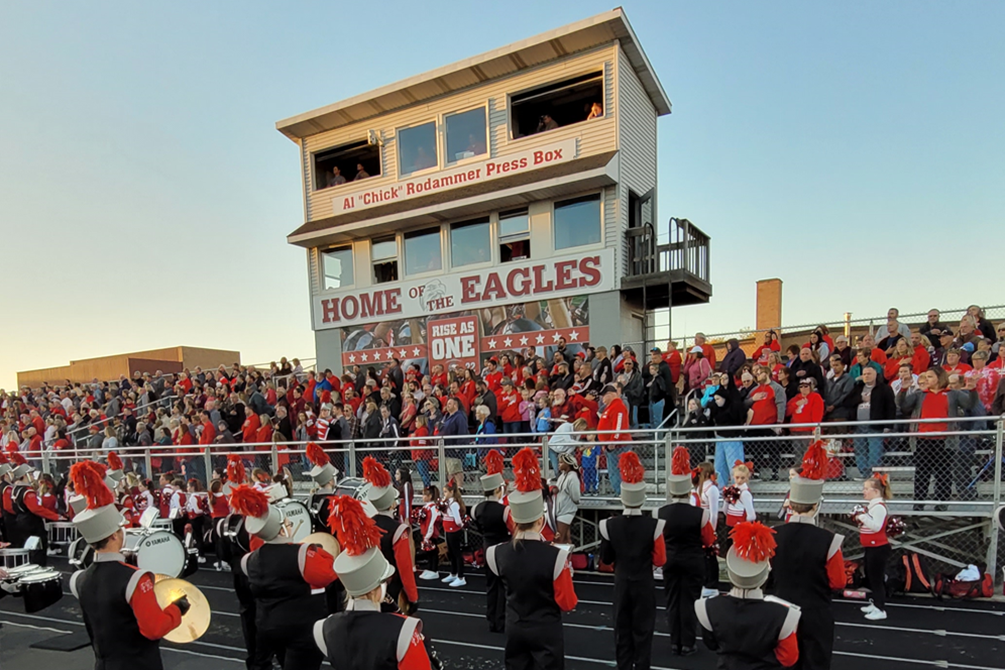
Many people may believe that totaling rushing yards or deciphering passing percentages is a thankless task. The 70-year-old Rodammer, who had the Frankenmuth press box named after him in 2022, prefers to think of his work as a labor of love.
Acting as a bridge between past and present Eagles teams and staying in touch with a community which loves its Friday Night Lights is his way of honoring a highly-successful football program.
 "It's a commitment, but it's also a labor of love," he said. "When they named the press box after me, I thought, "Gosh, I don't know if I deserve this.' I don't do it for the recognition. But when the alumni come back, and to see what the work means to them, that's what I get out of it."
Rodammer's connection with the program far exceeds keeping track of how many passes are attempted or how many yards the Eagles' defense surrenders. He's written two books about the program, including an 82-page history of the Frankenmuth-Millington rivalry. While his initial connection may have been as a failed scout, he's recognized as the program's official historian and leading goodwill ambassador as he's constantly stopped on the street and asked what the Eagles’ chances are for the upcoming season.
One of Rodammer's passions is organizing reunions of past teams, a couple of which included his two sons who played football at Frankenmuth.
When you consider all of Rodammer's contributions to the program, Frankenmuth coach Phil Martin said keeping stats is just a small part of his overall contribution to the program. The data turned in to coaches helps them plot offensive and defensive strategies. But Rodammer's work in writing game stories for community media, digging into archives for long-sought but pertinent information and communicating with past teams is his true value.
"But more than statistics, he's cared for the program for 40-plus years," Martin said. "He's helped tradition and the community in understanding what we have in 69 years of Frankenmuth football."
Rodammer, whose statistics career has covered a half-dozen athletic directors and five head coaches, takes particular pride in not just assembling the typical Friday night numbers, but in putting the long history of Eagles football into perspective. His boundless research of Frankenmuth football has taken him from local libraries to Detroit-area facilities which may contain older stories on the team. He uses that information to ensure the accuracy of his records.
"We've been successful in a lot of athletics like soccer or basketball, but Frankenmuth is a football town," said Rodammer, who added tabulating junior varsity statistics to his resume in 2002. "There's something about football that brings out the community. There are always a lot of older people in the stands who get into it.
"Athletics has a definite impact on the community, no doubt about it."
 Rodammer has missed only four games over his 44 seasons, 28 of which he has been joined by spotter Frank Bender. Two were for weddings, there was one funeral and once the fastpitch softball team he played for was in Minot, N.D., for a tournament. Rodammer is a member of the American Softball Association Hall of Fame.
He admits to being a "numbers guy," who developed programs for the Vassar Building Center before retiring 13 years ago, and he also kept statistics for his softball team for 20 years. Rodammer has his own definition of what numbers mean to him.
"I was only an average student, but there is something about stats," he said. "Yeah, I'm probably a little geekish about numbers."
Making the job easier – if not more fun – has been the wild success of the Frankenmuth program. The Eagles have won 62 consecutive conference games, including 12 league titles. Frankenmuth has been to two MHSAA Finals at Ford Field over the last four seasons. The Eagles have had 14 consecutive winning seasons, been to the playoffs 13 straight years and 29 times since 1987. The team is off to a 3-0 start this season and last week became the 14th program in state history to reach 500 victories.
Such success has left Rodammer with more than a few memories. For instance, he lists the team's 1987 playoff upset of Cheboygan as his personal favorite moment. Cheboygan was unbeaten, but the unraked Eagles prevailed 28-21. He also mentions a 28-20 win over powerhouse Ithaca in 2016 that interrupted a stunning string of Yellowjackets successes during an 118-5 run that included four MHSAA Finals titles and two more runner-up finishes between 2009-17. Another memory is Frankenmuth playing in its first championship game at a near-empty Ford Field due to COVID restrictions in January 2021.
Rodammer is hard-pressed to answer what he'd do with his Friday nights if he wasn't toiling away in a press box at a Frankenmuth football game. Maybe he'd work closer with his church, travel to see other local teams play or check off a couple stops toward his ultimate goal – to visit every Big 10 school for a game.
For the moment, at least, skipping a Friday night perched on a rickety chair tucked into the corner of a cramped press box isn't in the plan.
"I have a passion, but I don't do it for recognition," he said of connecting with the Eagles program "I want to keep a commitment from past teams to the present. That's what motivates me.
"I love summers, but every year I can't wait for the fall."
PHOTOS (Top) Al Rodammer, left and Eagles coach Phil Martin take a photo on the night the facility was named for its longtime stat person during the 2022 season. (Middle) The Al "Chick" Rodammer Press Box stands tall before the start of a Frankenmuth game this season. (Below) Rodammer does his work in the corner of the press box. (Top two photos by Chip DeGrace; below photo courtesy of Al Rodammer.)