


Add, Subtract, Divide, Multiply: MHSAA Not Alone
July 25, 2017
By Rob Kaminski
MHSAA benchmarks editor
This is the third part in a series on MHSAA tournament classification, past and present, that will be published over the next two weeks. This series originally ran in this spring's edition of MHSAA benchmarks.
As the MHSAA faces its most recent classification task with 8-Player Football, and opinions continue to swirl about as to the method, timeframe, location and other procedures, a look around the country provides plenty of company among state association brethren factoring variables into their own equations.
In the Pacific Northwest, the Oregon School Activities Association Football Playoffs are under public scrutiny as leadership ponders a five or six classification format beginning with the 2018-19 school year.
The OSAA has crowned six champions on the gridiron since 2006-07. Many of the state’s smaller schools would like to keep it that way, while larger schools lean toward a five-classification system, citing larger leagues, ease of travel and credibility to state championships as the advantages.
Still others would prefer more than six classes, pointing to safety issues and the opportunity to increase participation numbers as positives.
Moving southeast of Oregon, the Nevada Interscholastic Activities Association recently voted to hold serve on a classification proposal that was volleyed to the membership.
However, changes still could be forthcoming by as early as the 2018-19 season which would add a fifth classification in more populated southern Nevada while allowing northern schools to participate in four classifications. Such divisions could mean no state championship for the fifth class in southern Nevada.
Because of that, the NIAA wants equal numbers of schools in each classification on both ends of the state. Complicating the issue is the fact that the 24 largest schools in the state, by enrollment, are all in Clark County in Southern Nevada.
Across Nevada’s border into Arizona, charter schools are asking the Arizona Interscholastic Association to reconsider classification that was voted upon and approved in September 2015. That agreement called for the largest 33 percent of charter schools by enrollment to be placed in the state’s largest school classification, 3A, the middle 33 percent into 2A, and the smallest 33 percent into 1A.
Less than two years later the charter schools have had a change of heart and have asked to be considered the same as other Arizona public schools and be placed appropriately by enrollment beginning with the 2018-19 school year.
The situation in Arizona further illustrates how the public/private debate that all state associations have faced throughout existence now has the added dynamic of rapidly growing charter schools in today’s educational system, along with virtual school enrollment.
In the nation’s heartland, Nebraska has retooled its football classifications by using enrollment of boys students only in its schools rather than total enrollment. The Nebraska School Activities Association football-playing schools will kick off the 2018 season using this alignment.
Nebraska has three classes of 11-player football, with the smallest class divided in two, Class C-1 and C-2. The state also will have 8-player football for boys enrollments under 47, and the NSAA will sponsor a new 6-player tournament in 2018 for schools with 27 or fewer boys.
“This is a good proposal because some schools have a sizable imbalance between the number of boys and girls, and there’s a large gap (in enrollment) between the largest and smallest schools in Classes A and B,” NSAA executive director Jim Tenopir said. “I think this addresses both of those concerns.”
Swimmers in Georgia, meanwhile, will feel like they are moving with the current, rather than upstream in 2017-18, as the Georgia High School Association recently doubled the number of team championship events from two to four.
Swim enthusiasts can also count on longer days at the finals, as the top 30 finishers from the prelims will advance to the finals instead of 20, and all championship events will have three heats versus two.
Vandercook Lake Football Returns, Growing Despite School's Decreased Enrollment
By
Doug Donnelly
Special for MHSAA.com
September 17, 2024
A few weeks ago, Daniel Midena noticed someone watching his Vandercook Lake football team practice in Jackson.
 Upon some quick investigation, he discovered it was a friendly visit.
“I found out it was one of our alumni,” Midena said. “Turns out he just wanted to congratulate our guys on that win. I told our kids, if we do this right, the community is going to support you.”
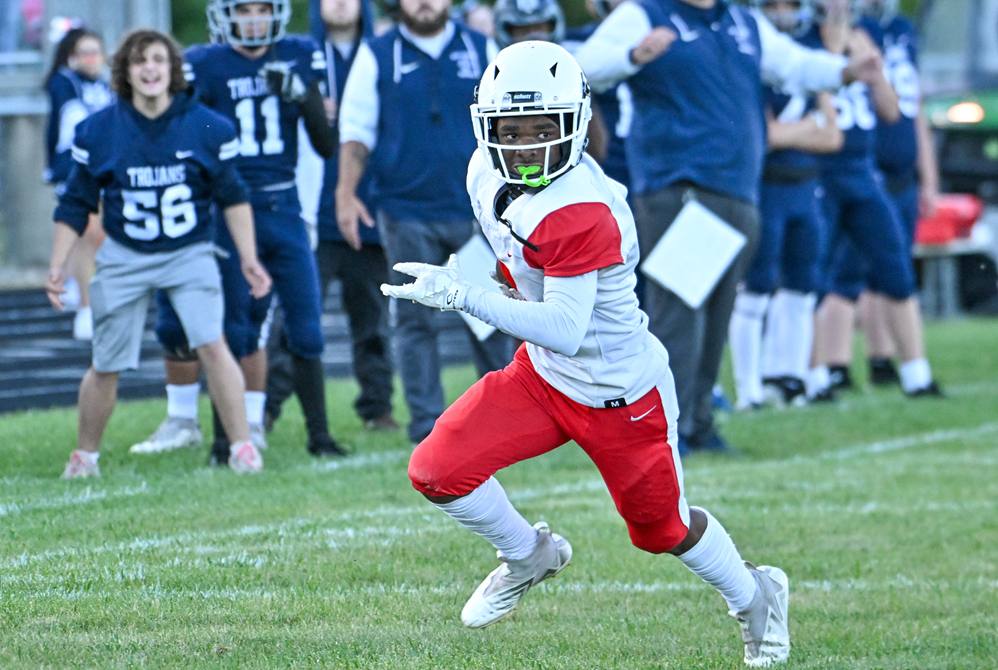
The Jayhawks had defeated East Jackson 43-28 on Sept. 6 to win their first 11-player varsity football game since 2018.
“I’m just so proud of the kids,” he said. “They put in a lot of hard work. To just experience that win and to know, ‘Yeah, we can do this.’ That was great for the kids. This is what winning feels like. So many people reached out with congratulations – some people that I don’t even know.”
The last winning season for Vandercook Lake was in 2015. It’s been a rocky road since for the football program, which has struggled to field full varsity teams and win games for the last decade. The Jayhawks moved to 8-player football in 2020 in an effort to save the program, but by 2022 the team was down to 10 players or fewer at times. They lost games that fall by scores of 79-0, 58-0, 65-0 and 70-0 before halting the season.
Midena, 32, a physical education and health teacher at Vandercook Lake, has been the architect of the rebuild. A Brooklyn Columbia Central graduate, Midena took over the Vandercook Lake Middle School football program a couple of years ago and saw some success. One of his teams went undefeated.
Once he entered the picture, the team more than doubled its turnout for football, from 11 players in 2022 to 30 players last season. This year he has nearly 40 athletes participating on the varsity and JV.
“We were at rock bottom,” he said. “I said, ‘Let’s see if we can change this. I was able to reach some of the kids in the hallways. We were able to double the numbers. There were a lot of kids who should have been playing. They just expected to lose here and didn’t want to play. I am trying to change that – to get an expect-to-win mentality.”
He’s also teaching the game to some athletes who never had the opportunity to play youth football or learn the game growing up.
“Still today, I’m teaching things I wouldn’t think I would have to,” he said. “From not playing football, some of these just need to be taught the simple rules. Every day we teach the game more than we play it. They must know the game before they can do it. That was a big thing. We’re literally teaching basic rules and schemes.”
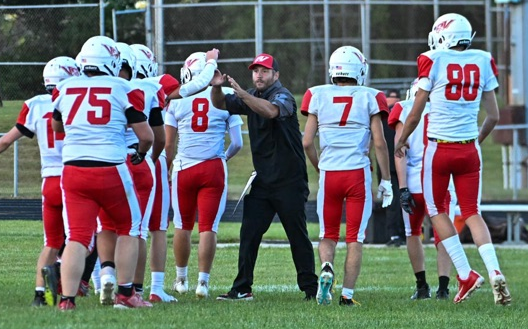 Midena has no trouble teaching the rules of the game. He’s officiated basketball, baseball and football for the MHSAA for several years. Last year he was one of the officials for the 11-player Division 4 Final at Ford Field.
“I think that helps big-time with the rule knowledge and teaching the kids,” he said of his referee background.
Most of all, he’s building relationships with a new era of football players at the Jackson County school. When he was asked to take over the program once the school decided to return to 11-player football, he decided to take off his referee hat and pick the coaching whistle. Having coached several of the current varsity players while they were in middle school was an advantage.
“I feel we have done a tremendous amount of growth from last year to this year,” he said. “I had relationships with them; they knew my expectations.
He is now looking to build consistency in the program.
“Most challenging is consistency,” Midena said. “That is our big word. I still fight numbers every day. Monday, we finished the JV game with 11 players, and we won. That is still a problem. The kids have to learn that you have to show up every day for practice. It’s the process over the outcome. You can’t just show up and think we are going to do okay on Friday.
“We’re still trying to drive home to the kids you have to be consistent in everything you do.”
The Jayhawks are focused on building a foundation for football teams of the future. The current team has two seniors, six juniors and more than 30 freshmen and sophomores.
While he hopes there are more wins on this year’s schedule, he is not taking anything for granted.
“We take things on a game-by-game basis,” he said. “Our goal is to go out and compete and see how we are going to do.”
Some players are pulling double duty, participating in cross country or marching band this fall.
“They run in, I give them some details, and they go out and perform in the band. We share athletes in other sports,” he said.
The Vandercook Lake school district is going through a steady decline in enrollment, something Midena says keeps him up at night. In 2008, the high school enrollment was two students shy of 400. This fall, the enrollment is 190.
“I have to keep reaching the kids that we have here,” he said. “I can only concentrate on the kids we have here at the school. That’s what I am going to continue to do – try to get more kids to come out and play football.”
 Doug Donnelly has served as a sports and news reporter and city editor over 25 years, writing for the Daily Chief-Union in Upper Sandusky, Ohio from 1992-1995, the Monroe Evening News from 1995-2012 and the Adrian Daily Telegram since 2013. He's also written a book on high school basketball in Monroe County and compiles record books for various schools in southeast Michigan. E-mail him at [email protected] with story ideas for Jackson, Washtenaw, Hillsdale, Lenawee and Monroe counties.
PHOTOS (Top) Vandercook Lake’s Leland Barton carries the ball against East Jackson this season. (Middle) Jayhawks coach Daniel Midena, middle, high-fives his players. (Photos by Jeff Steers.)