


Add, Subtract, Divide, Multiply: MHSAA Not Alone
July 25, 2017
By Rob Kaminski
MHSAA benchmarks editor
This is the third part in a series on MHSAA tournament classification, past and present, that will be published over the next two weeks. This series originally ran in this spring's edition of MHSAA benchmarks.
As the MHSAA faces its most recent classification task with 8-Player Football, and opinions continue to swirl about as to the method, timeframe, location and other procedures, a look around the country provides plenty of company among state association brethren factoring variables into their own equations.
In the Pacific Northwest, the Oregon School Activities Association Football Playoffs are under public scrutiny as leadership ponders a five or six classification format beginning with the 2018-19 school year.
The OSAA has crowned six champions on the gridiron since 2006-07. Many of the state’s smaller schools would like to keep it that way, while larger schools lean toward a five-classification system, citing larger leagues, ease of travel and credibility to state championships as the advantages.
Still others would prefer more than six classes, pointing to safety issues and the opportunity to increase participation numbers as positives.
Moving southeast of Oregon, the Nevada Interscholastic Activities Association recently voted to hold serve on a classification proposal that was volleyed to the membership.
However, changes still could be forthcoming by as early as the 2018-19 season which would add a fifth classification in more populated southern Nevada while allowing northern schools to participate in four classifications. Such divisions could mean no state championship for the fifth class in southern Nevada.
Because of that, the NIAA wants equal numbers of schools in each classification on both ends of the state. Complicating the issue is the fact that the 24 largest schools in the state, by enrollment, are all in Clark County in Southern Nevada.
Across Nevada’s border into Arizona, charter schools are asking the Arizona Interscholastic Association to reconsider classification that was voted upon and approved in September 2015. That agreement called for the largest 33 percent of charter schools by enrollment to be placed in the state’s largest school classification, 3A, the middle 33 percent into 2A, and the smallest 33 percent into 1A.
Less than two years later the charter schools have had a change of heart and have asked to be considered the same as other Arizona public schools and be placed appropriately by enrollment beginning with the 2018-19 school year.
The situation in Arizona further illustrates how the public/private debate that all state associations have faced throughout existence now has the added dynamic of rapidly growing charter schools in today’s educational system, along with virtual school enrollment.
In the nation’s heartland, Nebraska has retooled its football classifications by using enrollment of boys students only in its schools rather than total enrollment. The Nebraska School Activities Association football-playing schools will kick off the 2018 season using this alignment.
Nebraska has three classes of 11-player football, with the smallest class divided in two, Class C-1 and C-2. The state also will have 8-player football for boys enrollments under 47, and the NSAA will sponsor a new 6-player tournament in 2018 for schools with 27 or fewer boys.
“This is a good proposal because some schools have a sizable imbalance between the number of boys and girls, and there’s a large gap (in enrollment) between the largest and smallest schools in Classes A and B,” NSAA executive director Jim Tenopir said. “I think this addresses both of those concerns.”
Swimmers in Georgia, meanwhile, will feel like they are moving with the current, rather than upstream in 2017-18, as the Georgia High School Association recently doubled the number of team championship events from two to four.
Swim enthusiasts can also count on longer days at the finals, as the top 30 finishers from the prelims will advance to the finals instead of 20, and all championship events will have three heats versus two.
Cass City Focused on Moment but Playing for Biggest After Back-to-Back Semifinal Trips
By
Paul Costanzo
Special for MHSAA.com
September 5, 2024
For the Cass City volleyball team, the goal is clear in 2024.
 The Red Hawks, who have played in back-to-back Division 3 Semifinals and feature eight returning seniors – including four who were part of both long tournament runs – want to get back and finish on top in Battle Creek.
But for coach Amy Cuthrell to get her players to that big goal, she’s asked them not to think about it and focus on the smaller, daily ones instead.
“It’s details, the little things,” Cuthrell said. “You get better in practice, and in the game stage is where we show our skills. Practice has been intense. I do demand a little more in certain areas, and they’re responding. They know where we need to get better. They’re just good kids. I don’t think every day they think it’s fun, but for me, personally, I’m not going to settle. I want their dreams to be made. These are their memories.”
Cass City has made plenty of memories over the past two seasons, charging to the Semifinals for the first time since they made back-to-back runs in 1976-77. Like those late 70s runs, both ended with losses one match short of the Final.
“I’ve been thrilled to get there,” Cuthrell said. “But I just want to get over that hump.”
That’s about all Cuthrell will say about getting back to Battle Creek, however. While she’s perfectly fine using the past as motivation, she doesn’t want her team getting caught looking toward the future.
Easier said than done.
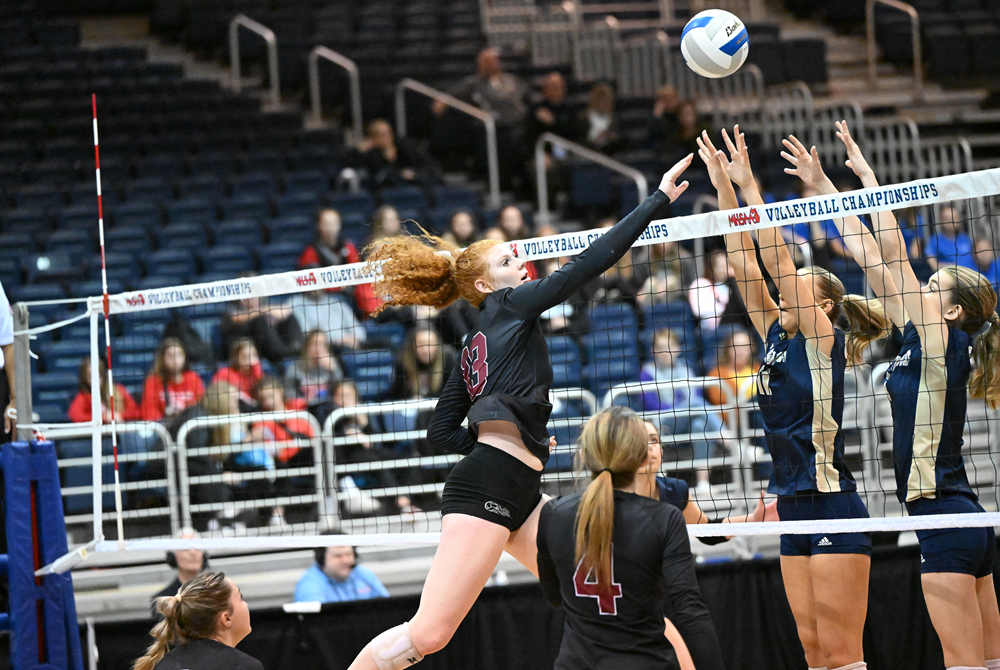
 Led by Texas Tech commit Shelby Ignash and fellow four-year player Kacee Gray, who has committed to Alma College, the Red Hawks seem to have been built this season for their longest run.
Isabelle Phillips and Alexis Champagne are in their third years on varsity, having also experienced both Semifinals. Kylie McKee, Mia Caister, Katelyn Rockwell and Alysa Fritz also return from last year’s team, which won the first set in the Semifinal against Traverse City St. Francis before falling in four.
“Growing up, we have all been playing volleyball together, all eight of us, since the sixth grade,” Gray said. “We’ve known we’re a special group and that we have a group of special athletes. So we’ve been putting the time in day in and day out, pushing each other to be a better team. Now we’re here, and we’re still hungry and ready for more.”
Cuthrell is doing her best to feed that hunger with as much on-court knowledge as she can. While the losses at Kellogg Arena were certainly learning experiences for the players, they were the same for the coach.
“I’ve looked at all the tapes, and I really had to reflect on what I can change as a coach,” she said. “I’ve broken down some of the things that I’m going to have to really focus on, different elements of the game. This is a complex game. It may not seem complex to some, but it’s a very detailed sport.”
Better communication on the court and the ability to move on from one play and focus on what’s next is something Cuthrell said she’s focused on this season. Through two early-season tournaments, she’s also liked what she’s seen from her team’s ability to analyze opponents during a match. Cass City is 5-4-1 after trips to the Frankenmuth Invitational and Warrior Showdown, and has wins over the past two Division 3 Finals champions – Pewamo-Westphalia and Kalamazoo Christian. Cass City also split its match against Traverse St. Francis.
 The tough early schedule is by design, of course, to better prepare the Red Hawks for November. It’s also going to set them up for a tough league schedule, which will be played with a massive target on their backs.
“I think everyone wants to beat us,” Ignash said. “It makes it more exciting, too. You never know, someone can pop out and give you everything.”
That has certainly helped hammer home Cuthrell’s message about staying in the moment.
“I can’t say how they think all the time, but I do know they meet the daily grind, and we do not speak of the future in our practices – we talk about today,” Cuthrell said. “I think humility is important, and we’re lucky to have a very strong program and tradition. They understand the culture, and they are humble in knowing this is one day at a time.”
You can’t block out all outside noise, though, especially at a time when statewide results and weekly rankings are so easily accessible. The most recent poll from the Michigan Interscholastic Volleyball Coaches Association has Cass City ranked No. 3.
That will filter through the Cass City team, but in a way that Cuthrell certainly won’t mind.
“Any time a new ranking gets posted, we’re sending it to the group chat,” Gray said. “But seeing it is more motivating, because we’re not at the top.”
 Paul Costanzo served as a sportswriter at The Port Huron Times Herald from 2006-15, including three years as lead sportswriter, and prior to that as sports editor at the Hillsdale Daily News from 2005-06. He can be reached at [email protected] with story ideas for Genesee, Lapeer, St. Clair, Sanilac, Huron, Tuscola, Saginaw, Bay, Arenac, Midland and Gladwin counties.
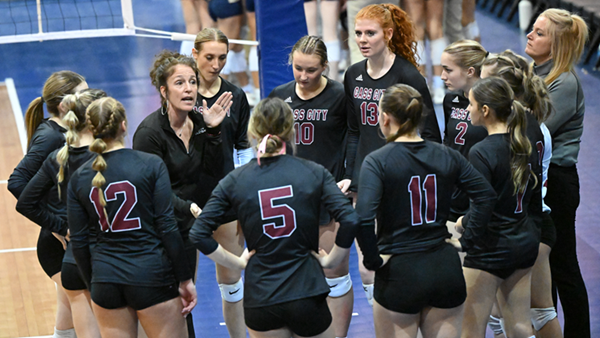
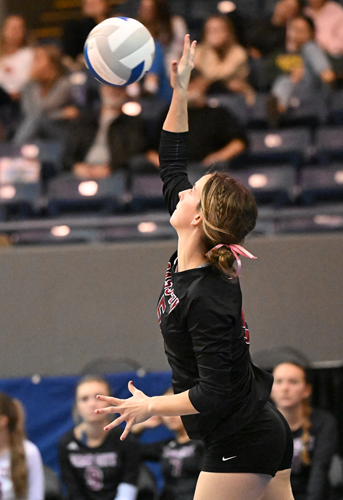
PHOTOS (Top) Shelby Ignash sends the ball over a block during Cass City’s Semifinal match last season against Traverse City St. Francis. (Middle) Red Hawks coach Amy Cuthrell talks things over with her team during that match at Kellogg Arena. (Below) Kacee Gray serves during the Semifinal.