

Add, Subtract, Divide, Multiply: MHSAA Not Alone
July 25, 2017
By Rob Kaminski
MHSAA benchmarks editor
This is the third part in a series on MHSAA tournament classification, past and present, that will be published over the next two weeks. This series originally ran in this spring's edition of MHSAA benchmarks.
As the MHSAA faces its most recent classification task with 8-Player Football, and opinions continue to swirl about as to the method, timeframe, location and other procedures, a look around the country provides plenty of company among state association brethren factoring variables into their own equations.
In the Pacific Northwest, the Oregon School Activities Association Football Playoffs are under public scrutiny as leadership ponders a five or six classification format beginning with the 2018-19 school year.
The OSAA has crowned six champions on the gridiron since 2006-07. Many of the state’s smaller schools would like to keep it that way, while larger schools lean toward a five-classification system, citing larger leagues, ease of travel and credibility to state championships as the advantages.
Still others would prefer more than six classes, pointing to safety issues and the opportunity to increase participation numbers as positives.
Moving southeast of Oregon, the Nevada Interscholastic Activities Association recently voted to hold serve on a classification proposal that was volleyed to the membership.
However, changes still could be forthcoming by as early as the 2018-19 season which would add a fifth classification in more populated southern Nevada while allowing northern schools to participate in four classifications. Such divisions could mean no state championship for the fifth class in southern Nevada.
Because of that, the NIAA wants equal numbers of schools in each classification on both ends of the state. Complicating the issue is the fact that the 24 largest schools in the state, by enrollment, are all in Clark County in Southern Nevada.
Across Nevada’s border into Arizona, charter schools are asking the Arizona Interscholastic Association to reconsider classification that was voted upon and approved in September 2015. That agreement called for the largest 33 percent of charter schools by enrollment to be placed in the state’s largest school classification, 3A, the middle 33 percent into 2A, and the smallest 33 percent into 1A.
Less than two years later the charter schools have had a change of heart and have asked to be considered the same as other Arizona public schools and be placed appropriately by enrollment beginning with the 2018-19 school year.
The situation in Arizona further illustrates how the public/private debate that all state associations have faced throughout existence now has the added dynamic of rapidly growing charter schools in today’s educational system, along with virtual school enrollment.
In the nation’s heartland, Nebraska has retooled its football classifications by using enrollment of boys students only in its schools rather than total enrollment. The Nebraska School Activities Association football-playing schools will kick off the 2018 season using this alignment.
Nebraska has three classes of 11-player football, with the smallest class divided in two, Class C-1 and C-2. The state also will have 8-player football for boys enrollments under 47, and the NSAA will sponsor a new 6-player tournament in 2018 for schools with 27 or fewer boys.
“This is a good proposal because some schools have a sizable imbalance between the number of boys and girls, and there’s a large gap (in enrollment) between the largest and smallest schools in Classes A and B,” NSAA executive director Jim Tenopir said. “I think this addresses both of those concerns.”
Swimmers in Georgia, meanwhile, will feel like they are moving with the current, rather than upstream in 2017-18, as the Georgia High School Association recently doubled the number of team championship events from two to four.
Swim enthusiasts can also count on longer days at the finals, as the top 30 finishers from the prelims will advance to the finals instead of 20, and all championship events will have three heats versus two.
Tradition-Filled Tri-County Conference Kicking Off Final Season of 11-Player Football
By
Doug Donnelly
Special for MHSAA.com
August 20, 2024
The bus driver went too fast.
 It was fall of 1979, and Ottawa Lake Whiteford football coach John Hoover had come up with a plan for his Bobcats to dress in their own locker room, warm up on their own field and arrive at the Petersburg Summerfield football field for a Tri-County Conference battle just moments before kickoff.
The plan was working, except the bus driver went a little too fast.
“I don’t remember when I decided we would do it,” Hoover said. “But the night before our game, I got in my car, and I drove about the speed that I thought the bus driver would take from Whiteford to Summerfield. I had a stopwatch to time it just right. I didn’t tell anybody.”
The ploy was meant to rattle the opponent, perhaps make the other team lose focus on the game at hand.
“It’s only like 20 minutes between schools, so warming up at Whiteford and driving was no different than warming up at Summerfield and walking out to the field and waiting through the national anthem and the coin toss,” Hoover thought.
The scheme was working to perfection, but when Hoover determined the arrival would be too soon, he had the bus driver pull over just outside of Petersburg. Finally, the bus made its final trek and arrived.
On the first play from scrimmage, Summerfield fumbled, Whiteford recovered and scored a few plays later – the only touchdown of the game in a 7-0 Bobcats win.
 “I don’t know if it worked,” Hoover said. “But, when the bus got near, when we were driving up the road where the Summerfield stadium was, the head coach (LeRoy Wood) was out in the middle of the street, looking down the road, looking for us. I knew right then that it probably worked. It wouldn’t have worked if we had cell phones like they do today.”
Summerfield and Whiteford have played some spirited games over the years as rivals in the Tri-County Conference. Unfortunately, the season that starts next week will be the last one for 11-player football in the TCC.
With the makeup of the league changing over the last decade or so and the move to 8-player football for three league schools, this is the final season for TCC football after 51 years of small-town competition.
The league has just three remaining schools playing 11-player football – Whiteford, Summerfield and Erie Mason. There is no TCC football schedule for 2025 and beyond, although the league itself will stay together for other sports.
“The 2024 season will be the last season that a TCC football champion is recognized in the current league format for football,” Britton Deerfield athletic director Erik Johnson said.
It will be the end of an era in southeast Michigan.
The league was formed in 1973 with schools from Washtenaw, Lenawee and Monroe Counties.
Several schools have taken turns at the top of the conference. Sand Creek has the most league championships, winning 15 between 1977 and 2011 – 14 of them under head coach Ernie Ayers. Morenci (9), Whiteford (7), Summerfield (7) and Clinton (7) have hoisted their fair share of league football trophies. Ayers is the winningest coach in league history, going 174-71 in league games over 38 seasons. Sand Creek left the TCC in football only after last season and will compete in the Big 8 Conference this season.
Whiteford is the only league school to win an MHSAA Finals football championship, but Sand Creek, Morenci and Clinton all have appeared in state championship games.
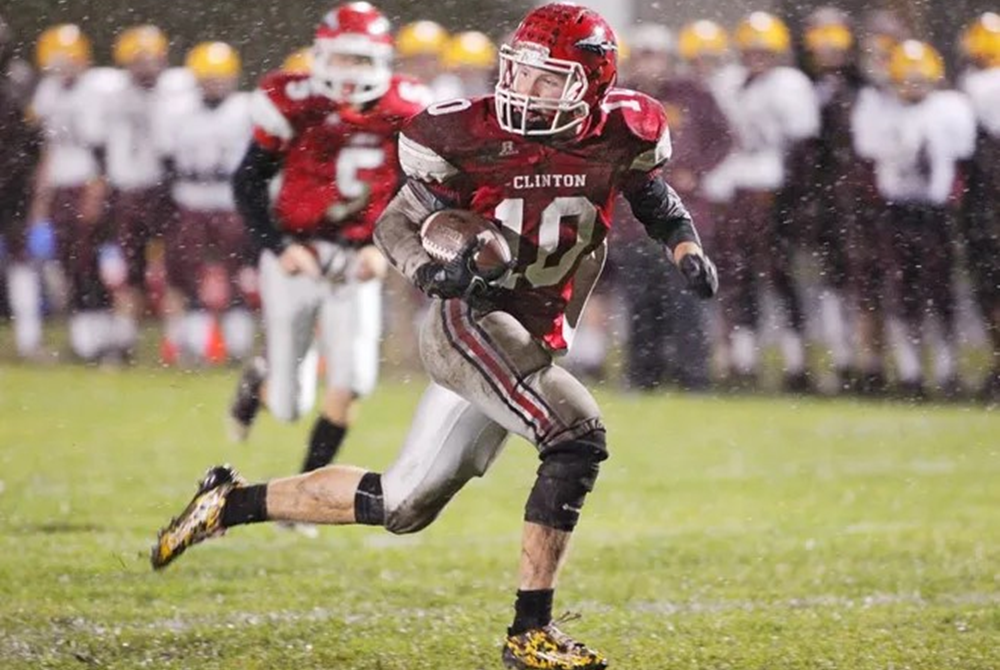
Both times Clinton played in Finals, Mathew Sexton was the star. Sexton would go on to play four years at Eastern Michigan University and has been in multiple NFL training camps and played in the XFL. He’s the league record holder for touchdowns and points scored.
 “I loved being in the TCC,” Sexton said. “It was great competition and was always a blast. Played with some great players, coaches and love the atmosphere each game would bring. Clinton and the TCC made me who I am today. I’m thankful for the experience it gave me.”
Summerfield graduate Jamie LaRocca was an all-state running back in the league, coached in the league and later watched his sons play football in the league as student-athletes at Whiteford.
“There were some great games, great battles,” LaRocca said. “Most of all, it was competitive. Sand Creek was good, Summerfield had good teams and Morenci had some great teams. Different teams always seemed to make their run.”
Britton and Deerfield were two charter members of the TCC, along with Ann Arbor St. Thomas (now known as Ann Arbor Father Gabriel Richard), Summerfield and Adrian Madison. During the 1990s, however, Britton and Deerfield formed a co-op and became Britton-Deerfield. They later officially combined high schools to become Britton Deerfield
BD had a dominating run on the football field in the late 1990s and early 2000s. Among the players who played for BD teams were Dan Musielewicz and Dustin Beurer. Beurer is now the head coach at Division II Northwood University while Musielewicz is head coach at Division III University of Olivet.
Beurer said he remembers as a high school student going to class with others from rivals Sand Creek or Madison at the Lenawee County Vocational Tech school all week, then playing against them on Friday nights.
“I get goosebumps thinking about those days,” he said. “It was small-town football at its finest back in the day.”
Brad Maska, now the head boys basketball coach at Onsted, was the BD quarterback when that team won multiple TCC titles.
“It is sad,” Maska said of the end of the TCC football era. “It truly was a great conference that produced a lot of great teams, coaches, and players throughout the years.
“The best part of the conference was the small-school pride from the communities. Friday night playing at Sand Creek or Whiteford when I was in school was always the only thing going on in town and the communities always got around us, and the atmosphere for small-school football was amazing.”
 Doug Donnelly has served as a sports and news reporter and city editor over 25 years, writing for the Daily Chief-Union in Upper Sandusky, Ohio from 1992-1995, the Monroe Evening News from 1995-2012 and the Adrian Daily Telegram since 2013. He's also written a book on high school basketball in Monroe County and compiles record books for various schools in southeast Michigan. E-mail him at [email protected] with story ideas for Jackson, Washtenaw, Hillsdale, Lenawee and Monroe counties.
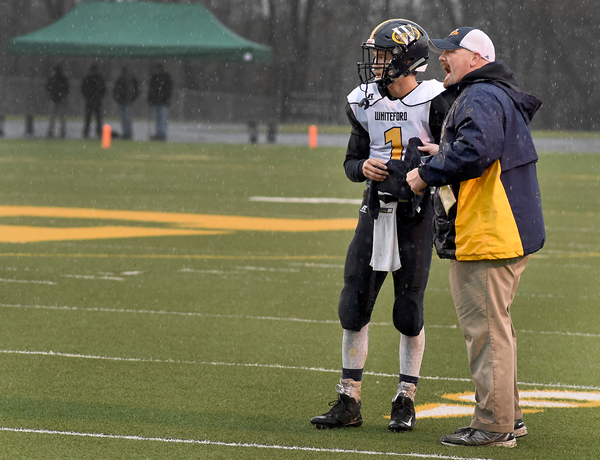
PHOTOS (Top) Clinton’s Mathew Sexton scored more touchdowns in Tri-County Conference games than any player in league history. (Middle) Thomas Eitniear was the quarterback and Jason Mensing head coach at Whiteford when the Bobcats became the first school in Tri-County Conference history to win an MHSAA Finals football championship. (Below) Ernie Ayers coached at Sand Creek for 38 years and won 14 Tri-County Conference championships. (Photos courtesy of the Adrian Daily Telegram and Monroe News.)