

Add, Subtract, Divide, Multiply: MHSAA Not Alone
July 25, 2017
By Rob Kaminski
MHSAA benchmarks editor
This is the third part in a series on MHSAA tournament classification, past and present, that will be published over the next two weeks. This series originally ran in this spring's edition of MHSAA benchmarks.
As the MHSAA faces its most recent classification task with 8-Player Football, and opinions continue to swirl about as to the method, timeframe, location and other procedures, a look around the country provides plenty of company among state association brethren factoring variables into their own equations.
In the Pacific Northwest, the Oregon School Activities Association Football Playoffs are under public scrutiny as leadership ponders a five or six classification format beginning with the 2018-19 school year.
The OSAA has crowned six champions on the gridiron since 2006-07. Many of the state’s smaller schools would like to keep it that way, while larger schools lean toward a five-classification system, citing larger leagues, ease of travel and credibility to state championships as the advantages.
Still others would prefer more than six classes, pointing to safety issues and the opportunity to increase participation numbers as positives.
Moving southeast of Oregon, the Nevada Interscholastic Activities Association recently voted to hold serve on a classification proposal that was volleyed to the membership.
However, changes still could be forthcoming by as early as the 2018-19 season which would add a fifth classification in more populated southern Nevada while allowing northern schools to participate in four classifications. Such divisions could mean no state championship for the fifth class in southern Nevada.
Because of that, the NIAA wants equal numbers of schools in each classification on both ends of the state. Complicating the issue is the fact that the 24 largest schools in the state, by enrollment, are all in Clark County in Southern Nevada.
Across Nevada’s border into Arizona, charter schools are asking the Arizona Interscholastic Association to reconsider classification that was voted upon and approved in September 2015. That agreement called for the largest 33 percent of charter schools by enrollment to be placed in the state’s largest school classification, 3A, the middle 33 percent into 2A, and the smallest 33 percent into 1A.
Less than two years later the charter schools have had a change of heart and have asked to be considered the same as other Arizona public schools and be placed appropriately by enrollment beginning with the 2018-19 school year.
The situation in Arizona further illustrates how the public/private debate that all state associations have faced throughout existence now has the added dynamic of rapidly growing charter schools in today’s educational system, along with virtual school enrollment.
In the nation’s heartland, Nebraska has retooled its football classifications by using enrollment of boys students only in its schools rather than total enrollment. The Nebraska School Activities Association football-playing schools will kick off the 2018 season using this alignment.
Nebraska has three classes of 11-player football, with the smallest class divided in two, Class C-1 and C-2. The state also will have 8-player football for boys enrollments under 47, and the NSAA will sponsor a new 6-player tournament in 2018 for schools with 27 or fewer boys.
“This is a good proposal because some schools have a sizable imbalance between the number of boys and girls, and there’s a large gap (in enrollment) between the largest and smallest schools in Classes A and B,” NSAA executive director Jim Tenopir said. “I think this addresses both of those concerns.”
Swimmers in Georgia, meanwhile, will feel like they are moving with the current, rather than upstream in 2017-18, as the Georgia High School Association recently doubled the number of team championship events from two to four.
Swim enthusiasts can also count on longer days at the finals, as the top 30 finishers from the prelims will advance to the finals instead of 20, and all championship events will have three heats versus two.
Ovid-Elsie Running Legend Darling Seeking to 'Win the Day' on Trading Floor
By
Paul Costanzo
Special for MHSAA.com
August 13, 2024
Maverick Darling’s competitive running days have been behind him for nearly a decade, but the eight-time MHSAA Finals champion from Ovid-Elsie isn’t done competing.
 Darling, who was also a five-time All-American at Wisconsin, is now fighting for wins on the Viking Forest Products lumber trading floor in Minnesota.
“Our trading floor is very unique,” Darling said. “We have 60 traders, and probably 30-35 of them are former student-athletes in college. It’s very competitive, but kind of like a locker room. It’s kind of a unique way for me to still be competitive even though I’m not in athletics. I really love it.”
Darling is a commodity trader at Viking Forest, trading mostly OSB, plywood and dimensional lumber to buyers throughout the United States. He lives with his fiancé Danielle and their two dogs in Plymouth, Minn., a suburb of Minneapolis.
Lessons learned while working toward Finals titles on the dirt roads of Ovid and national goals on the trails of Madison, Wis., are helping him find success again.
“My lessons I learned from running and the reward, whether good, great or OK, is that no matter the day, you have to go put in the effort and work, and it carries over to my work,” he said. “I now literally start over every day. We had a saying: ‘Win the day.’ And ‘Win the day’ kind of means something different for every day. I try to apply that to my life. It’s motivating to be successful every day.”
Friendly competition between teammates leading to greater success also carried over from cross country and track to the trading floor.
“We have a department where it feels almost like my cross country team in college,” he said. “One guy will put up 30 orders that day, and we’re all happy for that person. The synergy between the group is awesome. But it motivates me to be like, tomorrow that’s going to be me.”
Darling had spent his first three years out of Wisconsin running professionally and had coaching stops at Iona and Cal-Berkeley after that. But when the pandemic hit, he stepped away from coaching and made the move to trading.
 That ended a spectacular career in the sport, which was actually second choice for most of Darling’s childhood.
Growing up, he was a top snowmobile racer, along with his brother.
“My first (high school) cross country race, I took seventh,” Darling said. “I didn’t know better, but that’s pretty good. My mom was like, ‘Seventh? You know, we’re used to first or second (in snowcross).’ We’re not a running family. I started at about 18 minutes in the 5K, and at the state meet I finished eighth and ran 16:13. I was like, ‘OK, maybe this is something I can really be good at.’”
It was at the end of his junior year, after winning his heat at the Nike Outdoor Nationals, that Darling turned his entire focus to running. By that time, he had already won two Division 3 cross country titles, two 3,200-meter titles and one 1,600 at MHSAA Finals.
He was training often, but knew he was undertrained because of the limitations on where and when he could run during mid-Michigan winters. Colleges knew it, too, and that led to a barrage of communication as soon as they were able to reach out.
“I probably had 150 of those (hand-written letters) sent to the house,” Darling said. “I would get two to three phone calls a night after July 1. It wasn’t like overwhelming, because I was pretty confident at that point where I wanted to go to school.”
Darling committed to Wisconsin on the day of the Lower Peninsula Cross Country Finals his senior year. He also won his third Finals title that day with a then-Division 3 record time of 14:52. At the time, it was the third fastest time ever run in Michigan.
He would later win his second straight 1,600/3,200 double at the Track & Field Finals, running 8:58 in the 3,200 during the season, which was the 12th-best high school time in the country that year.
The choice to go to Wisconsin was based on his drive to be challenged as much as possible.
“I thought, ‘If I come into this room, I’m probably the eighth or ninth best runner in this room – maybe,’” Darling said. “I had such a great recruiting trip. I grew up in Ovid, and everything I ran there was pretty much dirt roads. Wisconsin has a lot of dirt trails, and I kind of loved that. I could run from our locker room and be on a trail in a mile, mile and a half.”
 Darling’s collegiate career proved he had made the right decision. He was the Big Ten Freshman of the Year for the 2009 cross country season, and an All-American in 2010 and 2012. He was a three-time All-American in track, as well.
The Badgers also had massive team success during Darling’s tenure, winning a cross country national title in 2011, four Big Ten cross country titles and two Big Ten track & field titles.
Darling was surrounded by great runners throughout his time in Madison, including close friend Mohammed Ahmed, who finished fourth in the 10,000 meters at this Olympics, one spot behind another Michigan distance star, Grand Blanc’s Grant Fisher.
Watching the results of a distance boom he was a big part of has been a joy for Darling this summer.
“I thought I was pretty good, then watching these guys – it’s jealousy,” he said with a laugh. “And also, it’s just cool to see. Michigan is one of the best distance states men’s and women’s-wise. It’s great to see them not only be on the international level, but to have that success.”
2024 Made In Michigan
August 8: Shores Star Walker Continues Drive for Hoops Greatness as College Coach - Read
August 6: MCC's Glover Fills Key Role as Athletic Trainer for Super Bowl Champions - Read
August 1: Lessons from Multi-Sport Experience Guide Person in Leading New Team - Read
July 30: After Successful 'Sequel,' Suttons Bay's Hursey Embarking on Next Chapter - Read
July 24: East Kentwood Run Part of Memorable Start on Knuble's Way to NHL, Olympics - Read
July 22: Monroe High Memories Remain Rich for Michigan's 1987 Mr. Baseball - Read
July 17: Record-Setting Viney Gained Lifelong Confidence at Marine City - Read
July 11: High School 'Hoop Squad' Close to Heart as Hughes Continues Coaching Climb - Read
July 10: Nightingale Embarking on 1st Season as College Football Head Coach - Read
June 28: E-TC's Witt Bulldozing Path from Small Town to Football's Biggest Stage - Read
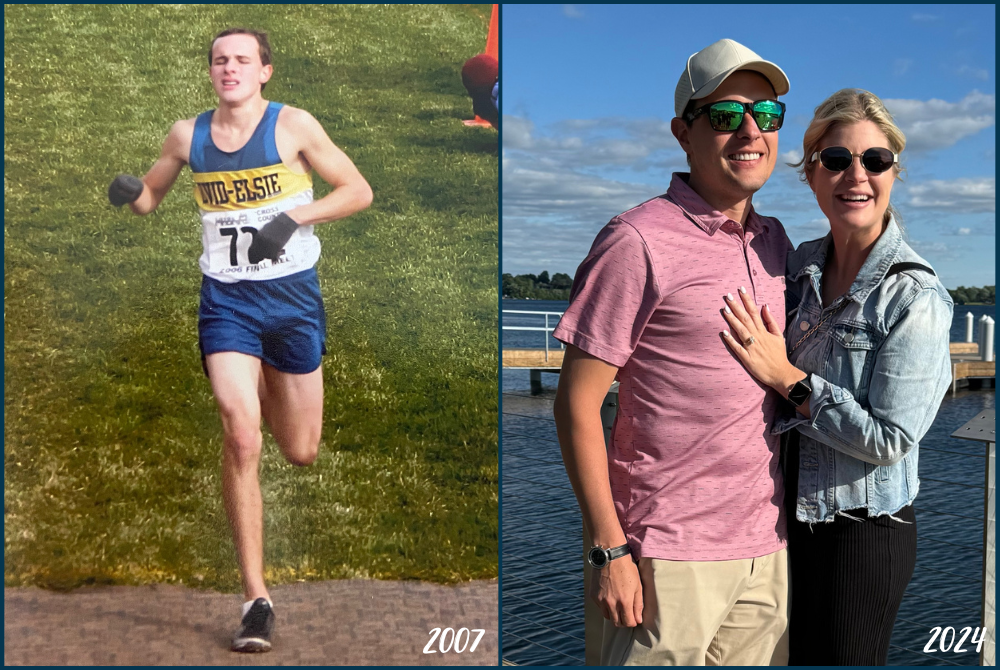
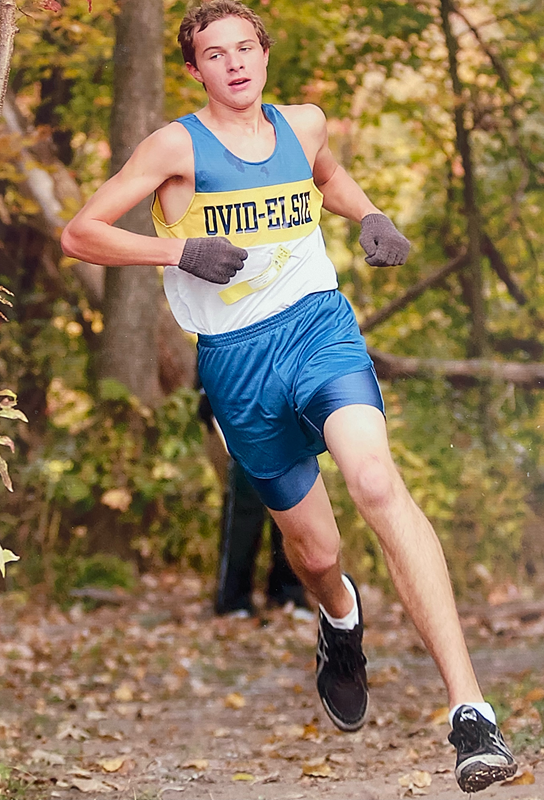
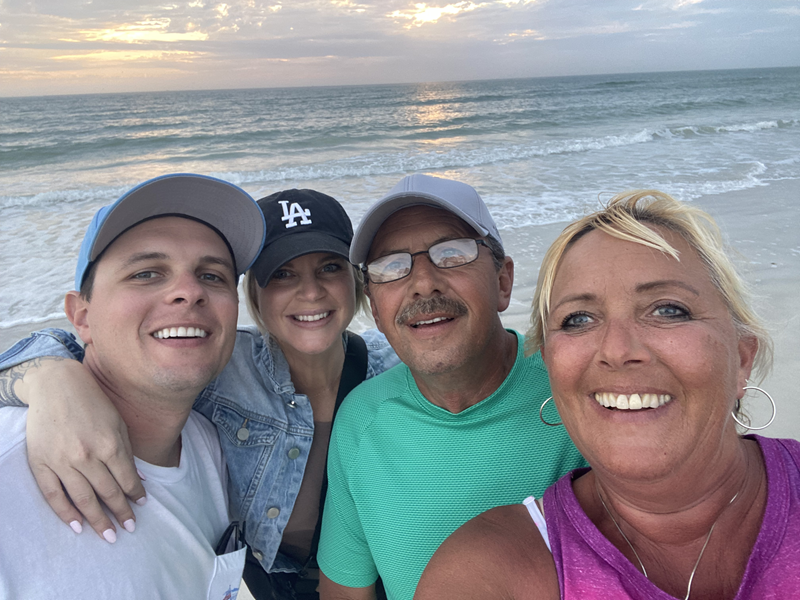
PHOTOS (Top) At left, Maverick Darling crosses the finish line during a race as an Ovid-Elsie senior in 2007; at right Darling poses with fiancé Danielle. (Middle) Darling rounds a turn during a high school race. (Below) Darling and Danielle enjoy a sunset over the water with her parents. (Photos courtesy of Maverick Darling.)