

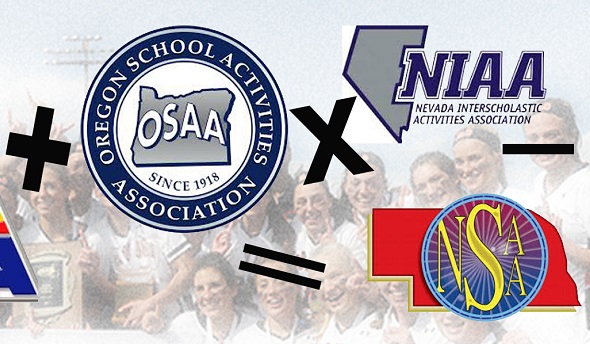
Add, Subtract, Divide, Multiply: MHSAA Not Alone
July 25, 2017
By Rob Kaminski
MHSAA benchmarks editor
This is the third part in a series on MHSAA tournament classification, past and present, that will be published over the next two weeks. This series originally ran in this spring's edition of MHSAA benchmarks.
As the MHSAA faces its most recent classification task with 8-Player Football, and opinions continue to swirl about as to the method, timeframe, location and other procedures, a look around the country provides plenty of company among state association brethren factoring variables into their own equations.
In the Pacific Northwest, the Oregon School Activities Association Football Playoffs are under public scrutiny as leadership ponders a five or six classification format beginning with the 2018-19 school year.
The OSAA has crowned six champions on the gridiron since 2006-07. Many of the state’s smaller schools would like to keep it that way, while larger schools lean toward a five-classification system, citing larger leagues, ease of travel and credibility to state championships as the advantages.
Still others would prefer more than six classes, pointing to safety issues and the opportunity to increase participation numbers as positives.
Moving southeast of Oregon, the Nevada Interscholastic Activities Association recently voted to hold serve on a classification proposal that was volleyed to the membership.
However, changes still could be forthcoming by as early as the 2018-19 season which would add a fifth classification in more populated southern Nevada while allowing northern schools to participate in four classifications. Such divisions could mean no state championship for the fifth class in southern Nevada.
Because of that, the NIAA wants equal numbers of schools in each classification on both ends of the state. Complicating the issue is the fact that the 24 largest schools in the state, by enrollment, are all in Clark County in Southern Nevada.
Across Nevada’s border into Arizona, charter schools are asking the Arizona Interscholastic Association to reconsider classification that was voted upon and approved in September 2015. That agreement called for the largest 33 percent of charter schools by enrollment to be placed in the state’s largest school classification, 3A, the middle 33 percent into 2A, and the smallest 33 percent into 1A.
Less than two years later the charter schools have had a change of heart and have asked to be considered the same as other Arizona public schools and be placed appropriately by enrollment beginning with the 2018-19 school year.
The situation in Arizona further illustrates how the public/private debate that all state associations have faced throughout existence now has the added dynamic of rapidly growing charter schools in today’s educational system, along with virtual school enrollment.
In the nation’s heartland, Nebraska has retooled its football classifications by using enrollment of boys students only in its schools rather than total enrollment. The Nebraska School Activities Association football-playing schools will kick off the 2018 season using this alignment.
Nebraska has three classes of 11-player football, with the smallest class divided in two, Class C-1 and C-2. The state also will have 8-player football for boys enrollments under 47, and the NSAA will sponsor a new 6-player tournament in 2018 for schools with 27 or fewer boys.
“This is a good proposal because some schools have a sizable imbalance between the number of boys and girls, and there’s a large gap (in enrollment) between the largest and smallest schools in Classes A and B,” NSAA executive director Jim Tenopir said. “I think this addresses both of those concerns.”
Swimmers in Georgia, meanwhile, will feel like they are moving with the current, rather than upstream in 2017-18, as the Georgia High School Association recently doubled the number of team championship events from two to four.
Swim enthusiasts can also count on longer days at the finals, as the top 30 finishers from the prelims will advance to the finals instead of 20, and all championship events will have three heats versus two.
Robichaud's Wheatley Inducted Into NFHS Hall of Fame, Speaks for Class of 2024
By
Geoff Kimmerly
MHSAA.com senior editor
August 1, 2024
BOSTON — Tyrone Wheatley on July 1 became the 10th Michigan honoree to be inducted into the National High School Hall of Fame by the National Federation of State High School Associations (NFHS) – and in addition to that honor, was selected to speak on behalf of the 12-member class during the induction ceremony in Boston.
The now-Wayne State University football coach surely is best known as a star running back for University of Michigan who went on to play 10 seasons in the NFL for the New York Giants and Oakland Raiders. Wheatley did lead his Robichaud football team to the Class B championship in 1990 and earned a Parade All-America honor, running over three seasons for a combined 4,257 yards and 67 touchdowns, including 2,010 yards and 33 scores on 208 carries as a senior in 1990 – the latter despite playing quarterback half of that season.
But Wheatley also is arguably most glorified in Michigan high school athletics for his accomplishments on the track, where as a junior in 1990 he became the first (of still only two) athletes to win four individual events at an MHSAA Lower Peninsula Finals – placing first in the 100 and 200-meter dashes, 110-meter hurdles and long jump. He led Robichaud to the Class B team title that day, scoring 40 of its 49 points. Wheatley completed his high school career in 1991 with three more Class B individual track & field championships and nine total over his final three seasons; he was injured in the 100 during that senior-year meet and could not run his final race to attempt another four-title day.
Wheatley also was a standout on the basketball court for Robichaud, averaging 14 points and 16 rebounds per game as a senior in earning all-state recognition in that sport as well.
He returned to Robichaud as its varsity football coach in 2007 and led that team to a 9-2 record and the MHSAA Playoffs for the first time since 1994. He then served as an assistant football coach at four college programs including U-M and Syracuse, and with the Buffalo Bills, Jacksonville Jaguars and Denver Broncos. He also served as Morgan State University's head coach from 2019-21 and just completed his first season as head coach at Wayne State.
The video above was shown as an introduction before Wheatley was awarded his Hall of Fame plaque and medal during the induction ceremony. Below, he speaks for the Class of 2024.
Previous Michigan inductees to the National High School Hall of Fame
2022: John E. "Jack" Roberts, MHSAA - Watch
2016: Ken Beardslee, Vermontville Maple Valley - Watch
2011: Brad Van Pelt, Owosso
2007: Jim Johnson, Bloomfield Hills Cranbrook
2005: Bob Wood, Grosse Pointe Woods University Liggett
2001: Richie Jordan, Fennville
2000: Diane Laffey, Warren Regina
1986: Lofton Greene, River Rouge
1983: Charles E. Forsythe, MHSAA