

Add, Subtract, Divide, Multiply: MHSAA Not Alone
July 25, 2017
By Rob Kaminski
MHSAA benchmarks editor
This is the third part in a series on MHSAA tournament classification, past and present, that will be published over the next two weeks. This series originally ran in this spring's edition of MHSAA benchmarks.
As the MHSAA faces its most recent classification task with 8-Player Football, and opinions continue to swirl about as to the method, timeframe, location and other procedures, a look around the country provides plenty of company among state association brethren factoring variables into their own equations.
In the Pacific Northwest, the Oregon School Activities Association Football Playoffs are under public scrutiny as leadership ponders a five or six classification format beginning with the 2018-19 school year.
The OSAA has crowned six champions on the gridiron since 2006-07. Many of the state’s smaller schools would like to keep it that way, while larger schools lean toward a five-classification system, citing larger leagues, ease of travel and credibility to state championships as the advantages.
Still others would prefer more than six classes, pointing to safety issues and the opportunity to increase participation numbers as positives.
Moving southeast of Oregon, the Nevada Interscholastic Activities Association recently voted to hold serve on a classification proposal that was volleyed to the membership.
However, changes still could be forthcoming by as early as the 2018-19 season which would add a fifth classification in more populated southern Nevada while allowing northern schools to participate in four classifications. Such divisions could mean no state championship for the fifth class in southern Nevada.
Because of that, the NIAA wants equal numbers of schools in each classification on both ends of the state. Complicating the issue is the fact that the 24 largest schools in the state, by enrollment, are all in Clark County in Southern Nevada.
Across Nevada’s border into Arizona, charter schools are asking the Arizona Interscholastic Association to reconsider classification that was voted upon and approved in September 2015. That agreement called for the largest 33 percent of charter schools by enrollment to be placed in the state’s largest school classification, 3A, the middle 33 percent into 2A, and the smallest 33 percent into 1A.
Less than two years later the charter schools have had a change of heart and have asked to be considered the same as other Arizona public schools and be placed appropriately by enrollment beginning with the 2018-19 school year.
The situation in Arizona further illustrates how the public/private debate that all state associations have faced throughout existence now has the added dynamic of rapidly growing charter schools in today’s educational system, along with virtual school enrollment.
In the nation’s heartland, Nebraska has retooled its football classifications by using enrollment of boys students only in its schools rather than total enrollment. The Nebraska School Activities Association football-playing schools will kick off the 2018 season using this alignment.
Nebraska has three classes of 11-player football, with the smallest class divided in two, Class C-1 and C-2. The state also will have 8-player football for boys enrollments under 47, and the NSAA will sponsor a new 6-player tournament in 2018 for schools with 27 or fewer boys.
“This is a good proposal because some schools have a sizable imbalance between the number of boys and girls, and there’s a large gap (in enrollment) between the largest and smallest schools in Classes A and B,” NSAA executive director Jim Tenopir said. “I think this addresses both of those concerns.”
Swimmers in Georgia, meanwhile, will feel like they are moving with the current, rather than upstream in 2017-18, as the Georgia High School Association recently doubled the number of team championship events from two to four.
Swim enthusiasts can also count on longer days at the finals, as the top 30 finishers from the prelims will advance to the finals instead of 20, and all championship events will have three heats versus two.
After Successful 'Sequel,' Suttons Bay's Hursey Embarking on Next Chapter
By
Tom Spencer
Special for MHSAA.com
July 30, 2024
Thomas Hursey’s story is a Hollywood writer’s dream. He really is the stuff of sequels.
 He could star in a remake of “Hoosiers” – titled in the singular as just “The Hoosier” – or maybe “Against All Odds II” is more fitting.
Hursey is a 2018 graduate of Suttons Bay High School. He was in a class of just 30 students. He grew up where there is snow on the ground, many argue, for six months of the year. He never played an Amateur Junior Golf Association tournament. And, he had zero scholarship offers from Division I colleges.
To top it off, basketball was his favorite sport in high school. It still is today.
Hursey, who admits he pretty much hated golf, switched his focus from the basketball court to the links midway through high school. He gave up on playing college basketball despite scoring 1,200 points during his career and achieving all-state status.
As a high school freshman, he helped a team comprised of only senior teammates win the Lower Peninsula Division 4 golf championship. He earned all-state in golf too and did receive a scholarship offer from Division II Ferris State University. He took it and excelled there.
So maybe his movie would be titled “The Bulldog.” Again, as a freshman at FSU, he had only senior teammates – and he was named Great Lakes Intercollegiate Athletic Conference Freshman of the Year.
Hursey went on to pick up individual titles and conference player of the year awards as he led the Bulldogs to GLIAC championships and trips to the NCAA Division II Tournament.
Today, many say Hursey could make a run at the PGA Tour – and they may wonder why he doesn’t. Instead, he is about to join a Philadelphia-based pharmaceutical company and put his science and business background to work.
He has a biology degree from Ferris and a master’s in business from Indiana University. He has no interest in playing an individual sport after his stellar high school team sports career at Suttons Bay. His preference is to work hard with teammates and relish a leadership role similar to the one he had playing for the Norsemen in golf, basketball and tennis and while running cross country.
“I am much more of a team-sport guy,” Hursey explained. “I can’t really get the same motivation when it’s just an individual tournament – I need to be surrounded by team.”
Unlike most Big Ten golfers, professional golf was never really on Hursey‘s mind. Veteran IU golf coach Mike Mayer believes Hursey is capable of continuing his golf career, but respects his decision to take another path.
“Thomas was a gift to us,” Mayer said. “Very truthfully, Thomas Hursey might very well be at the top of the list as a great athlete, and great golfer, but more importantly a great person.
“I have had a lot of great student-athletes and you don’t rank them, but at the same time you know which ones stand out,” Mayer continued. “And Thomas Hursey simply stands out.”
Hursey’s parents are former college athletes, retired teachers and longtime high school sports coaches. His father Todd was his high school coach and is now the golf coach at Traverse City West. His mother Nicki was the Suttons Bay softball coach and coached siblings Laura and Jane on the softball field, where they became all-staters as well. Jane, a 2015 Suttons Bay graduate, was also an all-state basketball player. Laura, a 2020 grad, also starred in volleyball.
Thomas Hursey had a reputation as a nice competitor, and his parents treasure that even more than the success he found in high school and college sports.
“I always, and so did Todd, looked out more and hounded him be humble more than anything,” Nicki said. “He had talent and God-given gifts, but what made me so proud was just the way he acted on the course and the number of parents that come up to me and say what a wonderful son you have.”
Mayer, too, proudly recalls Thomas’ politeness and humility.
“As a coach, that’s at least as equally, if not more than rewarding than winning,” he said.
Mayer admits he secretly wishes Hursey would try pursuing professional golf, but respects his decision to end his golf career while it was still a team sport.
“Thomas Hursey has the athletic ability to play professional golf,” Mayer confirmed. “I fully understand his decision – he is going to be successful in whatever he chooses to do.”
Hursey had four top-20 and two top-10 outings for IU during his last season, including an 18th place finish at the Big Ten Championship. During his career at IU, Hursey was named a Big Ten Distinguished Scholar, a Big Ten Sportsmanship Honoree and to the academic all-Big Ten team.
Hursey’s first love was basketball. He’s a fan of the Indiana Hoosiers program and became quite familiar over the years with Michigan State University coach Tom Izzo and his son, Steven.
 The Izzo connection started when Michigan State was recruiting Dwaun Anderson, a Suttons Bay graduate and the Mr. Basketball Award winner in 2011.
Hursey recalls all the hardest practices in basketball as he hoped to someday play at the college level. He had a tremendous work ethic on the court, and it helped his transition to golf.
Even though golf is the most difficult sport he’s taken on, Hursey mastered it more easily because of his desire to get better and not let anything get in the way of success.
“The chip on my shoulder – the grit I had – I think that helped me get to the next level in golf,” Hursey noted. “I really never felt I was as good as I was – I still don’t think I am.
“People tell me I’m good at golf, and I just don’t believe that because I just have this hunger to get better,” Hursey continued. “I am my biggest critic.”
Hursey quickly added he benefitted from two other critics – his sisters. He’s admitted he believes they possess more athleticism than he does.
“They always pushed me to get better, and they always pushed me to work harder,” he said. “They are kind of no-nonsense people.
“Growing up I never got more encouragement from them as much as I did critiquing,” he continued. “That was huge in terms of molding me.”
Hursey’s accomplishments are not at the top of the minds of his parents and former athletic director.
“I always say I am excited about the things he accomplished, but I am proud of the way he is as a person,” Todd Hursey said. “I am proud of how he is and how he handled himself.”
Retired Suttons Bay athletics director, Doug Periard agrees. He watched Hursey’s work ethic develop early and found him regularly at open gyms. Periard also singled out Hursey’s sportsmanship.
“I cannot think of a discouraging word the young man ever said to a teammate or opponent,” Periard said. “He was able to demonstrate both sportsmanship and leadership in defeat, and also in victory.”
2024 Made In Michigan
July 24: East Kentwood Run Part of Memorable Start on Knuble's Way to NHL, Olympics - Read
July 22: Monroe High Memories Remain Rich for Michigan's 1987 Mr. Baseball - Read
July 17: Record-Setting Viney Gained Lifelong Confidence at Marine City - Read
July 11: High School 'Hoop Squad' Close to Heart as Hughes Continues Coaching Climb - Read
July 10: Nightingale Embarking on 1st Season as College Football Head Coach - Read
June 28: E-TC's Witt Bulldozing Path from Small Town to Football's Biggest Stage - Read
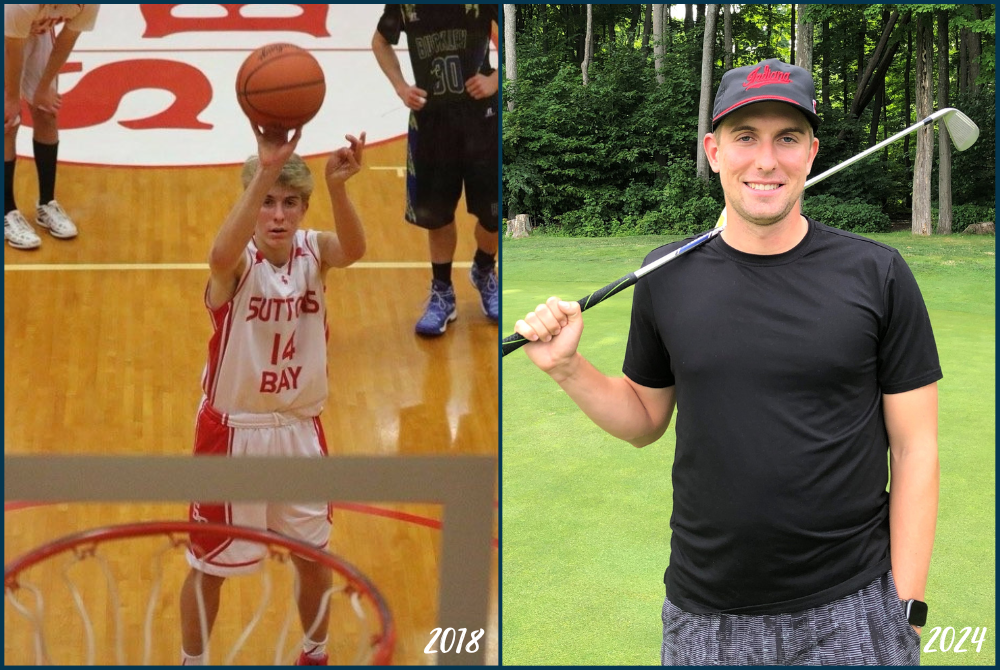
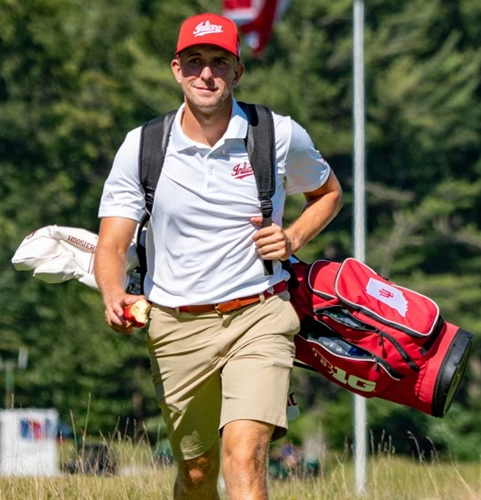
PHOTOS (Top) At left, Suttons Bay's Thomas Hursey prepares to shoot a free throw during his senior season, and at right Hursey remains at home on the golf course. (Middle) Hursey grabs a quick snack during a round while golfing for Indiana. (Below) Hursey, recently, with his parents Nicki and Todd. (Recent photos by Tom Spencer; Indiana and Suttons Bay photos courtesy of the Hursey family.)