

Add, Subtract, Divide, Multiply: MHSAA Not Alone
July 25, 2017
By Rob Kaminski
MHSAA benchmarks editor
This is the third part in a series on MHSAA tournament classification, past and present, that will be published over the next two weeks. This series originally ran in this spring's edition of MHSAA benchmarks.
As the MHSAA faces its most recent classification task with 8-Player Football, and opinions continue to swirl about as to the method, timeframe, location and other procedures, a look around the country provides plenty of company among state association brethren factoring variables into their own equations.
In the Pacific Northwest, the Oregon School Activities Association Football Playoffs are under public scrutiny as leadership ponders a five or six classification format beginning with the 2018-19 school year.
The OSAA has crowned six champions on the gridiron since 2006-07. Many of the state’s smaller schools would like to keep it that way, while larger schools lean toward a five-classification system, citing larger leagues, ease of travel and credibility to state championships as the advantages.
Still others would prefer more than six classes, pointing to safety issues and the opportunity to increase participation numbers as positives.
Moving southeast of Oregon, the Nevada Interscholastic Activities Association recently voted to hold serve on a classification proposal that was volleyed to the membership.
However, changes still could be forthcoming by as early as the 2018-19 season which would add a fifth classification in more populated southern Nevada while allowing northern schools to participate in four classifications. Such divisions could mean no state championship for the fifth class in southern Nevada.
Because of that, the NIAA wants equal numbers of schools in each classification on both ends of the state. Complicating the issue is the fact that the 24 largest schools in the state, by enrollment, are all in Clark County in Southern Nevada.
Across Nevada’s border into Arizona, charter schools are asking the Arizona Interscholastic Association to reconsider classification that was voted upon and approved in September 2015. That agreement called for the largest 33 percent of charter schools by enrollment to be placed in the state’s largest school classification, 3A, the middle 33 percent into 2A, and the smallest 33 percent into 1A.
Less than two years later the charter schools have had a change of heart and have asked to be considered the same as other Arizona public schools and be placed appropriately by enrollment beginning with the 2018-19 school year.
The situation in Arizona further illustrates how the public/private debate that all state associations have faced throughout existence now has the added dynamic of rapidly growing charter schools in today’s educational system, along with virtual school enrollment.
In the nation’s heartland, Nebraska has retooled its football classifications by using enrollment of boys students only in its schools rather than total enrollment. The Nebraska School Activities Association football-playing schools will kick off the 2018 season using this alignment.
Nebraska has three classes of 11-player football, with the smallest class divided in two, Class C-1 and C-2. The state also will have 8-player football for boys enrollments under 47, and the NSAA will sponsor a new 6-player tournament in 2018 for schools with 27 or fewer boys.
“This is a good proposal because some schools have a sizable imbalance between the number of boys and girls, and there’s a large gap (in enrollment) between the largest and smallest schools in Classes A and B,” NSAA executive director Jim Tenopir said. “I think this addresses both of those concerns.”
Swimmers in Georgia, meanwhile, will feel like they are moving with the current, rather than upstream in 2017-18, as the Georgia High School Association recently doubled the number of team championship events from two to four.
Swim enthusiasts can also count on longer days at the finals, as the top 30 finishers from the prelims will advance to the finals instead of 20, and all championship events will have three heats versus two.
High School 'Hoop Squad' Close to Heart as Hughes Continues Coaching Climb
By
Keith Dunlap
Special for MHSAA.com
July 11, 2024
Jareica Hughes had a Hall of Fame collegiate basketball career playing at University of Texas-El Paso and has played professionally overseas, but her most prized possession is something she earned playing high school basketball in Michigan.
 A standout at now-closed Southfield-Lathrup High School during the early-to-mid 2000s, Hughes proudly displays a signature symbol of Lathrup’s Class A championship team in 2005.
“I have my state championship ring on me right now,” said Hughes, now an assistant head coach for the women’s basketball program at UTEP. “I wear this ring every single day. Not so much for the basketball aspect. Inside of the ring it says ‘Hoop Squad.’ It’s more the connection I’ve had with those particular young ladies. Friends that I’ve known since I was kid. Every once in a while when we talk, we go back in time.”
Believe it or not, Hughes and her high school teammates next year will have to go back 20 years to commemorate a run to the title that started when they were freshmen.
It was a gradual build-up to what was the first girls basketball state championship won by a public school in Oakland County. Lathrup, which has since merged with the former Southfield High School to form Southfield Arts & Technology, remained the only public school in Oakland County to win a state girls basketball title until West Bloomfield did so in 2022 and again this past March.
Lathrup lost in the District round to Bloomfield Hills Marian during Hughes’ freshman year, and then after defeating Marian in a District Final a year later, lost to West Bloomfield in a Regional Final.
When Hughes was a junior, the team got to the state’s final four, but a bad third quarter resulted in a heartbreaking one-point Semifinal loss to eventual champion Lansing Waverly.
A year later, when Hughes and other core players such as Brittane Russell, Timika Williams, Dhanmite’ Slappey and Briana Whitehead were seniors, they finished the job and won the Class A crown with a 48-36 win over Detroit Martin Luther King in the Final.
However, the signature moment of that title run actually came during the Semifinal round and was produced by Hughes, a playmaking wizard at point guard who made the team go.
Trailing by three points during the waning seconds of regulation against Grandville and Miss Basketball winner Allyssa DeHaan – a dominant 6-foot-8 center – Hughes drained a tying 3-pointer from the wing that was well beyond the 3-point line.
Lathrup went on to defeat Grandville in overtime and prevail against King.
Hughes said the year prior, she passed up on taking a potential winning or tying shot in the Semifinal loss against Waverly, and was reminded of that constantly by coaches and teammates. “I just remember in the huddle before that shot, that just kept ringing in my mind,” she said. “That was special. I cried for weeks not being able to get a shot off (the year before) and leaving the tournament like that.”
Growing up in Detroit, Hughes got into basketball mainly because she had five older brothers and an older sister who played the game. In particular, Hughes highlights older brother Gabriel for getting her into the game and taking her from playground to playground.
“I’m from Detroit,” she said. “We played ball all day long. Sunup to sundown. When the light comes on, you had to run your butt into the house.”
 Hughes played for the Police Athletic League and also at the famed St. Cecilia gym in the summer, developing her game primarily against boys.
“My first team was on a boys team,” she said. “I was a captain on a boys team.”
The family moved into Lathrup’s district before she began high school.
Once she helped lead Lathrup to the 2005 championship, she went on to a fine career at UTEP, where she was the Conference USA Player of the Year twice and helped lead the Miners to their first NCAA Tournament appearance.
Hughes still holds school records for career assists (599), steals (277) and minutes played (3,777). On Monday, she was named to Conference USA’s 2024 Hall of Fame class.
After a brief professional career overseas was derailed by a shoulder injury, Hughes said getting into coaching was a natural fit.
“I had to make the hard decision, and I knew as a kid I wanted to be around basketball,” she said. “Once I made that decision (to quit), I knew I was going to coach.”
Hughes started coaching in the Detroit area, first serving as an assistant at Southfield A&T from 2016-20 and then at Birmingham Groves for a season. She then served as interim head coach at Colby Community College in Kansas before being named an assistant at UTEP in May 2023, a month after her former coach Keitha Adams returned to lead the program after six seasons at Wichita State.
While fully immersed in her job with UTEP, Hughes’ high school memories in Michigan certainly aren’t going away anytime soon – especially with the 20th anniversary of Lathrup’s championship coming up.
“We are still close friends because we all essentially grew up together,” she said. “They are still my friends to this day.”
2024 Made In Michigan
July 10: Nightingale Embarking on 1st Season as College Football Head Coach - Read
June 28: E-TC's Witt Bulldozing Path from Small Town to Football's Biggest Stage - Read
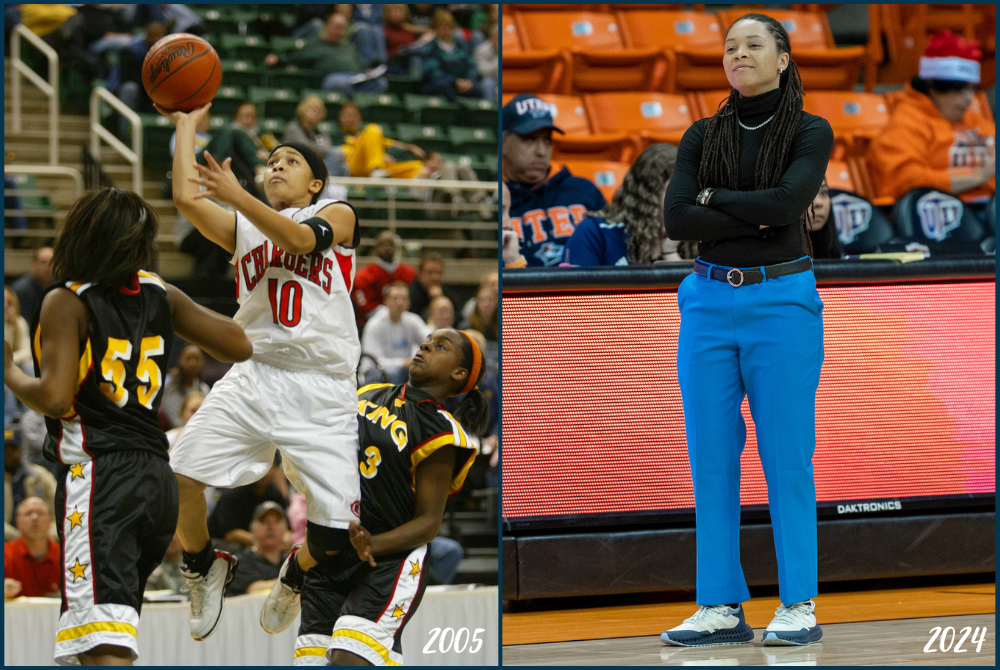
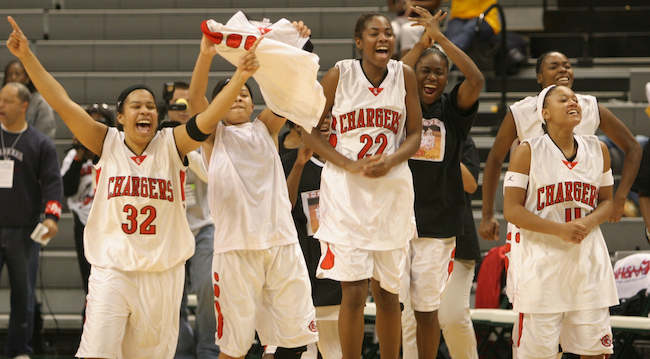
PHOTOS (Top) At left, Southfield-Lathrup’s Jareica Hughes drives to the basket against Detroit Martin Luther King during the 2005 Class A Final; at right, Hughes coaches this past season at UTEP. (Middle) Hughes, second from left, begins the championship celebration with her Lathrup teammates at Breslin Center. (UTEP photo courtesy of the UTEP sports information department.)