

Add, Subtract, Divide, Multiply: MHSAA Not Alone
July 25, 2017
By Rob Kaminski
MHSAA benchmarks editor
This is the third part in a series on MHSAA tournament classification, past and present, that will be published over the next two weeks. This series originally ran in this spring's edition of MHSAA benchmarks.
As the MHSAA faces its most recent classification task with 8-Player Football, and opinions continue to swirl about as to the method, timeframe, location and other procedures, a look around the country provides plenty of company among state association brethren factoring variables into their own equations.
In the Pacific Northwest, the Oregon School Activities Association Football Playoffs are under public scrutiny as leadership ponders a five or six classification format beginning with the 2018-19 school year.
The OSAA has crowned six champions on the gridiron since 2006-07. Many of the state’s smaller schools would like to keep it that way, while larger schools lean toward a five-classification system, citing larger leagues, ease of travel and credibility to state championships as the advantages.
Still others would prefer more than six classes, pointing to safety issues and the opportunity to increase participation numbers as positives.
Moving southeast of Oregon, the Nevada Interscholastic Activities Association recently voted to hold serve on a classification proposal that was volleyed to the membership.
However, changes still could be forthcoming by as early as the 2018-19 season which would add a fifth classification in more populated southern Nevada while allowing northern schools to participate in four classifications. Such divisions could mean no state championship for the fifth class in southern Nevada.
Because of that, the NIAA wants equal numbers of schools in each classification on both ends of the state. Complicating the issue is the fact that the 24 largest schools in the state, by enrollment, are all in Clark County in Southern Nevada.
Across Nevada’s border into Arizona, charter schools are asking the Arizona Interscholastic Association to reconsider classification that was voted upon and approved in September 2015. That agreement called for the largest 33 percent of charter schools by enrollment to be placed in the state’s largest school classification, 3A, the middle 33 percent into 2A, and the smallest 33 percent into 1A.
Less than two years later the charter schools have had a change of heart and have asked to be considered the same as other Arizona public schools and be placed appropriately by enrollment beginning with the 2018-19 school year.
The situation in Arizona further illustrates how the public/private debate that all state associations have faced throughout existence now has the added dynamic of rapidly growing charter schools in today’s educational system, along with virtual school enrollment.
In the nation’s heartland, Nebraska has retooled its football classifications by using enrollment of boys students only in its schools rather than total enrollment. The Nebraska School Activities Association football-playing schools will kick off the 2018 season using this alignment.
Nebraska has three classes of 11-player football, with the smallest class divided in two, Class C-1 and C-2. The state also will have 8-player football for boys enrollments under 47, and the NSAA will sponsor a new 6-player tournament in 2018 for schools with 27 or fewer boys.
“This is a good proposal because some schools have a sizable imbalance between the number of boys and girls, and there’s a large gap (in enrollment) between the largest and smallest schools in Classes A and B,” NSAA executive director Jim Tenopir said. “I think this addresses both of those concerns.”
Swimmers in Georgia, meanwhile, will feel like they are moving with the current, rather than upstream in 2017-18, as the Georgia High School Association recently doubled the number of team championship events from two to four.
Swim enthusiasts can also count on longer days at the finals, as the top 30 finishers from the prelims will advance to the finals instead of 20, and all championship events will have three heats versus two.
Healthy Tomlinson Gives Portage Northern Major Reason to Dream Big
By
Pam Shebest
Special for MHSAA.com
May 14, 2024
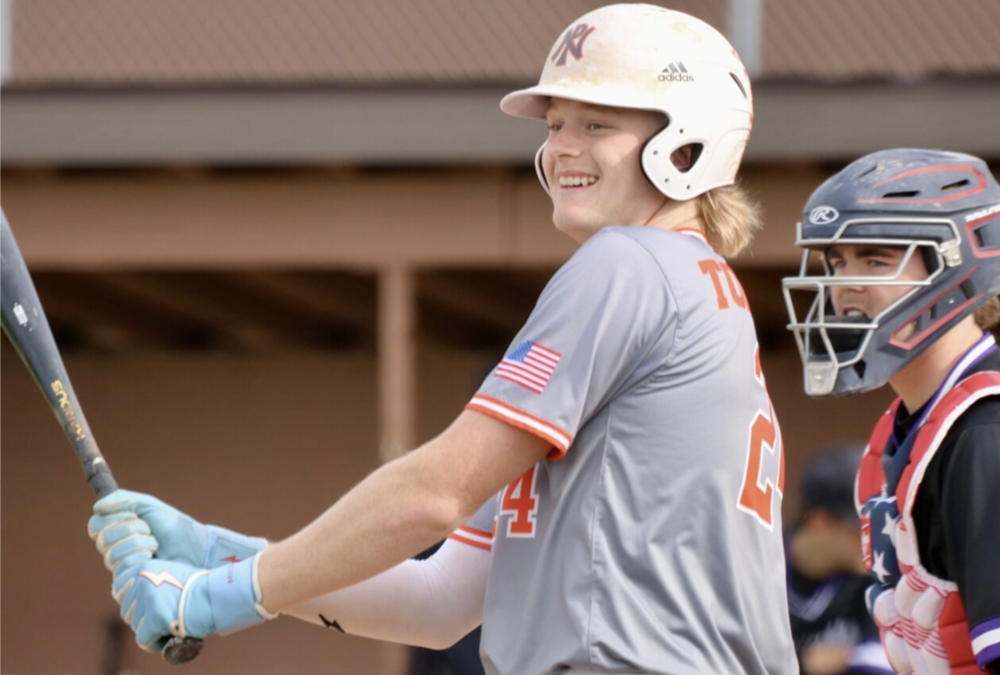
PORTAGE – Ty Tomlinson ended last season as a member of the Michigan High School Baseball Coaches Association all-state Dream Team.
 This season began as more of a nightmare for the Portage Northern senior.
The lanky shortstop stepped up to the plate for his second at-bat of the Huskies’ opening game and started legging out a double.
“On my way to first base, my first step out of the box, I heard a nice little pop,” Tomlinson said. “Coach (Ben) Neal was screaming at me because he thought I wasn’t hustling. Turns out I was just barely making it to the base.”
That’s because the “pop” was a hamstring injury that sidelined him for nearly half the team's games so far.
“It was rough,” the senior said. “Definitely not how I wanted to start my year. I played three years without getting hurt, and to start the year off like that, especially after all the work we put in this off-season, I was really excited to see it pan out.”
His dad, Ryan Tomlinson, said he knew right away what happened.
“I saw it,” he said. “I knew what happened without talking to him. He’s a very competitive kid.”
Ryan Tomlinson is no stranger to seeing injuries. After 20 years, he recently retired as Western Michigan University’s women’s tennis coach. The first thing he did after Ty’s injury was set his son up with a trainer.
 “Ty would get up at 6 a.m. to work with my trainer, then go to school, then come home to work in the training room,” Ryan said.
The injury kept the shortstop out of the game, but not out of the action.
“It was hard on a personal level because I’ve grown up as a competitor, but we have so much depth,” Tomlinson said. “I did a lot of the pitch charting, so I was in the game every pitch. As much as I hated being away, we still played great.”
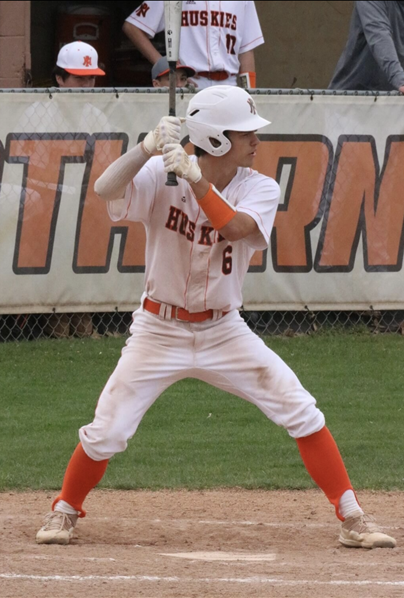
While Tomlinson was sidelined, senior second baseman Ryan Juodawlkis lost his infield partner.
“Me and Ty, we’ve been a duo for years,” Juodawlkis said. “We have great chemistry.
“We’ve played together a long time. We grew up together playing ball since 11-U. We’ve always been on the field together, talking to each other and communicating.”
With Tomlinson out, Brice Welke, one of two sophomores on the team, stepped in at shortstop.
“It’s always harder to adjust to someone else, especially a younger guy,” Juodawlkis said. “It’s the communicating, who’s got the bag for a steal, who’s gonna hold a runner on.”
Prepping to contend
When the schedule comes out at the beginning of the season, the first two dates the Huskies circle are against Mattawan and Portage Central, Tomlinson said.
Central is the crosstown rival with players who are friends outside of school, and Mattawan is the team that ended Northern’s last two seasons in Division I District Finals.
 Northern, ranked No. 15 in Division 1 this spring, was to take a 16-5 record against eighth-ranked Mattawan into a contest scheduled for last Thursday. But the devastation from the EF2 category tornado two days earlier resulted in school being canceled for three days, postponing the game.
“They know they still get to play, so they’re not too heartbroken about (postponing the game),” second-year head coach Adam Cardona said. “A few have been without power a few days, no one lost their homes, but some of their families have been affected, which I know is weighing on them a bit. Praise the Lord, everybody is safe.
“With everything that’s going on, I think they understand it puts baseball in perspective; there’s bigger things than baseball. I think they’re ready to get back into it and get some of that normalcy back.”
Games against Mattawan and Portage Central, especially, are a good indication of the Huskies' playoff potential.
“Our pitchers need to throw strikes and provide weak contact,” Juodawlkis noted as keys to making it past Districts. “Don’t try to do too much and put the ball in play.”
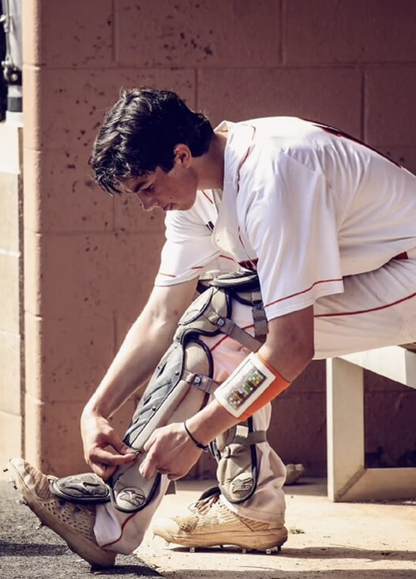
Senior catcher Braden Welke added, “It’s going to take better situational hitting and a lot better moving runners over (to advance).”
Baseball is in the Welkes’ DNA.
Their father Ben played college ball, and their grandfather Tim Welke, as well as a great uncle, Bill, are former MLB umpires.
 While their grandfather is at most games, he doesn’t try to “umpire” them.
“He more just talks and chats with the umpires. Both give me plenty of stories and pointers,” Braden Welke laughed.
Cardona said Welke is one of the best catchers in Southwest Michigan.
“That dude just loves the game of baseball,” Cardona said. “He’s happy to be out here every single day.
“Behind the dish, he calls everything. He sees the game and knows the game well.”
Welke said he likes being in control.
“I like being able to touch the ball every single play,” he said. “You’re always in the play, always talking. You’re kind of the leader on the field.”
Other seniors on the team are Maxwell Pidgeon, Jack Mick, Antonio Parsayar, Keegan McIntyre and Danny Tafoya. Juniors are Nolan Ratliff, Seth Bartlam, Drew Clyne, Thomas Horein, Mateo Icaza, Izaak Bobbio, Finn Malek, Nolan Wilson, Andrew Wagster, Braden Hembree, Mason Wesaw, David Li and Evan Elkins. Evan McIntyre is the other sophomore.
Diehard fans
While his dad played and coached tennis, Ty Tomlinson knew at an early age it was not for him.
“I grew up playing tennis along with baseball and other sports, trying other sports out,” he said. “Tennis was just not for me.
“I was not the fleetest of foot back in my day, so I couldn’t move around the court all too well,” he laughed. “Dad and I would kind of butt heads a little bit, so I was ‘I’ve got to move on.’”
Ryan Tomlinson is a huge Detroit Tigers fan.
So huge, that his three sons’ names are all derived from former Tigers greats including two Hall of Famers.
Ty is named for Ty Cobb, while his 11-year-old brother is Graydon Gibson (from Kirk Gibson) and his 7-year-old bother is Myles Kaline (Al Kaline).
However, the two younger Tomlinsons are finding their niche in hockey right now.
Ty Tomlinson originally committed to play baseball at University of Michigan next season. But after feeling he found a better fit at George Mason University in Fairfax, Va., the shortstop de-committed and opted to head south to play for the Division I Atlantic 10 Patriots.
“Plus it’s warmer,” he laughed. “I’m not a fan of the cold, and apparently neither is my hamstring.”
 Pam Shebest served as a sportswriter at the Kalamazoo Gazette from 1985-2009 after 11 years part-time with the Gazette while teaching French and English at White Pigeon High School. She can be reached at [email protected] with story ideas for Calhoun, Kalamazoo and Van Buren counties.
PHOTOS (Top) Portage Northern’s Ty Tomlinson smiles during an at bat. (2) Ryan Juodawlkis stands in for a pitch. (3) Huskies coach Adam Cardona. (4) Catcher Braden Welke puts on his equipment. (Action photos courtesy of the Portage Northern baseball program; head shot by Pam Shebest.)