

Add, Subtract, Divide, Multiply: MHSAA Not Alone
July 25, 2017
By Rob Kaminski
MHSAA benchmarks editor
This is the third part in a series on MHSAA tournament classification, past and present, that will be published over the next two weeks. This series originally ran in this spring's edition of MHSAA benchmarks.
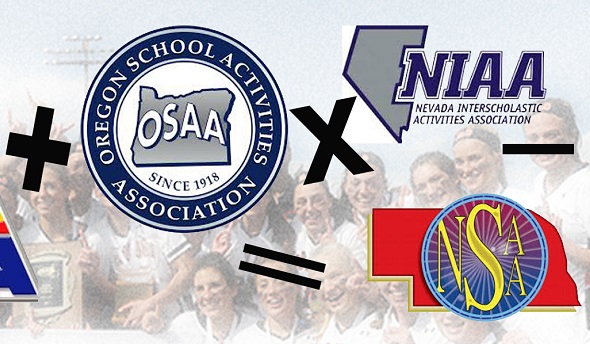
As the MHSAA faces its most recent classification task with 8-Player Football, and opinions continue to swirl about as to the method, timeframe, location and other procedures, a look around the country provides plenty of company among state association brethren factoring variables into their own equations.
In the Pacific Northwest, the Oregon School Activities Association Football Playoffs are under public scrutiny as leadership ponders a five or six classification format beginning with the 2018-19 school year.
The OSAA has crowned six champions on the gridiron since 2006-07. Many of the state’s smaller schools would like to keep it that way, while larger schools lean toward a five-classification system, citing larger leagues, ease of travel and credibility to state championships as the advantages.
Still others would prefer more than six classes, pointing to safety issues and the opportunity to increase participation numbers as positives.
Moving southeast of Oregon, the Nevada Interscholastic Activities Association recently voted to hold serve on a classification proposal that was volleyed to the membership.
However, changes still could be forthcoming by as early as the 2018-19 season which would add a fifth classification in more populated southern Nevada while allowing northern schools to participate in four classifications. Such divisions could mean no state championship for the fifth class in southern Nevada.
Because of that, the NIAA wants equal numbers of schools in each classification on both ends of the state. Complicating the issue is the fact that the 24 largest schools in the state, by enrollment, are all in Clark County in Southern Nevada.
Across Nevada’s border into Arizona, charter schools are asking the Arizona Interscholastic Association to reconsider classification that was voted upon and approved in September 2015. That agreement called for the largest 33 percent of charter schools by enrollment to be placed in the state’s largest school classification, 3A, the middle 33 percent into 2A, and the smallest 33 percent into 1A.
Less than two years later the charter schools have had a change of heart and have asked to be considered the same as other Arizona public schools and be placed appropriately by enrollment beginning with the 2018-19 school year.
The situation in Arizona further illustrates how the public/private debate that all state associations have faced throughout existence now has the added dynamic of rapidly growing charter schools in today’s educational system, along with virtual school enrollment.
In the nation’s heartland, Nebraska has retooled its football classifications by using enrollment of boys students only in its schools rather than total enrollment. The Nebraska School Activities Association football-playing schools will kick off the 2018 season using this alignment.
Nebraska has three classes of 11-player football, with the smallest class divided in two, Class C-1 and C-2. The state also will have 8-player football for boys enrollments under 47, and the NSAA will sponsor a new 6-player tournament in 2018 for schools with 27 or fewer boys.
“This is a good proposal because some schools have a sizable imbalance between the number of boys and girls, and there’s a large gap (in enrollment) between the largest and smallest schools in Classes A and B,” NSAA executive director Jim Tenopir said. “I think this addresses both of those concerns.”
Swimmers in Georgia, meanwhile, will feel like they are moving with the current, rather than upstream in 2017-18, as the Georgia High School Association recently doubled the number of team championship events from two to four.
Swim enthusiasts can also count on longer days at the finals, as the top 30 finishers from the prelims will advance to the finals instead of 20, and all championship events will have three heats versus two.
MHSAA Student Advisory Council Names Members from Class of 2026
By
Geoff Kimmerly
MHSAA.com senior editor
May 6, 2024
Eight student-athletes who will be juniors at their schools during the 2024-25 academic year have been selected to serve two-year terms on the Michigan High School Athletic Association’s Student Advisory Council.
The Student Advisory Council is a 16-member group which provides feedback on issues impacting educational athletics from a student’s perspective, and also is involved in the operation of MHSAA championship events and other programming. Members of the Student Advisory Council serve for two years, beginning as juniors. Eight new members are selected annually to serve on the SAC, with nominations made by MHSAA member schools. The incoming juniors will join the group of eight seniors-to-be appointed a year ago.
Selected to begin serving on the Student Advisory Council in 2024-25 are: Itzel Albarran, Bronson; Harper Barnhart, Brownstown Woodhaven; Diamond Cook, Southfield Christian; Henry Ewles, Pontiac Notre Dame Prep; Cole Haist, Big Rapids; Frannie Keeley, Jenison; Trey LaValley, Romeo; and Ethan Stine, Bridgman.
Those eight new members were selected from 90 applicants. The first Student Advisory Council was formed for the 2006-07 school year. With the addition of this class beginning this summer, members will have represented 142 schools from 51 leagues plus independent schools that do not play in a league. Combined, the new appointees have participated in 10 MHSAA sports, and five will be the first SAC members from their respective schools.
The Student Advisory Council generally meets seven times each school year, and once more for a 24-hour leadership camp. In addition to assisting in the promotion of the educational value of interscholastic athletics, the Council discusses issues dealing with the 4 S’s of educational athletics: scholarship, sportsmanship, safety (including health and nutrition) and the sensible scope of athletic programs. There also is a fifth S discussed by the group – student leadership.
This school year, the Council handed out championship trophies at Finals events, led sessions during four Sportsmanship Summits and provided assistance at the Women In Sports Leadership Conference, provided feedback to the MHSAA Representative Council on proposed rule changes, worked on a mental health initiative, and wrote the script for a public service announcement on adult spectator sportsmanship that will be included in broadcasts beginning this upcoming school year.
The new additions to the SAC will join the Class of 2025 members who were selected a year ago: Cale Bell, Sault Ste. Marie; Drew Cady, Oxford; Macy Jenkins, Milford; Isaiah Kabban, Harbor Beach; Ella Knudsen, Leland; Kaylee Kranz, Clinton; Joey Spada, Kalamazoo Central; and Aynalem Zoet, Grandville Calvin Christian.
The MHSAA is a private, not-for-profit corporation of voluntary membership by more than 1,500 public and private senior high schools and junior high/middle schools which exists to develop common rules for athletic eligibility and competition. No government funds or tax dollars support the MHSAA, which was the first such association nationally to not accept membership dues or tournament entry fees from schools. Member schools which enforce these rules are permitted to participate in MHSAA tournaments, which attract more than 1.4 million spectators each year.