

Add, Subtract, Divide, Multiply: MHSAA Not Alone
July 25, 2017
By Rob Kaminski
MHSAA benchmarks editor
This is the third part in a series on MHSAA tournament classification, past and present, that will be published over the next two weeks. This series originally ran in this spring's edition of MHSAA benchmarks.
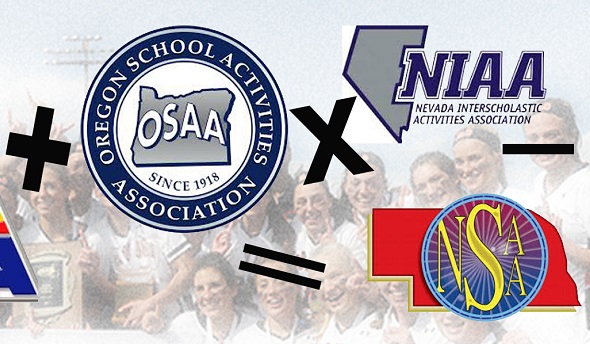
As the MHSAA faces its most recent classification task with 8-Player Football, and opinions continue to swirl about as to the method, timeframe, location and other procedures, a look around the country provides plenty of company among state association brethren factoring variables into their own equations.
In the Pacific Northwest, the Oregon School Activities Association Football Playoffs are under public scrutiny as leadership ponders a five or six classification format beginning with the 2018-19 school year.
The OSAA has crowned six champions on the gridiron since 2006-07. Many of the state’s smaller schools would like to keep it that way, while larger schools lean toward a five-classification system, citing larger leagues, ease of travel and credibility to state championships as the advantages.
Still others would prefer more than six classes, pointing to safety issues and the opportunity to increase participation numbers as positives.
Moving southeast of Oregon, the Nevada Interscholastic Activities Association recently voted to hold serve on a classification proposal that was volleyed to the membership.
However, changes still could be forthcoming by as early as the 2018-19 season which would add a fifth classification in more populated southern Nevada while allowing northern schools to participate in four classifications. Such divisions could mean no state championship for the fifth class in southern Nevada.
Because of that, the NIAA wants equal numbers of schools in each classification on both ends of the state. Complicating the issue is the fact that the 24 largest schools in the state, by enrollment, are all in Clark County in Southern Nevada.
Across Nevada’s border into Arizona, charter schools are asking the Arizona Interscholastic Association to reconsider classification that was voted upon and approved in September 2015. That agreement called for the largest 33 percent of charter schools by enrollment to be placed in the state’s largest school classification, 3A, the middle 33 percent into 2A, and the smallest 33 percent into 1A.
Less than two years later the charter schools have had a change of heart and have asked to be considered the same as other Arizona public schools and be placed appropriately by enrollment beginning with the 2018-19 school year.
The situation in Arizona further illustrates how the public/private debate that all state associations have faced throughout existence now has the added dynamic of rapidly growing charter schools in today’s educational system, along with virtual school enrollment.
In the nation’s heartland, Nebraska has retooled its football classifications by using enrollment of boys students only in its schools rather than total enrollment. The Nebraska School Activities Association football-playing schools will kick off the 2018 season using this alignment.
Nebraska has three classes of 11-player football, with the smallest class divided in two, Class C-1 and C-2. The state also will have 8-player football for boys enrollments under 47, and the NSAA will sponsor a new 6-player tournament in 2018 for schools with 27 or fewer boys.
“This is a good proposal because some schools have a sizable imbalance between the number of boys and girls, and there’s a large gap (in enrollment) between the largest and smallest schools in Classes A and B,” NSAA executive director Jim Tenopir said. “I think this addresses both of those concerns.”
Swimmers in Georgia, meanwhile, will feel like they are moving with the current, rather than upstream in 2017-18, as the Georgia High School Association recently doubled the number of team championship events from two to four.
Swim enthusiasts can also count on longer days at the finals, as the top 30 finishers from the prelims will advance to the finals instead of 20, and all championship events will have three heats versus two.

- Baseball
- Girls Soccer
- Softball
- Girls Track & Field
- Boys Track & Field
- Boys Tennis
- Girls Tennis
- Girls Golf
- Boys Golf
- Girls Lacrosse
- Boys Lacrosse
- MHSAA News
Lacrosse Finals Move to U-M Among Headlines as Spring Sports Ramp Up
By
Geoff Kimmerly
MHSAA.com senior editor
April 9, 2024
The Girls & Boys Lacrosse Finals will be played at University of Michigan Lacrosse Stadium for the first time, one of the most notable changes for this season as sports ramp up for more than 100,000 athletes anticipated to participate this spring for Michigan High School Athletic Association member schools.
The MHSAA sponsors postseason competition each spring in baseball, girls and boys lacrosse, girls soccer, softball, girls and boys track & field, boys golf (Lower and Upper Peninsula) and girls golf (UP), and girls (LP) and boys (UP) tennis.
The U-M Lacrosse Stadium opened for competition in 2018 and seats 2,000 spectators. The Girls Lacrosse Finals will be played Friday, June 7, with Division 1 at 4 p.m. and Division 2 at 7 p.m. The Boys Lacrosse Finals will be played the following day, June 8, with Division 2 at 11 a.m. and Division 1 at 2 p.m.
Girls lacrosse also has a significant format adjustment this season, as games will be played with four 12-minutes quarters instead of the previous two halves, in part to allow coaches more opportunities to provide direct instruction during a game. Two more rules changes are expected to improve flow of play – players awarded a free position outside of the critical scoring area no longer must come to a stop and settled stance before self-starting, and false start penalties outside the critical scoring area have been eliminated.
Several more rules changes will be noticeable this spring:
In boys lacrosse, a change was made to enhance player safety. Play will stop immediately any time a player’s helmet comes off, and that player may not return until the next dead ball after play continues.
Fair and legal starts are a continued emphasis for track & field, and a rule change will allow for movement before the start of the race as long as a competitor does not leave their mark with a hand or a foot after the “set” command, or make forward motion before the starting device is activated.
A significant rule change in softball alters pitch delivery mechanics. The pitcher may now have both feet off the ground at the same time when releasing the ball as long as both feet remain within the 24-inch width of a pitching plate and the pitcher does not replant the pivot foot before delivering the pitch.
Another change in softball requires that a playbook/playcard be worn on the wrist or kept in a back pocket to reduce distractions. If worn by the pitcher, the equipment must be worn on the non-pitching arm. Similarly in baseball, a wristband with plays or instructions will be permitted but must be a single, solid color, and for pitchers may not contain the colors white or gray or be otherwise distracting. Baseball players must wear this wristband on the wrist or forearm, and pitchers may wear one only on their non-pitching arm.
Also in baseball, a rule change allows for one-way communication devices worn by the catcher to receive instructions from the dugout while on defense, for the purpose of calling pitches. The coach must be inside the dugout/bench area to use the communication device.
Golfers now are required to participate in at least four competitions for the high school team prior to representing that school team in an MHSAA Regional or Final. Those four regular-season competitions may be 9 or 18-hole events.
In tennis, for the first time in Lower Peninsula play, a No. 1 doubles flight from a non-qualifying team will be able to advance from its Regional to Finals competition. To do so, that No. 1 doubles flight must finish first or second at its Regional, and the No. 1 singles player from that team also must have qualified for the Finals individually by finishing first or second in Regional play.
On the soccer pitch, two officiating-related changes will be especially noticeable. Officials now may stop the clock to check on an injured player without that player being required to leave the match – previously that player would have to sub out. Also, categories for fouls have been redefined: careless (which is a foul but does not receive a card), reckless (a foul with a yellow card) and excessive force (foul with red card).
The 2023-24 Spring campaign culminates with postseason tournaments, as the championship schedule begins with the Upper Peninsula Girls & Boys Golf and Boys Tennis Finals during the week of May 27 and wraps up with Girls Soccer, Baseball and Softball Finals on June 15. Here is a complete list of winter tournament dates:
Baseball
Districts – May 23-June 1
Regional Semifinals – June 5
Regional Finals, Quarterfinals – June 8
Semifinals – June 13-14
Finals – June 15
Golf
LP Boys Regionals – May 28-June 1
UP Girls & Boys Finals – May 29, 30, 31 or June 1
LP Boys Finals – June 7-8
Boys Lacrosse
Pre-Regionals – May 10-15
Regionals – May 16-29
Quarterfinals – May 31 or June 1
Semifinals – June 5
Finals – June 8
Girls Lacrosse
Pre-Regionals – May 16-18, or May 20
Regionals – May 22-June 1
Semifinals – June 5
Finals – June 7
Girls Soccer
Districts – May 22-June 1
Regionals – June 4-8
Semifinals – June 11-12
Finals – June 14-15
Softball
Districts – May 23-June 1
Regionals – June 8
Quarterfinals – June 11
Semifinals – June 13-14
Finals – June 15
Tennis
LP Girls Regionals – May 15-18
UP Boys Finals – May 29, 30, 31 or June 1
LP Girls Finals – May 31-June 1
Track & Field
Regionals – May 16-18
Finals – June 1