

Add, Subtract, Divide, Multiply: MHSAA Not Alone
July 25, 2017
By Rob Kaminski
MHSAA benchmarks editor
This is the third part in a series on MHSAA tournament classification, past and present, that will be published over the next two weeks. This series originally ran in this spring's edition of MHSAA benchmarks.
As the MHSAA faces its most recent classification task with 8-Player Football, and opinions continue to swirl about as to the method, timeframe, location and other procedures, a look around the country provides plenty of company among state association brethren factoring variables into their own equations.
In the Pacific Northwest, the Oregon School Activities Association Football Playoffs are under public scrutiny as leadership ponders a five or six classification format beginning with the 2018-19 school year.
The OSAA has crowned six champions on the gridiron since 2006-07. Many of the state’s smaller schools would like to keep it that way, while larger schools lean toward a five-classification system, citing larger leagues, ease of travel and credibility to state championships as the advantages.
Still others would prefer more than six classes, pointing to safety issues and the opportunity to increase participation numbers as positives.
Moving southeast of Oregon, the Nevada Interscholastic Activities Association recently voted to hold serve on a classification proposal that was volleyed to the membership.
However, changes still could be forthcoming by as early as the 2018-19 season which would add a fifth classification in more populated southern Nevada while allowing northern schools to participate in four classifications. Such divisions could mean no state championship for the fifth class in southern Nevada.
Because of that, the NIAA wants equal numbers of schools in each classification on both ends of the state. Complicating the issue is the fact that the 24 largest schools in the state, by enrollment, are all in Clark County in Southern Nevada.
Across Nevada’s border into Arizona, charter schools are asking the Arizona Interscholastic Association to reconsider classification that was voted upon and approved in September 2015. That agreement called for the largest 33 percent of charter schools by enrollment to be placed in the state’s largest school classification, 3A, the middle 33 percent into 2A, and the smallest 33 percent into 1A.
Less than two years later the charter schools have had a change of heart and have asked to be considered the same as other Arizona public schools and be placed appropriately by enrollment beginning with the 2018-19 school year.
The situation in Arizona further illustrates how the public/private debate that all state associations have faced throughout existence now has the added dynamic of rapidly growing charter schools in today’s educational system, along with virtual school enrollment.
In the nation’s heartland, Nebraska has retooled its football classifications by using enrollment of boys students only in its schools rather than total enrollment. The Nebraska School Activities Association football-playing schools will kick off the 2018 season using this alignment.
Nebraska has three classes of 11-player football, with the smallest class divided in two, Class C-1 and C-2. The state also will have 8-player football for boys enrollments under 47, and the NSAA will sponsor a new 6-player tournament in 2018 for schools with 27 or fewer boys.
“This is a good proposal because some schools have a sizable imbalance between the number of boys and girls, and there’s a large gap (in enrollment) between the largest and smallest schools in Classes A and B,” NSAA executive director Jim Tenopir said. “I think this addresses both of those concerns.”
Swimmers in Georgia, meanwhile, will feel like they are moving with the current, rather than upstream in 2017-18, as the Georgia High School Association recently doubled the number of team championship events from two to four.
Swim enthusiasts can also count on longer days at the finals, as the top 30 finishers from the prelims will advance to the finals instead of 20, and all championship events will have three heats versus two.
DeWitt's Thomas Blazes Swimming Path with Historic Finals Performance
By
Steve Vedder
Special for MHSAA.com
April 4, 2024
Aaron Thomas easily could have decided that swimming wasn't going to be part of his life.
 The DeWitt senior could've pieced together some combination of his other entertainment interests to fill his time. For instance, he could have spent more time with friends or immersed himself in video games. Or maybe devoted more time to a flirtation with golf or playing trumpet in the school band. Thomas also could have gained a head start on college and his ultimate goal of a degree in biomedical engineering.
Considering the lifetime of challenges he's faced in swimming, those seemed more tenable options.
Instead, Thomas chose the tougher path.
"My life is swimming," he said. "I've been in water so much, I've never looked back."
By "looking back," Thomas means ignoring a disability that would have turned many youngsters away from the pool. He was born without 65 percent of his pointer finger on his left hand and with a thumb that's only about 90-percent intact. The other three fingers stop at the top of the knuckle. As DeWitt coach Brock Delaney explains, much of a swimmer’s success comes from the power of fingers and subsequent strength in the hands – and without that combination, swimmers are at an immediate disadvantage.
But rather than letting those obstacles keep him high and dry, Thomas has excelled and finished this season with a historic first. He qualified for the Lower Peninsula Division 3 Finals in the 200-yard individual medley and finished 29th and also competed in the Paralympic 100 freestyle exhibition event and topped all divisions with a time of 54.07 seconds. In doing so, Thomas became the first competitor to swim that combination at a Finals meet.
Thomas additionally this winter made DeWitt's Century Club of swimmers who have amassed 100 points in a season for the second time, and he has earned National Interscholastic Swim Coaches Association (NISCA) Paralympic All-American honors in the 200-yard freestyle (1:56.64), 200 IM (2:08.21), and 500 free (5:11.58). He also competes in Paralympic swimming as part of the Mid-Michigan Aquatics Club.
To some, the quest for those achievements likely would seem a long and difficult path. But to Thomas, it's business as usual. A disability? What disability, offers Thomas, whose ultimate goal is swimming in the 2028 Summer Paralympics in Los Angeles.
"I've always loved swimming," he said. "When I'm in the water, I never worry about anything. I just feel free."
 And Thomas has found a way to even the playing field, Delaney said.
"He's such a hard worker who has made up for a left-hand deficiency," Delaney said. "He's legit, a strong kid who loves to swim. "
But determination can take a swimmer only so far. Delaney said Thomas, classified as an S10 swimmer for Paralympic events, has developed physical strategies to increase his performance. In the backstroke, for instance, Thomas swims with his left hand underwater to help in propulsion. For speed, Thomas tries to keep his body on his "power side."
The rest, Delaney said, is simply heart.
"He moved here from Alma between his eighth grade and freshmen years," he said. "If not our hardest worker, he's in the top three. He's got something not all athletes have."
Thomas said one of the chief reasons he spends so much time around pools is the type of person he finds there. He describes people who combine encouragement and understanding with a will to compete despite any perceived physical shortcomings. What he's learned from them not only explains his swim career, but teaches valuable life lessons as well.
In fact, Thomas' career plans, beginning at Hope College in the fall, include securing a degree in biomedical engineering with an ultimate plan to help build prosthetics.
"Getting to know people in the prosthetic field really interests me," he said. "Swimming and prosthetics have been a nice tie-in with school. Prosthetics ties it all together for me."
Thomas said he can think of only a single instance where he questioned whether he should follow his love of swimming. But that thought quickly passed, and he's thrown himself into the sport ever since.
"I wouldn't trade my disability for the world," he said. "It's given me so many opportunities. The whole club and school thing and getting to the state meet never would have happened.”
Thomas will swim at Hope, and his goal is to qualify for the 200 IM at the Los Angeles Paralympic games. Thomas estimates he's within 15 seconds of qualifying in that meet's long course event.
"It's achievable," he said. "For sure it's doable."
Whether he makes it to Los Angeles or if his swim career quietly winds down, Thomas, who describes himself as competitive, said he still will have gained something for which everyone strives, athlete or not.
"Water has always been a safe spot for me," he said. "I think I've always used it as kind of a break from life. It helps clear my head.
“I've always been taught that you get out of work what you put into it. Work always pays off in the end. I've always remembered that.”
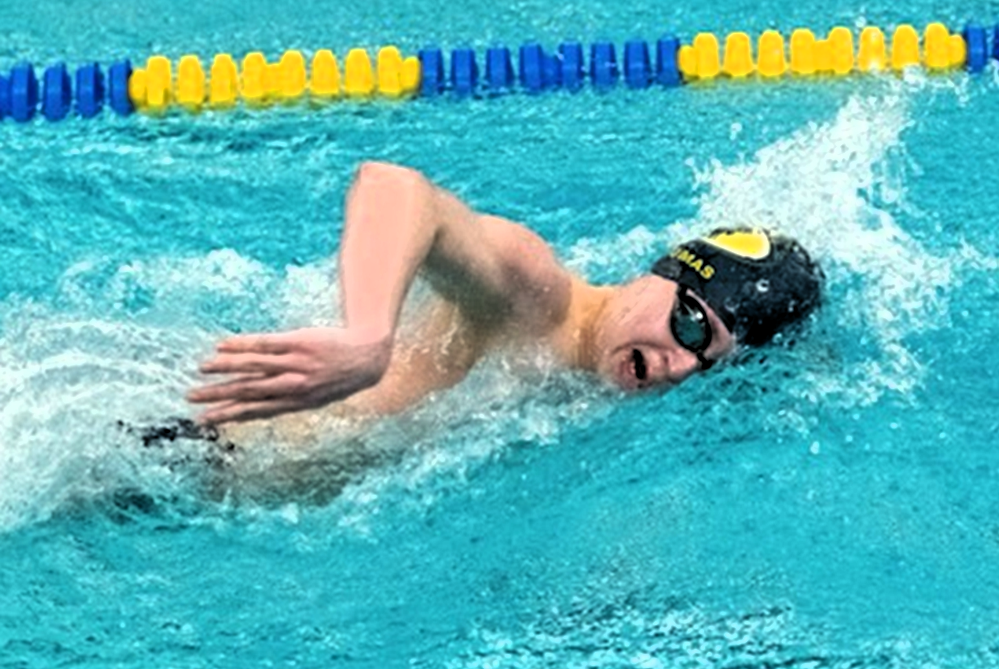
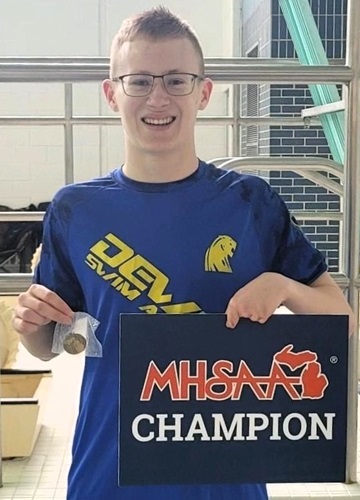
PHOTOS (Top) Aaron Thomas races for the DeWitt swimming & diving team. (Middle) Thomas posted the fastest time across all divisions in the Paralympic 100 freestyle exhibition at this season’s Finals. (Photos provided by the DeWitt swimming & diving program and Thomas family.)