

Add, Subtract, Divide, Multiply: MHSAA Not Alone
July 25, 2017
By Rob Kaminski
MHSAA benchmarks editor
This is the third part in a series on MHSAA tournament classification, past and present, that will be published over the next two weeks. This series originally ran in this spring's edition of MHSAA benchmarks.
As the MHSAA faces its most recent classification task with 8-Player Football, and opinions continue to swirl about as to the method, timeframe, location and other procedures, a look around the country provides plenty of company among state association brethren factoring variables into their own equations.
In the Pacific Northwest, the Oregon School Activities Association Football Playoffs are under public scrutiny as leadership ponders a five or six classification format beginning with the 2018-19 school year.
The OSAA has crowned six champions on the gridiron since 2006-07. Many of the state’s smaller schools would like to keep it that way, while larger schools lean toward a five-classification system, citing larger leagues, ease of travel and credibility to state championships as the advantages.
Still others would prefer more than six classes, pointing to safety issues and the opportunity to increase participation numbers as positives.
Moving southeast of Oregon, the Nevada Interscholastic Activities Association recently voted to hold serve on a classification proposal that was volleyed to the membership.
However, changes still could be forthcoming by as early as the 2018-19 season which would add a fifth classification in more populated southern Nevada while allowing northern schools to participate in four classifications. Such divisions could mean no state championship for the fifth class in southern Nevada.
Because of that, the NIAA wants equal numbers of schools in each classification on both ends of the state. Complicating the issue is the fact that the 24 largest schools in the state, by enrollment, are all in Clark County in Southern Nevada.
Across Nevada’s border into Arizona, charter schools are asking the Arizona Interscholastic Association to reconsider classification that was voted upon and approved in September 2015. That agreement called for the largest 33 percent of charter schools by enrollment to be placed in the state’s largest school classification, 3A, the middle 33 percent into 2A, and the smallest 33 percent into 1A.
Less than two years later the charter schools have had a change of heart and have asked to be considered the same as other Arizona public schools and be placed appropriately by enrollment beginning with the 2018-19 school year.
The situation in Arizona further illustrates how the public/private debate that all state associations have faced throughout existence now has the added dynamic of rapidly growing charter schools in today’s educational system, along with virtual school enrollment.
In the nation’s heartland, Nebraska has retooled its football classifications by using enrollment of boys students only in its schools rather than total enrollment. The Nebraska School Activities Association football-playing schools will kick off the 2018 season using this alignment.
Nebraska has three classes of 11-player football, with the smallest class divided in two, Class C-1 and C-2. The state also will have 8-player football for boys enrollments under 47, and the NSAA will sponsor a new 6-player tournament in 2018 for schools with 27 or fewer boys.
“This is a good proposal because some schools have a sizable imbalance between the number of boys and girls, and there’s a large gap (in enrollment) between the largest and smallest schools in Classes A and B,” NSAA executive director Jim Tenopir said. “I think this addresses both of those concerns.”
Swimmers in Georgia, meanwhile, will feel like they are moving with the current, rather than upstream in 2017-18, as the Georgia High School Association recently doubled the number of team championship events from two to four.
Swim enthusiasts can also count on longer days at the finals, as the top 30 finishers from the prelims will advance to the finals instead of 20, and all championship events will have three heats versus two.
Symptoms of a Meniscus Tear — and When to Seek Treatment
April 2, 2024
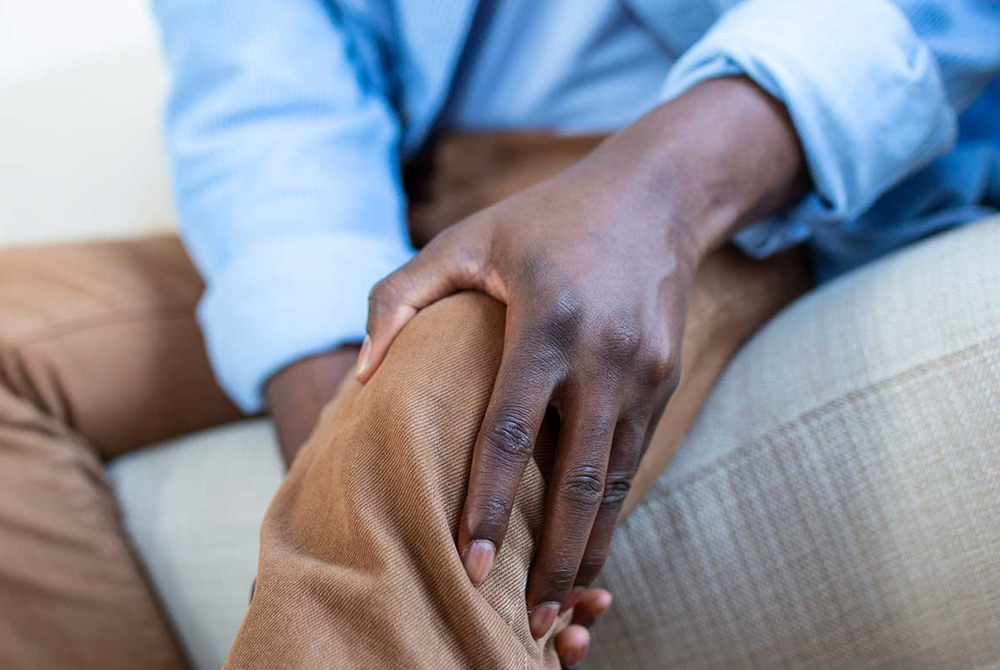
Meniscus tears are not one size fits all: Sometimes they cause no pain, other times they’re excruciating.
 Once in a while they heal or adapt on their own, but more often than not they require physical therapy or surgery.
“Your meniscus is a fiber elastic cartilage that acts as a shock absorber for the knee,” says Ahmad Bazzi, M.D., a sports medicine physician at Henry Ford Health. “It also helps stabilize the knee joint. But when it tears — which can occur in young athletes after a pivot injury or in older people who have arthritis — it can be painful.”
Here, Dr. Bazzi shares symptoms of a meniscus tear and when to see a doctor.
What Does A Meniscus Tear Feel Like?
Depending upon the level of injury and type of tear, meniscus tears can either be asymptomatic or cause symptoms like:
- Locking. When the meniscus tears, a piece of it might move into the knee joint, causing mechanical issues like stiffness and locking of the knee joint.
- Catching or clicking. This often feels like a sudden ‘click’ in the knee joint, where it suddenly gives out while you’re walking or doing certain movements.
- Localized pain on the inner or outer part of the knee. In young athletes, a meniscus tear often causes an impaired range of motion and localized pain on the inner or outer part of the knee.
- Pain and swelling. In older people, a meniscus tear often causes swelling and an overall aching pain in the knee.
Treatment Options For Meniscus Tears
A meniscus tear can only heal on its own if the tear is on the outer part of the knee where it has better access to blood supply. If you’re experiencing pain a few days after injury and you have limited range of motion, instability and/or swelling in the knee, Dr. Bazzi recommends seeing a doctor to get an examination and, if needed, an MRI for diagnosis.
“It’s hard to tell what type of meniscus tear you have if you haven’t seen a doctor,” says Dr. Bazzi. “If you have a mechanically unstable tear and it goes untreated, it could lead to worsening range of motion and stiffness, or worsening arthritis. It’s important to get seen by a doctor to get an accurate diagnosis and the proper treatment. It may take one to three months for a full recovery.”
Here, Dr. Bazzi shares treatment options:
Surgery
If someone is having mechanical symptoms like locking or catching, surgery may be considered right away, especially if it’s an athlete younger than 40 years old. “Meniscus tear surgery has a shorter recovery compared to other knee surgeries,” says Dr. Bazzi. “Surgery could either consist of a meniscectomy, which is partial or complete removal of the meniscus, or sometimes just a meniscus repair.”
Hyaluronic acid or cortisone injections
Non-operative treatments are often recommended for older people who have degenerative tears due to arthritis. “This is because meniscus surgery doesn’t often relieve their pain since they have underlying arthritis, meaning they have cartilage loss in the meniscus,” says Dr. Bazzi.
Instead, a cortisone injection, which is an anti-inflammatory medication that can be injected into the knee, can reduce inflammation, swelling and pain caused by arthritis.
A hyaluronic acid injection may also be considered, which adds cushioning in the knee. “Hyaluronic acid is one of the substances that make up our cartilage, so this injection helps us mimic the lost cartilage,” says Dr. Bazzi. “It also has anti-inflammatory properties.”
Physical therapy
Physical therapy is another great option, especially for older people who need non-operative treatment options. It can help the knee adapt to the tear, reduce pain and encourage full range of motion. “Physical therapy for meniscus tears focuses on balance exercises and exercises to strengthen the muscles around the knee,” says Dr. Bazzi. “This helps to uphold the knee joint to achieve full range of motion and strength while being pain-free.”
To find a sports medicine provider at Henry Ford Health, visit henryford.com/athletes or call 313-651-1969.
Reviewed by Ahmad Bazzi, M.D., a sports medicine physician who sees patients at Henry Ford Medical Center – Fairlane.