


Add, Subtract, Divide, Multiply: MHSAA Not Alone
July 25, 2017
By Rob Kaminski
MHSAA benchmarks editor
This is the third part in a series on MHSAA tournament classification, past and present, that will be published over the next two weeks. This series originally ran in this spring's edition of MHSAA benchmarks.
As the MHSAA faces its most recent classification task with 8-Player Football, and opinions continue to swirl about as to the method, timeframe, location and other procedures, a look around the country provides plenty of company among state association brethren factoring variables into their own equations.
In the Pacific Northwest, the Oregon School Activities Association Football Playoffs are under public scrutiny as leadership ponders a five or six classification format beginning with the 2018-19 school year.
The OSAA has crowned six champions on the gridiron since 2006-07. Many of the state’s smaller schools would like to keep it that way, while larger schools lean toward a five-classification system, citing larger leagues, ease of travel and credibility to state championships as the advantages.
Still others would prefer more than six classes, pointing to safety issues and the opportunity to increase participation numbers as positives.
Moving southeast of Oregon, the Nevada Interscholastic Activities Association recently voted to hold serve on a classification proposal that was volleyed to the membership.
However, changes still could be forthcoming by as early as the 2018-19 season which would add a fifth classification in more populated southern Nevada while allowing northern schools to participate in four classifications. Such divisions could mean no state championship for the fifth class in southern Nevada.
Because of that, the NIAA wants equal numbers of schools in each classification on both ends of the state. Complicating the issue is the fact that the 24 largest schools in the state, by enrollment, are all in Clark County in Southern Nevada.
Across Nevada’s border into Arizona, charter schools are asking the Arizona Interscholastic Association to reconsider classification that was voted upon and approved in September 2015. That agreement called for the largest 33 percent of charter schools by enrollment to be placed in the state’s largest school classification, 3A, the middle 33 percent into 2A, and the smallest 33 percent into 1A.
Less than two years later the charter schools have had a change of heart and have asked to be considered the same as other Arizona public schools and be placed appropriately by enrollment beginning with the 2018-19 school year.
The situation in Arizona further illustrates how the public/private debate that all state associations have faced throughout existence now has the added dynamic of rapidly growing charter schools in today’s educational system, along with virtual school enrollment.
In the nation’s heartland, Nebraska has retooled its football classifications by using enrollment of boys students only in its schools rather than total enrollment. The Nebraska School Activities Association football-playing schools will kick off the 2018 season using this alignment.
Nebraska has three classes of 11-player football, with the smallest class divided in two, Class C-1 and C-2. The state also will have 8-player football for boys enrollments under 47, and the NSAA will sponsor a new 6-player tournament in 2018 for schools with 27 or fewer boys.
“This is a good proposal because some schools have a sizable imbalance between the number of boys and girls, and there’s a large gap (in enrollment) between the largest and smallest schools in Classes A and B,” NSAA executive director Jim Tenopir said. “I think this addresses both of those concerns.”
Swimmers in Georgia, meanwhile, will feel like they are moving with the current, rather than upstream in 2017-18, as the Georgia High School Association recently doubled the number of team championship events from two to four.
Swim enthusiasts can also count on longer days at the finals, as the top 30 finishers from the prelims will advance to the finals instead of 20, and all championship events will have three heats versus two.
Edison Ends 2023-24 Winter Season Back at Breslin, Back on Top
By
Dean Holzwarth
Special for MHSAA.com
March 23, 2024
EAST LANSING – Detroit Edison wanted the opportunity to gain redemption in its return to Michigan State University’s Breslin Center.
The Pioneers needed stout defense during the final quarter Saturday to accomplish that goal.
Edison held Ann Arbor Father Gabriel Richard to only three fourth-quarter points on its way to a 41-33 win in Saturday’s Division 2 title game.
The Pioneers (23-3) won the program’s fifth Finals championship over the last 10 years and handed the Irish their only loss of the season.
 “We set a goal, and that was to go back here and win,” said Edison coach Monique Brown, whose team lost in a Regional Final last year after winning Division 2 in 2022.
“I gave them a theme this year, and it was leadership. We had six seniors, and they bought into everything we were doing. To see them fight through adversity at the end of the game was great. We made a run, and we fought through. We wanted to be smiling at the end of the year, and we are.”
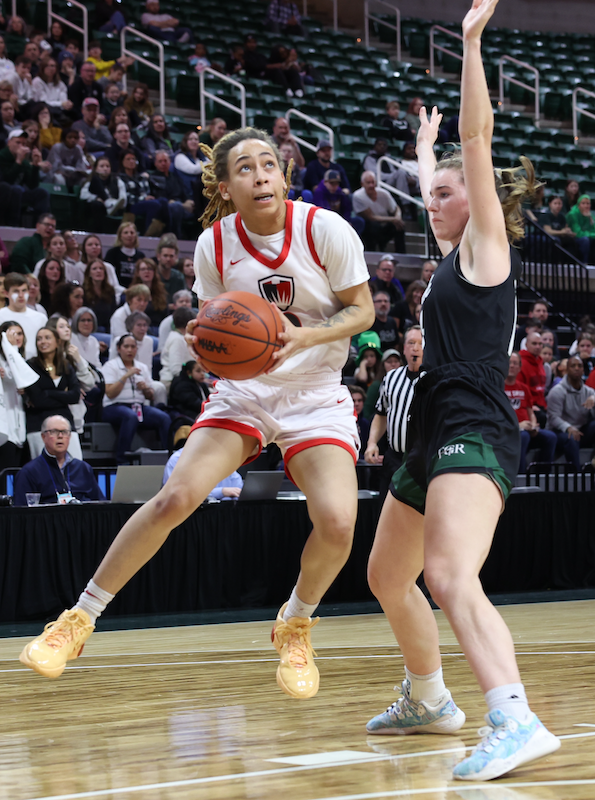
Edison led 22-17 at the half and still maintained a slight edge going into the fourth quarter when Myana Cooksey dropped in a short baseline jumper to make it 34-30.
The Irish trimmed Edison’s lead to one (34-33) when Cora Williams scored inside and converted the and-one with 4:49 left.
But the Pioneers held the Irish scoreless the rest of the game.
“There was a little squabble that happened, and I think it woke us up and gave us a kickstart,” Brown said. “I told them it wasn’t a boxing match, it was a basketball game and we had to score the ball and play good defense.
“We do so many defensive drills, and we started something the last two weeks where we play defense for a whole minute. If you want to win you have to play defense and make sure they don’t get good shots.”
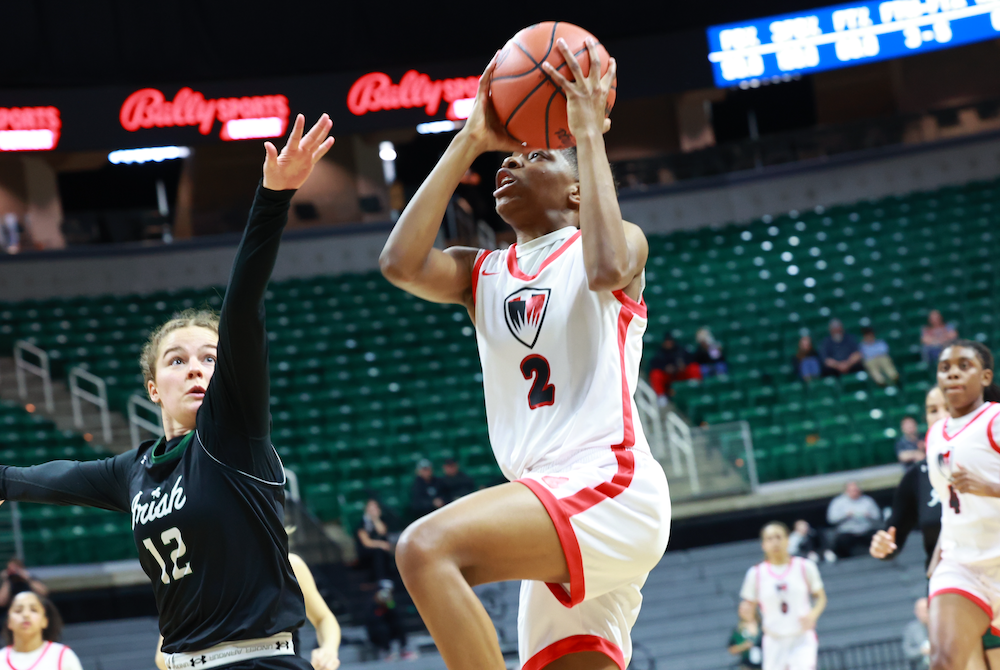
Senior Isis Johnson-Musah led the Pioneers with 16 points and five rebounds, while Cooksey finished with nine points and six boards.
“To come in here in my first year and help them win their fifth (championship) means a lot,” Johnson-Musah said. “We were just trying to play good defense and not foul (in the fourth quarter). And no 3-pointers because we saw what they did (Friday night). We tried to not let that happen.”
 FGR (28-1) was seeking a perfect season and the program’s first Finals win since 1993 in Class D. The Irish advanced to Saturday on a buzzer-beating 3-pointer in Friday’s Semifinal against Grand Rapids West Catholic.
However, a tough shooting night this time proved to be the Irish’s downfall as they were 12 of 38 from the field and 1 of 12 from beyond the 3-point arc. FGR also was just 8 of 14 from the free throw line.
“Sometimes you don’t have that rhythm, and it was just one of those days,” Irish coach Tim Cain said. “Our shot wasn’t falling, and when they went to four guards it got us out of our comfort zone defensively. We thought we could dominate down low, but we got into foul trouble. They played well, and Isis made a lot of plays.
“The special part of the season is the players and the relationships. We won a lot of games, and I will miss my seniors.”
Junior Charlotte Miller, who made the game-winning shot Friday, led FGR with 12 points and five rebounds.
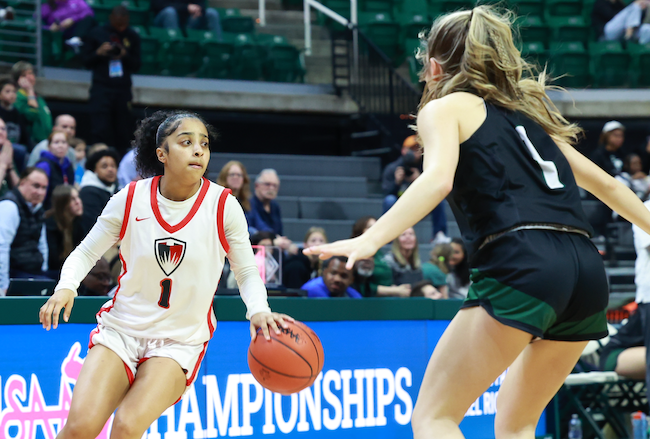
PHOTOS (Top) Detroit Edison’s Isis Johnson-Musah gets to the basket Saturday with FGR’s Bethie Benz (12) defending. (Middle) The Pioneers’ Myana Cooksey, left, drives the lane. (Below) Edison’s Devin Hagemann, left, considers her options with FGR’s Vanessa Rodriguez guarding her. (Photos by Hockey Weekly Action Photos.)