

Add, Subtract, Divide, Multiply: MHSAA Not Alone
July 25, 2017
By Rob Kaminski
MHSAA benchmarks editor
This is the third part in a series on MHSAA tournament classification, past and present, that will be published over the next two weeks. This series originally ran in this spring's edition of MHSAA benchmarks.
As the MHSAA faces its most recent classification task with 8-Player Football, and opinions continue to swirl about as to the method, timeframe, location and other procedures, a look around the country provides plenty of company among state association brethren factoring variables into their own equations.
In the Pacific Northwest, the Oregon School Activities Association Football Playoffs are under public scrutiny as leadership ponders a five or six classification format beginning with the 2018-19 school year.
The OSAA has crowned six champions on the gridiron since 2006-07. Many of the state’s smaller schools would like to keep it that way, while larger schools lean toward a five-classification system, citing larger leagues, ease of travel and credibility to state championships as the advantages.
Still others would prefer more than six classes, pointing to safety issues and the opportunity to increase participation numbers as positives.
Moving southeast of Oregon, the Nevada Interscholastic Activities Association recently voted to hold serve on a classification proposal that was volleyed to the membership.
However, changes still could be forthcoming by as early as the 2018-19 season which would add a fifth classification in more populated southern Nevada while allowing northern schools to participate in four classifications. Such divisions could mean no state championship for the fifth class in southern Nevada.
Because of that, the NIAA wants equal numbers of schools in each classification on both ends of the state. Complicating the issue is the fact that the 24 largest schools in the state, by enrollment, are all in Clark County in Southern Nevada.
Across Nevada’s border into Arizona, charter schools are asking the Arizona Interscholastic Association to reconsider classification that was voted upon and approved in September 2015. That agreement called for the largest 33 percent of charter schools by enrollment to be placed in the state’s largest school classification, 3A, the middle 33 percent into 2A, and the smallest 33 percent into 1A.
Less than two years later the charter schools have had a change of heart and have asked to be considered the same as other Arizona public schools and be placed appropriately by enrollment beginning with the 2018-19 school year.
The situation in Arizona further illustrates how the public/private debate that all state associations have faced throughout existence now has the added dynamic of rapidly growing charter schools in today’s educational system, along with virtual school enrollment.
In the nation’s heartland, Nebraska has retooled its football classifications by using enrollment of boys students only in its schools rather than total enrollment. The Nebraska School Activities Association football-playing schools will kick off the 2018 season using this alignment.
Nebraska has three classes of 11-player football, with the smallest class divided in two, Class C-1 and C-2. The state also will have 8-player football for boys enrollments under 47, and the NSAA will sponsor a new 6-player tournament in 2018 for schools with 27 or fewer boys.
“This is a good proposal because some schools have a sizable imbalance between the number of boys and girls, and there’s a large gap (in enrollment) between the largest and smallest schools in Classes A and B,” NSAA executive director Jim Tenopir said. “I think this addresses both of those concerns.”
Swimmers in Georgia, meanwhile, will feel like they are moving with the current, rather than upstream in 2017-18, as the Georgia High School Association recently doubled the number of team championship events from two to four.
Swim enthusiasts can also count on longer days at the finals, as the top 30 finishers from the prelims will advance to the finals instead of 20, and all championship events will have three heats versus two.
Country Day Dominates Offensively, but Dominant Defense Sets Tone in Title Clincher
By
Drew Ellis
Special for MHSAA.com
June 13, 2026
EAST LANSING – Detroit Country Day collected its seventh MHSAA girls soccer state championship Saturday with a 1-0 win over Grand Rapids West Catholic in the Division 3 Final at DeMartin Field.
The Yellowjackets (14-4-3) held a sizable advantage in most key offensive stats, but the Falcons (18-6-2) remained within reach until the final seconds.
In the end, it was a dominant defensive effort, led by senior captain Jenna Shaban, that carried Country Day to its first championship since 2021.
“It’s Jenna Shaban leading the back line,” Yellowjackets coach Laura Hamway said. “There were minimal opportunities going at the goal because she’s collected and she understands pressure-cover-balance. She gives room for her teammates to make mistakes and steps in when needed.”
Country Day had a pretty young attack spark the lone goal, but the veteran defense of Shaban, senior Isabella Schimizzi and juniors Charlotte Duross and Julia Goetz pushed the Yellowjackets to the victory.
“Julia next to (Shaban) was outstanding the last two games, and then Charlotte and Bella’s ability to release at times and play the direct ball when needed,” Hamway added. “The back line just did a beautiful job recognizing if there is space and can we build, or did we need to go direct.”
The first 20 minutes were back-and-forth before Country Day started to develop stronger offensive opportunities.
In the 31st minute of play, sophomore Scarlett Lossia played a ball that went over the top of a pair of West Catholic defenders and found the foot of freshman Aliya Saad. Saad then played a perfect lob over the Falcons’ keeper that found the back of the net.
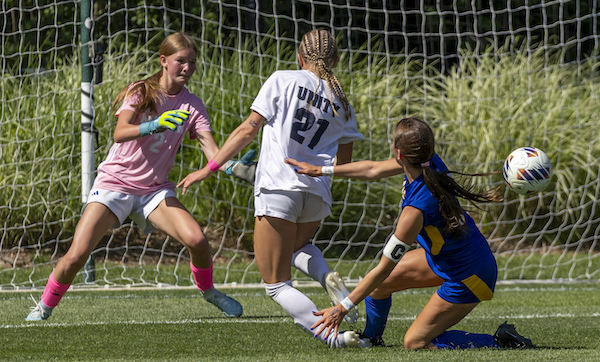 “The adrenaline was really pumping, and my teammate Scarlet played a really good ball over the top. I just saw it skim the center back’s head and I saw the goalie coming out, and knew I just had to put it over the top,” Saad said of her goal. “I just got my foot right there and stuck it to the laces, and it went right where I wanted.”
Hamway had a lot of praise for the intelligent shot that Saad played, showing the maturity of an upperclassman as opposed to a freshman.
“She can get in the seam, and we can play into her feet,” Hamway said of Saad. “She recognizes when she’s got to go back and cross-field dribble. She has so much confidence for a freshman. It’s rare for a kid to be creative, physically enough, and put a ball in the back of the net.
The goal was the only one to get past West Catholic senior keeper Katelyn Adams, who put up a strong effort in net.
Country Day put on even more pressure in the second half, but Adams shut the door on some great looks.
“She made some huge saves in the second half,” Falcons coach Ryan Smith said of Adams, who finished with seven saves in the match. “We went into a three-back and we pushed up and left some one-on-ones back there, and she made some huge saves.”
Country Day finished with a 15-1 shot advantage and had a 12-1 edge in corner kicks for the match. Hamway credited junior Georgia Hopkins, senior Ava Amezcua, junior Megan Mateer, and Lossia for their ball control as the reason for the offensive edge.
“Georgia really controls the game on offense. She wins all those flooded balls,” Hamway said. “Ava was in underneath, and it allowed Megan and Scarlett to be creative in the space out wide today.”
Despite the opportunities, West Catholic was never out of it. They had a few opportunities in Country Day territory during the closing minutes, but couldn’t put a shot on goal.
“(DCD) was good, obviously. They were super skilled,” Smith said. “They had some size that was tough for us to match, and they were a little deeper. Our girls battled to the end. We had it down with those long throws, so we gave it everything we had.”
The Falcons were appearing in their first Final on Saturday, and Smith beamed about the incredible run his team had this spring, including its first Regional championship.
“There’s nothing to be ashamed of. When I started here 10 years ago, and as a head coach seven years ago, we wanted to build a program. We’ve had so many teams come through here that have helped lay the foundation. I said to the girls, ‘You set the bar almost as high as you can,’” Smith said. “The last three months and the last three weeks of the playoffs was a heck of a ride.”
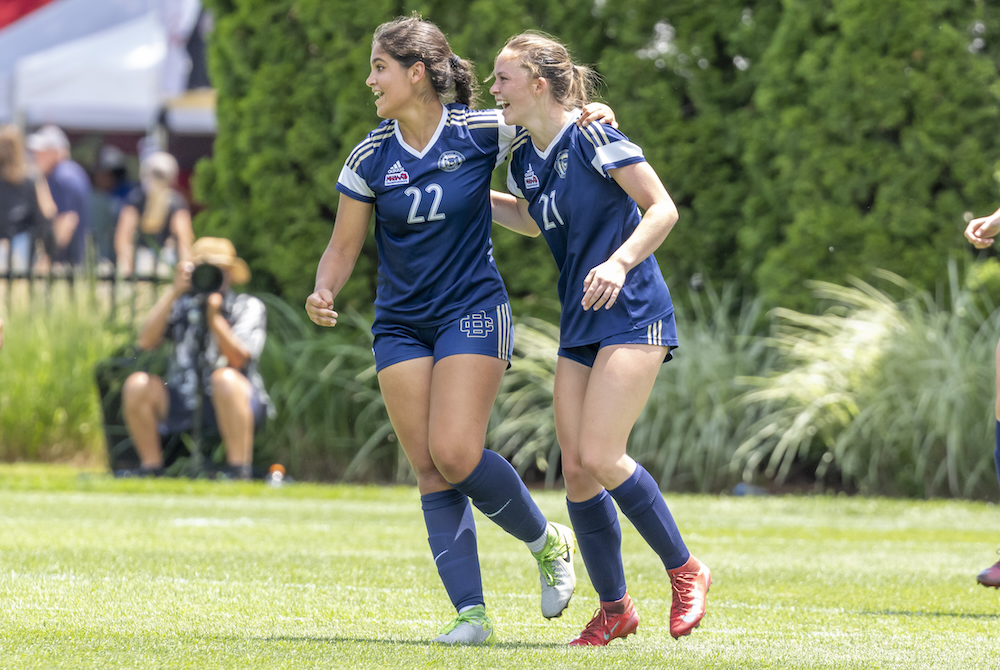
PHOTOS (Top) Detroit Country Day’s Megan Mateer (21) and Aliya Saad (22) enjoy a moment during their team’s Division 3 championship win Saturday at DeMartin Stadium. (Middle) Mateer controls possession while Grand Rapids West Catholic’s Elise Savickas (6) pursues. (Photos by Adam Sheehan/Hockey Weekly Action Photos.)