


Add, Subtract, Divide, Multiply: MHSAA Not Alone
July 25, 2017
By Rob Kaminski
MHSAA benchmarks editor
This is the third part in a series on MHSAA tournament classification, past and present, that will be published over the next two weeks. This series originally ran in this spring's edition of MHSAA benchmarks.
As the MHSAA faces its most recent classification task with 8-Player Football, and opinions continue to swirl about as to the method, timeframe, location and other procedures, a look around the country provides plenty of company among state association brethren factoring variables into their own equations.
In the Pacific Northwest, the Oregon School Activities Association Football Playoffs are under public scrutiny as leadership ponders a five or six classification format beginning with the 2018-19 school year.
The OSAA has crowned six champions on the gridiron since 2006-07. Many of the state’s smaller schools would like to keep it that way, while larger schools lean toward a five-classification system, citing larger leagues, ease of travel and credibility to state championships as the advantages.
Still others would prefer more than six classes, pointing to safety issues and the opportunity to increase participation numbers as positives.
Moving southeast of Oregon, the Nevada Interscholastic Activities Association recently voted to hold serve on a classification proposal that was volleyed to the membership.
However, changes still could be forthcoming by as early as the 2018-19 season which would add a fifth classification in more populated southern Nevada while allowing northern schools to participate in four classifications. Such divisions could mean no state championship for the fifth class in southern Nevada.
Because of that, the NIAA wants equal numbers of schools in each classification on both ends of the state. Complicating the issue is the fact that the 24 largest schools in the state, by enrollment, are all in Clark County in Southern Nevada.
Across Nevada’s border into Arizona, charter schools are asking the Arizona Interscholastic Association to reconsider classification that was voted upon and approved in September 2015. That agreement called for the largest 33 percent of charter schools by enrollment to be placed in the state’s largest school classification, 3A, the middle 33 percent into 2A, and the smallest 33 percent into 1A.
Less than two years later the charter schools have had a change of heart and have asked to be considered the same as other Arizona public schools and be placed appropriately by enrollment beginning with the 2018-19 school year.
The situation in Arizona further illustrates how the public/private debate that all state associations have faced throughout existence now has the added dynamic of rapidly growing charter schools in today’s educational system, along with virtual school enrollment.
In the nation’s heartland, Nebraska has retooled its football classifications by using enrollment of boys students only in its schools rather than total enrollment. The Nebraska School Activities Association football-playing schools will kick off the 2018 season using this alignment.
Nebraska has three classes of 11-player football, with the smallest class divided in two, Class C-1 and C-2. The state also will have 8-player football for boys enrollments under 47, and the NSAA will sponsor a new 6-player tournament in 2018 for schools with 27 or fewer boys.
“This is a good proposal because some schools have a sizable imbalance between the number of boys and girls, and there’s a large gap (in enrollment) between the largest and smallest schools in Classes A and B,” NSAA executive director Jim Tenopir said. “I think this addresses both of those concerns.”
Swimmers in Georgia, meanwhile, will feel like they are moving with the current, rather than upstream in 2017-18, as the Georgia High School Association recently doubled the number of team championship events from two to four.
Swim enthusiasts can also count on longer days at the finals, as the top 30 finishers from the prelims will advance to the finals instead of 20, and all championship events will have three heats versus two.
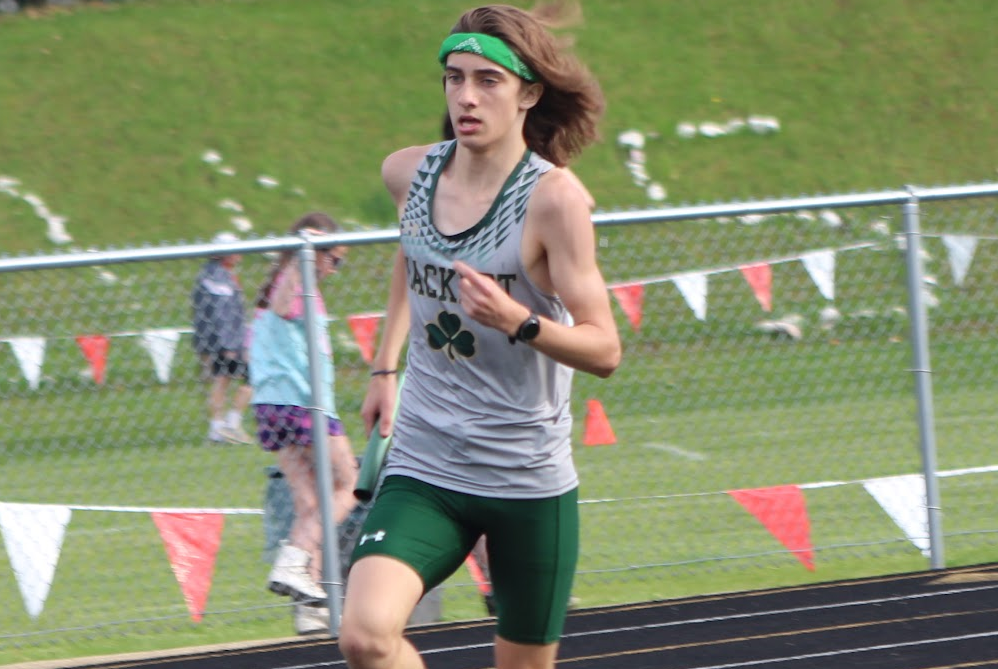
Hackett on Track to Roll Again with Distance Ace Among Those Leading Charge
By
Pam Shebest
Special for MHSAA.com
March 12, 2024
KALAMAZOO — After breaking one track record as a freshman, Marek Butkiewicz already has his eyes on two more.
 Not bad for a runner who did not even plan to run track during his years at Hackett Catholic Prep, a surprise to co-coach Shelly Germinder.
“I had heard plenty about him from some of the ultras (marathons) and different other races he had done,” Germinder said. "His commitment to the sport came through before we ever laid eyes on who he was. We knew he was going to be an asset to us.”
The current sophomore was not so sure.
“At the end of cross country (freshman year), I didn’t even think I wanted to do track,” Butkiewicz said. “Then I did it and it was ‘This is kind of fun.’
“I was good at it. I honestly didn’t have any desire going into (track season), and then I ran a couple fast times and I thought, ‘I can actually do this.’”
Butkiewicz said his freshman cross country season in 2022 was the first time he really took running seriously, and his interest was boosted when he ran a 17:31 at the Kalamazoo Christian Invitational.
“I was super happy to get the freshman record there,” he said.
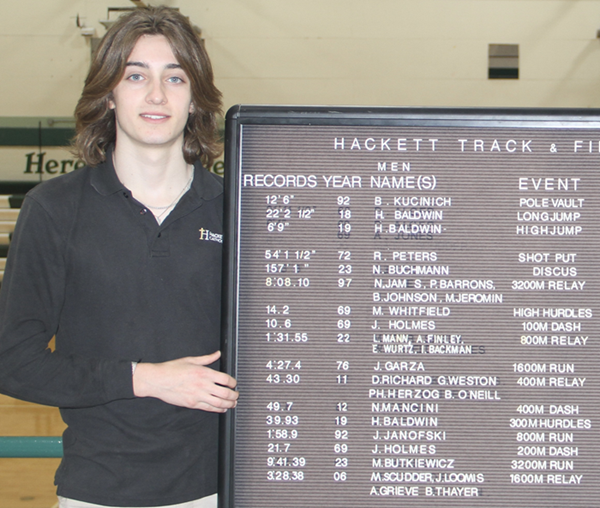
This past season, Butkiewicz shattered Hackett’s sophomore cross country record, running a personal best 16:12.2 at the MHSAA Lower Peninsula Division 4 Final, demolishing the record set by Bryan Martin (16:56) in 2000.
That record also has special meaning to Germinder. Martin is her brother.
 The Irish finished in third place at the Final last fall, one point behind Holland Calvary Christian.
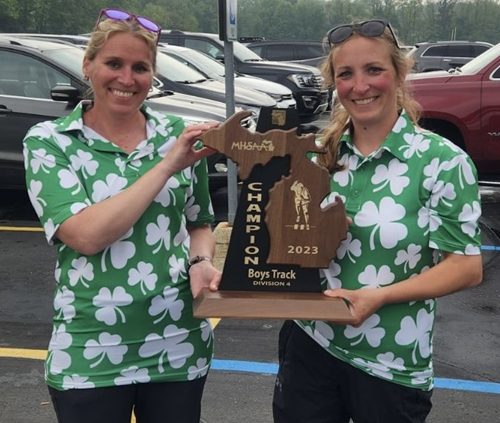
With the start of the spring sports season this week, the Hackett boys are hoping to make it three Finals track & field titles in a row and five over six years.
Last year’s boys team made it a sweep, winning the Southwestern Athletic Conference, Regionals, MHSAA Finals and Michigan Interscholastic Track Coaches Association (MITCA) Team State Finals.
The boys and girls teams also earned MITCA Division 4 academic awards, the girls with a cumulative 3.986 GPA and the boys with a 3.909 GPA.
This year’s team has grown from a combined 54 athletes last year to 64 with 38 boys and 26 girls.
“I think the students as a whole are seeing the successes of the team, but I also think it’s some of the flexibility we have in our sport,” Germinder said. “We know there are kids who want a dual sport and want to be involved in other things, and we want that for them, too.
“In a small school, we can’t be successful if we don’t have kids involved in multiple sports because there just aren’t enough bodies.”
Co-coach Charissa Dean said this year’s boys team will have a different look.
“We lost Liam (Mann), who was a really strong sprinter, and he left some big shoes to fill,” she said. “We have a nice nest egg of freshmen and sophomores.
“We had a junior (Gabe Oeurn) last year who is coming into his own, if you look at his track record from freshman to sophomore to junior. Last year, we had Sam Finley who was a freshman, and a sophomore (Jude Coffman) who was first time out.”
Lofty goals
Butkiewicz’s goal is to break his own school 3,200-meter record plus the 1,600-meter record, currently held by Jose Garza (4:27.4 set in 1976).
He’s pursuing a 9.25 in the 3,200 and 4.20 in the 1,600, while his long-term goal is breaking four minutes, hopefully running at a Division I university.
“His dedication, his commitment,” Germinder said. “You can’t teach that. That’s something he does on his own that comes from within. Snow, rain, whatever it is, he’s out there running, no matter what.”
The sophomore said he had no clue about records when he was a freshman, but after turning in a 10:37 in his first 3,200, then 10:05 followed by a 10 flat, he realized a record was in reach.
Butkiewicz credits his dedication for his success.
“I put in hundreds of miles a month, thousands a year, just into grinding and working toward goals,” he said. “I’ll shoot for 40-45 (miles) in-season. Offseason, when I’m building my aerobic base, I want 50 and upwards.”
As a freshman, he found a running buddy in then-junior Gavin Sehy.
“He was the fastest for the past two years and I was a little ahead of him, so we just stuck with each other and trained together,” Butkiewicz said. “Over the winter we started doing a couple miles together.”
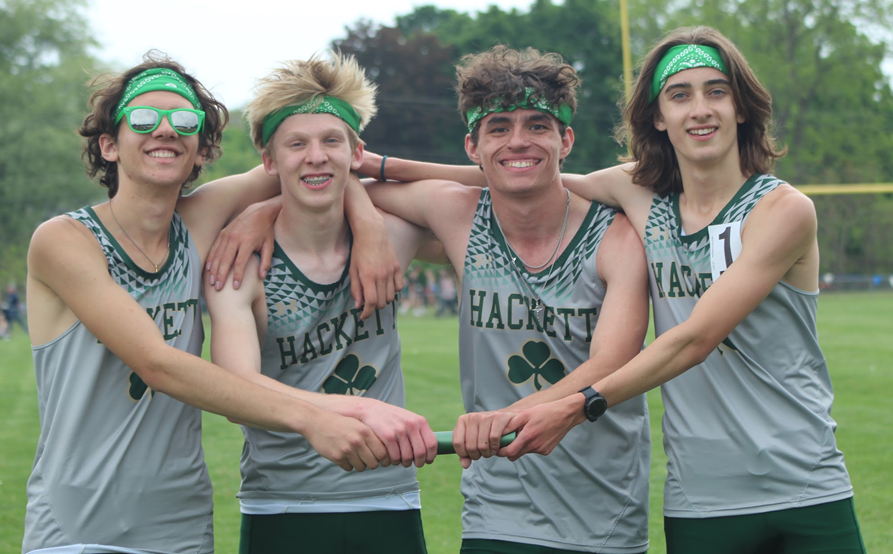
 Sehy, who is headed to Southwestern Michigan College in the fall, is shooting to break the school’s 800 record plus the 3,200 running with Nick Doerr, Alex Dumont and Butkiewicz.
Sehy was also a running buddy in cross country, finishing second on the team at 16:21.
“(Sehy) always had the potential, but it wasn’t until Marek came along that he started doing that training in the summer,” Dean said. “It has made a massive difference.”
Sehy and Butkiewicz competed in two ultramarathons (more than 26.2 miles) over the summer.
“I had never ran a marathon before, but somehow Marek convinced me to run 38 miles at Kettle Moraine State Forest (Wisconsin),” Sehy said. “And I did. Later in the summer, I ran 50 in Holly, Michigan.”
In the Wisconsin ultra, Butkiewicz was trying to finish the 100-mile run with Sehy pacing him for about 40 miles.
“I ended dropping at mile 75 because of some hip issues but he kept going and finished it,” Butkiewicz said. “The second one in Holly, I was doing 100 miles and he was doing 50, so we pretty much ran together for the first 50.”
Sehy said the two share the same mentality, which makes it easy to have a training buddy.
“We both really want it so bad, and we’re not afraid to do crazy things to get it,” he said. “Last year, during track, we needed to get some more miles in but just ran out of time during the week, so Sunday night we were out running 18 miles until after the sun went down out in the forest.”
Germinder said Sehy has noted he needs to have another runner to really push him.
“That’s one of the really beautiful things about the relationship they have,” she said. “It’s a healthy competition between them, but they want what’s best for each other, too.”
Butkiewicz lives near a land preserve where the two do much of their training, no matter what the weather, and they make it fun, jumping icy puddles and eating berries along the way.
“The coldest day of the year we ran with no shirts just because we could,” Sehy laughed.
When Sehy isn’t available to train, “I’ve been training a lot with Sean Siems; he’s a sophomore, a huge rising talent,” Butkiewicz said.
New year, new leaders
This year’s team will have a different look.
“We lost Liam and Bryce Brown and Nathan Buchmann (discus and only individual Finals champ),” Sehy said. “It’s tough to lose your best guys, but I think we have so much depth on this team, I think we’ll be all right.”
Just two weeks into the young season, Hackett will be on spring break, so many of the athletes pushed the coaches to schedule a meet before then.
 They found one in the Onsted Early Bird Meet on March 20.
“They want to see where they are going into spring break to know, is there extra work we need to do during spring break,” Germinder said. “Having a competition will tell them where they’re at.
“If you do nothing (over spring break), then you’re starting all over again. I think a lot of our athletes recognize that and know they have to work a little more.”
Besides Butkiewicz and Sehy, leaders on the team include pole vaulters/sprinters Jack Prom and Lauren Wild.
“Keegan Gallagher is our biggest cheerleader and keeps the team in good spirits,” Germinder added. “He brings something that isn’t just on the track.”
With such large numbers, “If they’re not competing, we like to take them with us on the bus anyway,” Dean said. “They can help support their teammates, they can run a stopwatch, they can take video of the relay handoffs so we can go back and look at it later.”
In spite of the success on the track or in the field, Germinder said she is most proud of the athletes as people.
“With that leadership comes responsibility of good sportsmanship, how they’re interacting with other teams on the line,” she said. “I love watching our boys praying together with other teams before they’re getting ready to run. Or shaking hands before or after, especially sprinting events. It says a lot about who we are.”
 Pam Shebest served as a sportswriter at the Kalamazoo Gazette from 1985-2009 after 11 years part-time with the Gazette while teaching French and English at White Pigeon High School. She can be reached at [email protected] with story ideas for Calhoun, Kalamazoo and Van Buren counties.
PHOTOS (Top) Kalamazoo Hackett Catholic Prep’s Marek Butkiewicz rounds a curve during a race last season. (2) Butkiewicz shows the school record board, including his 3,200 entry earned last season. (3) Hackett track coaches Charissa Dean, left, and Shelly Germinder hold up last season’s MHSAA Finals championship trophy. (4) The Hackett 3,200 relay, from left: Gavin Sehy, Alex Dumont, Nick Doerr and Butkiewicz. (Action, coaches and relay photos courtesy of the Kalamazoo Hackett Catholic Prep boys track & field program; record board photo by Pam Shebest.)