

Add, Subtract, Divide, Multiply: MHSAA Not Alone
July 25, 2017
By Rob Kaminski
MHSAA benchmarks editor
This is the third part in a series on MHSAA tournament classification, past and present, that will be published over the next two weeks. This series originally ran in this spring's edition of MHSAA benchmarks.
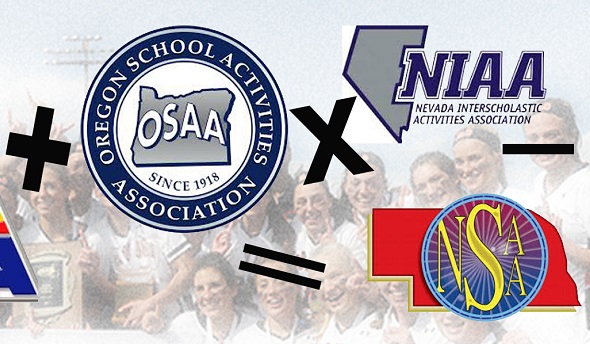
As the MHSAA faces its most recent classification task with 8-Player Football, and opinions continue to swirl about as to the method, timeframe, location and other procedures, a look around the country provides plenty of company among state association brethren factoring variables into their own equations.
In the Pacific Northwest, the Oregon School Activities Association Football Playoffs are under public scrutiny as leadership ponders a five or six classification format beginning with the 2018-19 school year.
The OSAA has crowned six champions on the gridiron since 2006-07. Many of the state’s smaller schools would like to keep it that way, while larger schools lean toward a five-classification system, citing larger leagues, ease of travel and credibility to state championships as the advantages.
Still others would prefer more than six classes, pointing to safety issues and the opportunity to increase participation numbers as positives.
Moving southeast of Oregon, the Nevada Interscholastic Activities Association recently voted to hold serve on a classification proposal that was volleyed to the membership.
However, changes still could be forthcoming by as early as the 2018-19 season which would add a fifth classification in more populated southern Nevada while allowing northern schools to participate in four classifications. Such divisions could mean no state championship for the fifth class in southern Nevada.
Because of that, the NIAA wants equal numbers of schools in each classification on both ends of the state. Complicating the issue is the fact that the 24 largest schools in the state, by enrollment, are all in Clark County in Southern Nevada.
Across Nevada’s border into Arizona, charter schools are asking the Arizona Interscholastic Association to reconsider classification that was voted upon and approved in September 2015. That agreement called for the largest 33 percent of charter schools by enrollment to be placed in the state’s largest school classification, 3A, the middle 33 percent into 2A, and the smallest 33 percent into 1A.
Less than two years later the charter schools have had a change of heart and have asked to be considered the same as other Arizona public schools and be placed appropriately by enrollment beginning with the 2018-19 school year.
The situation in Arizona further illustrates how the public/private debate that all state associations have faced throughout existence now has the added dynamic of rapidly growing charter schools in today’s educational system, along with virtual school enrollment.
In the nation’s heartland, Nebraska has retooled its football classifications by using enrollment of boys students only in its schools rather than total enrollment. The Nebraska School Activities Association football-playing schools will kick off the 2018 season using this alignment.
Nebraska has three classes of 11-player football, with the smallest class divided in two, Class C-1 and C-2. The state also will have 8-player football for boys enrollments under 47, and the NSAA will sponsor a new 6-player tournament in 2018 for schools with 27 or fewer boys.
“This is a good proposal because some schools have a sizable imbalance between the number of boys and girls, and there’s a large gap (in enrollment) between the largest and smallest schools in Classes A and B,” NSAA executive director Jim Tenopir said. “I think this addresses both of those concerns.”
Swimmers in Georgia, meanwhile, will feel like they are moving with the current, rather than upstream in 2017-18, as the Georgia High School Association recently doubled the number of team championship events from two to four.
Swim enthusiasts can also count on longer days at the finals, as the top 30 finishers from the prelims will advance to the finals instead of 20, and all championship events will have three heats versus two.
Kenowa Hills Rallies Early, but St. Mary's Rallies Late to Claim Latest Title
By
Keith Dunlap
Special for MHSAA.com
June 13, 2026
EAST LANSING — The McLane Stadium scoreboard definitely had to be a strange sight for Orchard Lake St. Mary’s early in Saturday’s Division 2 Final against Grand Rapids Kenowa Hills.
En route to 26 straight wins entering the game, St. Mary’s had routinely recorded lopsided wins, but found itself trailing an inspired Kenowa Hills team by four runs after three innings of play.
But while it was unfamiliar territory, panic certainly didn’t set in.
“We were calm, cool and collected,” Eaglets senior Hudson Brzustewicz said. “We knew we were going to put up runs. It was just a matter of time before the bats got hot and balls started dropping.”
Brzustewicz couldn’t have been more right, as St. Mary’s rallied for a 6-4 win in eight innings to add another Finals championship trophy to its collection.
The Eaglets (34-5) have now won seven titles and five since 2015 – four in Division 2 and the 2022 Division 1 crown.
It also gave head coach Nick DiPonio his first title as a coach after winning one as a player for St. Mary’s in 1998.
“They never had a doubt that they had it within themselves to persevere through everything,” DiPonio said. “It makes it that much sweeter.”
In the eighth inning with the game tied 4-4, junior Joseph Schilp started the winning rally with a sharp one-out single to left-center field. Schilp took second base on a passed ball, then went to third on a bunt single by senior Nate Baumann.
St. Mary’s senior and No. 9 hitter Preston Duff then brought Schilp home with another bunt single inside the third-base line to give their team a 5-4 lead.
 With two outs, Eaglets senior Luke Crighton hit an RBI single to make it 6-4.
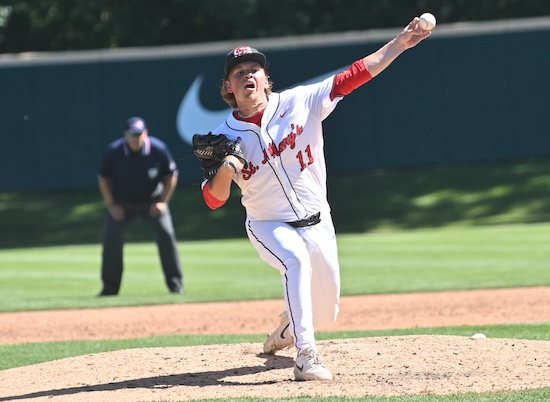
Kenowa Hills put runners on first and second with two outs in the bottom of the eighth inning, but St. Mary’s senior left-handed reliever Anthony Abela ended the game on a strikeout.
Abela came on in the fourth inning and provided five innings of scoreless relief, striking out six.
Making its first trip to a Final, Kenowa Hills finished 36-3.
“We just gave up a couple too many runs,” Knights head coach Todd VandenHeuvel said. “They outhit us (13-6). If we could have gotten a couple more baserunners on and stayed aggressive like we were and put more pressure on them, it might have been a different outcome. But very proud of the kids."
Kenowa Hills got off to a good start, taking a 1-0 lead in the bottom of the first inning on an RBI single up the middle by Andrew Lake to score senior Brennan Gustinis, who led off the inning with a double.
The Knights took a 2-0 lead in the third inning on junior Will Fussman’s RBI triple to the gap in right-center.
With two outs, an attempted steal of home by Fussman worked, as an errant St. Mary’s throw got behind the catcher, allowing Fussman to score and make it 3-0.
Kenowa Hills then made it 4-0 later in the inning when it executed a double steal perfectly with runners on first and third. With the runner on first breaking for second, senior Mason Peebles charged for home and slid underneath the tag at home plate after St. Mary’s cut off the throw to second and threw back to home.
The Eagles got one run back in the fourth, cutting the lead to 4-1 on an RBI groundout by senior Derick Conrad.
In the sixth inning, St. Mary’s made a move, cutting the Kenowa Hills lead to 4-3 on a two-run double to the gap in right-center by senior Tyler Shubnell.
The Eaglets then tied the game at 4-4 on an RBI single by Bauman.
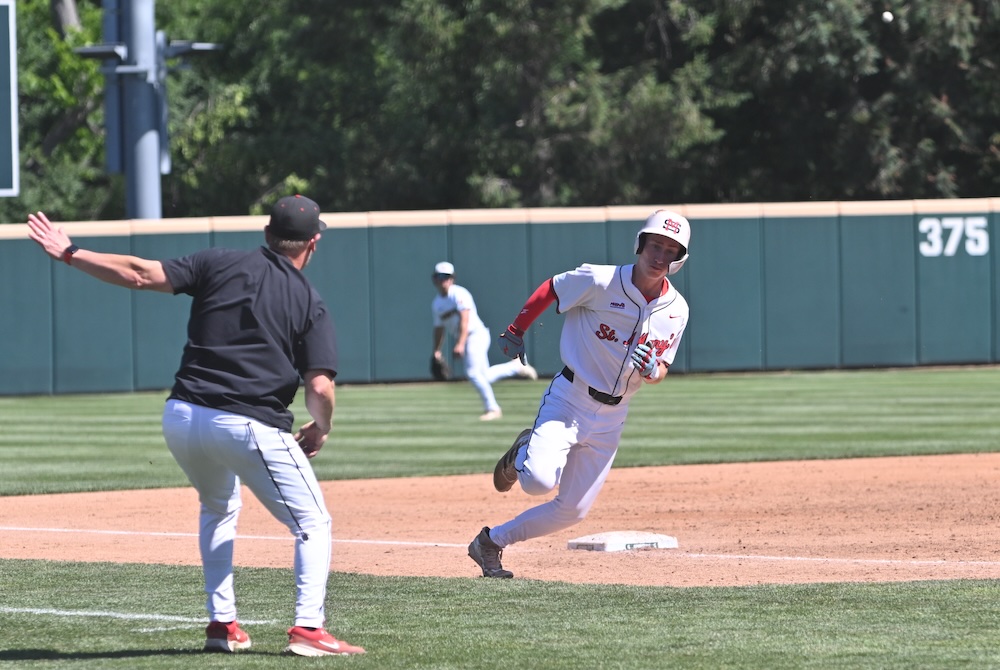
PHOTOS (Top) An Orchard Lake St. Mary's runner rounds third base Saturday as a Kenowa Hills throw comes in from the outfield. (Middle) Eaglets reliever Anthony Abela delivers a pitch.