

Add, Subtract, Divide, Multiply: MHSAA Not Alone
July 25, 2017
By Rob Kaminski
MHSAA benchmarks editor
This is the third part in a series on MHSAA tournament classification, past and present, that will be published over the next two weeks. This series originally ran in this spring's edition of MHSAA benchmarks.
As the MHSAA faces its most recent classification task with 8-Player Football, and opinions continue to swirl about as to the method, timeframe, location and other procedures, a look around the country provides plenty of company among state association brethren factoring variables into their own equations.
In the Pacific Northwest, the Oregon School Activities Association Football Playoffs are under public scrutiny as leadership ponders a five or six classification format beginning with the 2018-19 school year.
The OSAA has crowned six champions on the gridiron since 2006-07. Many of the state’s smaller schools would like to keep it that way, while larger schools lean toward a five-classification system, citing larger leagues, ease of travel and credibility to state championships as the advantages.
Still others would prefer more than six classes, pointing to safety issues and the opportunity to increase participation numbers as positives.
Moving southeast of Oregon, the Nevada Interscholastic Activities Association recently voted to hold serve on a classification proposal that was volleyed to the membership.
However, changes still could be forthcoming by as early as the 2018-19 season which would add a fifth classification in more populated southern Nevada while allowing northern schools to participate in four classifications. Such divisions could mean no state championship for the fifth class in southern Nevada.
Because of that, the NIAA wants equal numbers of schools in each classification on both ends of the state. Complicating the issue is the fact that the 24 largest schools in the state, by enrollment, are all in Clark County in Southern Nevada.
Across Nevada’s border into Arizona, charter schools are asking the Arizona Interscholastic Association to reconsider classification that was voted upon and approved in September 2015. That agreement called for the largest 33 percent of charter schools by enrollment to be placed in the state’s largest school classification, 3A, the middle 33 percent into 2A, and the smallest 33 percent into 1A.
Less than two years later the charter schools have had a change of heart and have asked to be considered the same as other Arizona public schools and be placed appropriately by enrollment beginning with the 2018-19 school year.
The situation in Arizona further illustrates how the public/private debate that all state associations have faced throughout existence now has the added dynamic of rapidly growing charter schools in today’s educational system, along with virtual school enrollment.
In the nation’s heartland, Nebraska has retooled its football classifications by using enrollment of boys students only in its schools rather than total enrollment. The Nebraska School Activities Association football-playing schools will kick off the 2018 season using this alignment.
Nebraska has three classes of 11-player football, with the smallest class divided in two, Class C-1 and C-2. The state also will have 8-player football for boys enrollments under 47, and the NSAA will sponsor a new 6-player tournament in 2018 for schools with 27 or fewer boys.
“This is a good proposal because some schools have a sizable imbalance between the number of boys and girls, and there’s a large gap (in enrollment) between the largest and smallest schools in Classes A and B,” NSAA executive director Jim Tenopir said. “I think this addresses both of those concerns.”
Swimmers in Georgia, meanwhile, will feel like they are moving with the current, rather than upstream in 2017-18, as the Georgia High School Association recently doubled the number of team championship events from two to four.
Swim enthusiasts can also count on longer days at the finals, as the top 30 finishers from the prelims will advance to the finals instead of 20, and all championship events will have three heats versus two.
Stoney Creek Finishes as Best from Rochester, Best in all of Division 1
By
Tom Kendra
Special for MHSAA.com
March 1, 2024
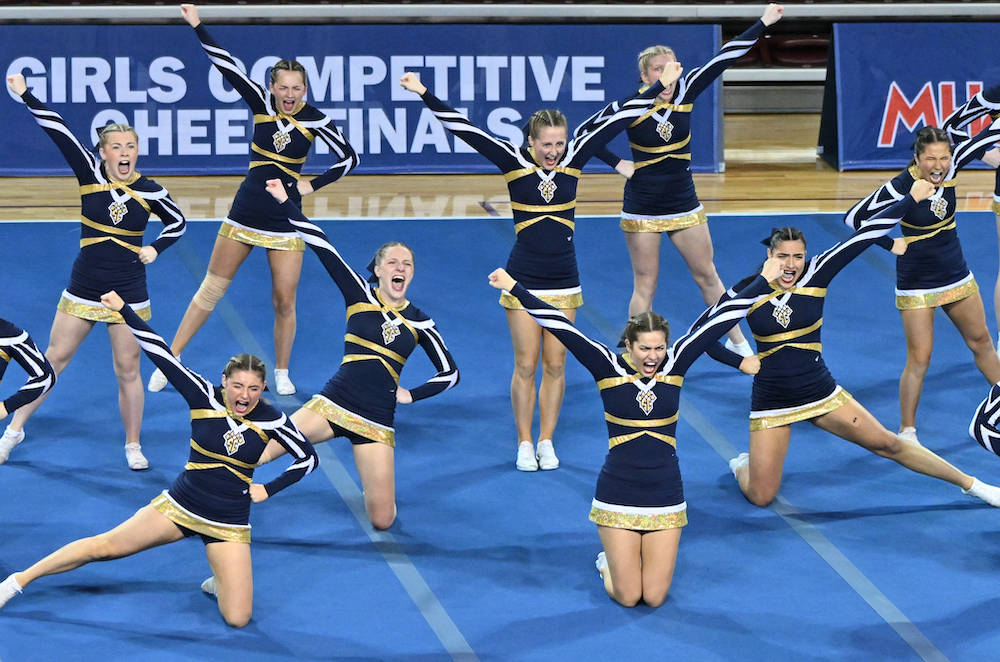
MOUNT PLEASANT – “The Rochester Invitational,” an event also known as the Division 1 Competitive Cheer Finals, proved Friday how a great rivalry pushes everyone to be their best.
The MHSAA represents schools covering more than 96,000 square miles in Michigan, but the Division 1 battle came down to three Rochester Community Schools all located within four miles of each other – Rochester, Rochester Adams and Rochester Hills Stoney Creek.
The teams have tussled at the Oakland Activities Association Red level, followed by District, Regional and Finals for years, with the difference between them often coming down to a tenth of a point, or less.
Rochester Adams won the Finals for the third-straight year in 2022, Rochester took the title last year and, appropriately enough, Stoney Creek led from start-to-finish and won Friday at Central Michigan University’s McGuirk Arena.
“Today was our day, and it feels great,” said Stoney Creek senior Charlotte Cahill. “It’s so tough. All three of our teams have experienced the close losses and the wins. It’s three great teams, and it comes down to the little, tiny, minute details.”
Stoney Creek finished with a three-round score of 792.98 - good for a 1.42-point margin of victory over second-place Adams (791.56), with Rochester a mere two-tenths of a point further back in third at 791.36.
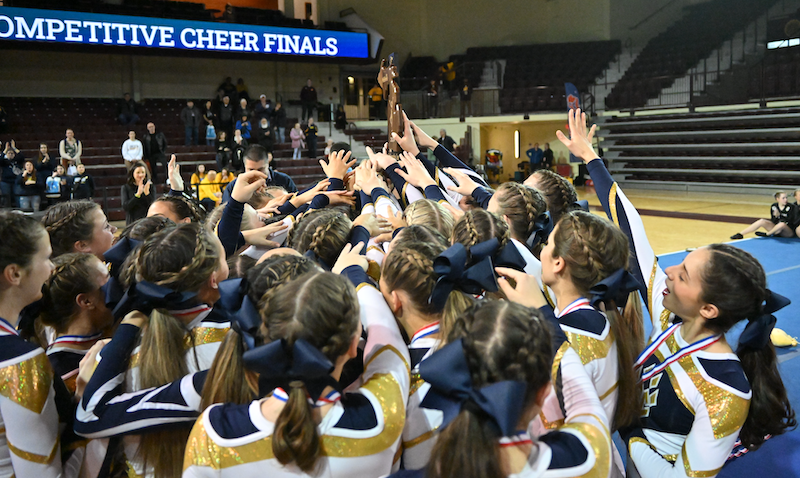
The Cougars captured their third Finals title, after winning most recently in 2019.
The competition was close throughout, with Stoney Creek holding the lead going into the pivotal third round, but with both Rochester and Adams less than two points behind.
McGuirk Arena was absolutely rocking with more than 3,000 fans as the three Rochester schools went back-to-back-to-back in the third round – first Stoney Creek, then Adams, then Rochester – to decide the title.
All three delivered nearly flawless performances, executing every stunt and basket toss with precision, with every flyer strong at the top.
 “What you have to understand is that it’s not like this just at state,” said Stoney Creek coach Tricia Williams, who is in her 21st season. “We do this on almost a weekly basis, so we feel this same pressure and we get better at learning how to handle it. Today, our girls handled it wonderfully.”
Adams actually posted the best score of the three schools in the final round, which was enough to leapfrog 2023 champion Rochester for second place but not enough to overtake Stoney Creek, which was slightly better than Adams in both Round 1 and Round 2.
“There’s a lot of attention on Round 3, but it takes all three rounds,” explained Williams, who is assisted by Andrea Cairns, Kayla Kenan, Jessica Ma and Susan Wood. “Against this good of competition, we have to be as perfect as we can in every round.”
While some cheer teams check the standings between each round and possibly adjust their strategy accordingly, the Cougars absolutely do not look at the scores.
“That’s one of our values as a team is not knowing the score,” explained senior Abby DeGraw. “We don’t think it makes sense to change the way that we’re performing. We just try to do our best each round and let the score take care of itself.”
That strategy worked to perfection Friday, as Stoney Creek went out with wins at Regionals and Finals after finishing second in the conference behind Rochester and second at Districts behind Adams. The Cougars’ winning score of 792.98 on Friday was just shy of their season-best of 793.56, which was good for second place at Districts.
Seniors Alison Kalaj and DeGraw, both returning all-staters, are two of the leaders for Stoney Creek, along with Cahill (second team in 2023) and Ariana Rabaut (honorable mention).
Other seniors for the Cougars were Kacey Bauer, Gracie Darling, Sofia Finazzo, Lily Leone, Laura Machak, Helena Merritt and Jane Stabnick.
Adams, which took home the runner-up trophy for the second-straight year after a three-peat as champions from 2020 to 2022, nearly roared back for the title with the best Round 3 score (322.10).
“I would say that was our best Round 3, not only of the season, but in years,” said 10th-year Adams coach Brooke Miller, who had just five seniors and just one returning all-state honoree in Lily Hittle (honorable mention). “They nailed it. They couldn’t have done any more.”
Miller and Williams exchanged a hug after the awards ceremony, full of mutual respect, and both expect the three-way Rochester rivalry to continue for the foreseeable future.
“The bottom line is that these three schools are pushing each other to be amazing,” said Miller. “It’s tenths of a point that you’re fighting for, and that forces you to be the best coach and the best athlete that you can be.”
Hartland placed fourth, followed by Macomb L’Anse Creuse North and Brighton.
PHOTOS (Top) Rochester Hills Stoney Creek competes during Friday’s Division 1 Finals at McGuirk Arena. (Middle) The Cougars celebrate their championship. (Photos by Hockey Weekly Action Photos.)