

Add, Subtract, Divide, Multiply: MHSAA Not Alone
July 25, 2017
By Rob Kaminski
MHSAA benchmarks editor
This is the third part in a series on MHSAA tournament classification, past and present, that will be published over the next two weeks. This series originally ran in this spring's edition of MHSAA benchmarks.
As the MHSAA faces its most recent classification task with 8-Player Football, and opinions continue to swirl about as to the method, timeframe, location and other procedures, a look around the country provides plenty of company among state association brethren factoring variables into their own equations.
In the Pacific Northwest, the Oregon School Activities Association Football Playoffs are under public scrutiny as leadership ponders a five or six classification format beginning with the 2018-19 school year.
The OSAA has crowned six champions on the gridiron since 2006-07. Many of the state’s smaller schools would like to keep it that way, while larger schools lean toward a five-classification system, citing larger leagues, ease of travel and credibility to state championships as the advantages.
Still others would prefer more than six classes, pointing to safety issues and the opportunity to increase participation numbers as positives.
Moving southeast of Oregon, the Nevada Interscholastic Activities Association recently voted to hold serve on a classification proposal that was volleyed to the membership.
However, changes still could be forthcoming by as early as the 2018-19 season which would add a fifth classification in more populated southern Nevada while allowing northern schools to participate in four classifications. Such divisions could mean no state championship for the fifth class in southern Nevada.
Because of that, the NIAA wants equal numbers of schools in each classification on both ends of the state. Complicating the issue is the fact that the 24 largest schools in the state, by enrollment, are all in Clark County in Southern Nevada.
Across Nevada’s border into Arizona, charter schools are asking the Arizona Interscholastic Association to reconsider classification that was voted upon and approved in September 2015. That agreement called for the largest 33 percent of charter schools by enrollment to be placed in the state’s largest school classification, 3A, the middle 33 percent into 2A, and the smallest 33 percent into 1A.
Less than two years later the charter schools have had a change of heart and have asked to be considered the same as other Arizona public schools and be placed appropriately by enrollment beginning with the 2018-19 school year.
The situation in Arizona further illustrates how the public/private debate that all state associations have faced throughout existence now has the added dynamic of rapidly growing charter schools in today’s educational system, along with virtual school enrollment.
In the nation’s heartland, Nebraska has retooled its football classifications by using enrollment of boys students only in its schools rather than total enrollment. The Nebraska School Activities Association football-playing schools will kick off the 2018 season using this alignment.
Nebraska has three classes of 11-player football, with the smallest class divided in two, Class C-1 and C-2. The state also will have 8-player football for boys enrollments under 47, and the NSAA will sponsor a new 6-player tournament in 2018 for schools with 27 or fewer boys.
“This is a good proposal because some schools have a sizable imbalance between the number of boys and girls, and there’s a large gap (in enrollment) between the largest and smallest schools in Classes A and B,” NSAA executive director Jim Tenopir said. “I think this addresses both of those concerns.”
Swimmers in Georgia, meanwhile, will feel like they are moving with the current, rather than upstream in 2017-18, as the Georgia High School Association recently doubled the number of team championship events from two to four.
Swim enthusiasts can also count on longer days at the finals, as the top 30 finishers from the prelims will advance to the finals instead of 20, and all championship events will have three heats versus two.
TC West Girls Repeat, FHNE's Grzelak Adds Sweep to Family's Success
By
James Cook
Special for MHSAA.com
February 26, 2024
HARBOR SPRINGS – A Grzelak state champion seems to be the norm.
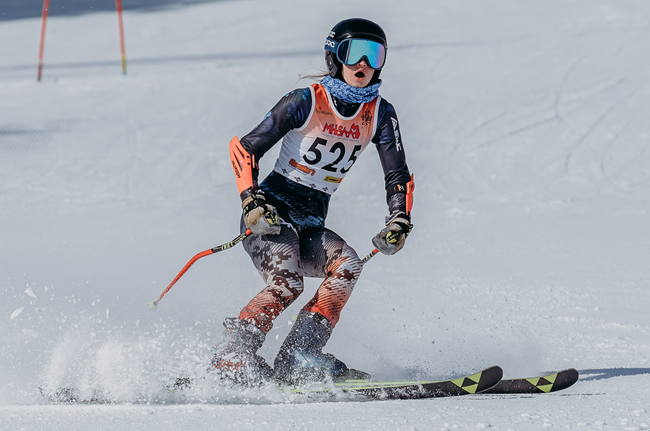
Katie Grzelak became the latest in the family to etch her name into the Michigan record books, becoming the third to claim an MHSAA Ski Finals championship over the last five years.
Her older sister Holly won the 2021 Division 1 slalom title also for Grand Rapids Forest Hills Northern/Eastern, while cousin Anna (who skied for Marquette) shared the slalom title with Traverse City Central’s Quinn Gerber a season ago.
Katie one-upped them both, sweeping the slalom and giant slalom titles this time around at Boyne Highlands.
“It’s a family tradition,” Katie Grzelak said. “I've been working towards it for a while now. It just felt good to finally put it together.”
Last year, she took second behind Rochester Adams’ Katie Fodale in GS and third in slalom. She’s been all-state six times in three seasons.
“It pretty cool,” said Marquette junior Sam Dehlin, a former teammate of Anna Grzelak who won the 2024 boys slalom title. “They really have a good thing going with the Grzelaks.”
Katie Grzelak said she was already receiving texts from relatives from all over asking if she extended the family tradition.
“I wasn't really expecting it, but I was really happy in the end,” she said. “I probably could have gone harder. I was happy with it, so I didn't feel the need to put too much down.”
Traverse City West's girls repeated as team champion, going back-to-back for the first time since the 2005-06 and 2006-07 seasons. TC West's girls also won the state's top spot in the academic all-state awards, with a team grade-point average of 3.886.
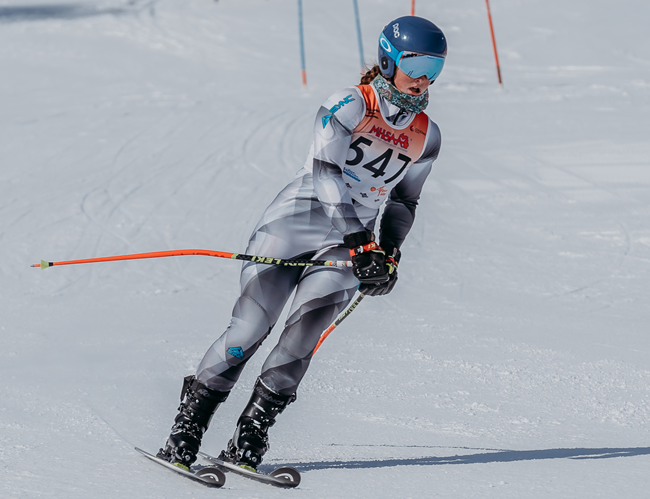
West junior Olivia Bageris came out of the fourth flight to place second in both the slalom and giant slalom.
The five-time all-stater leads a Titans team that's aiming to extend its Finals championship streak at least another year, despite losing three of its top six skiers after this one.
 "The goal is obviously to make it a three-peat," Bageris said. "Central, our best friends but our biggest rivals. It always comes down to the day of the race. Conference races are always different than the state meet, but the goal would be to make it a three-peat."
West also gets freshman Sarah Shapiro back from injury next season.
"It means a lot," Bageris said. "It hasn't happened in a while. The boys have done it, and we've kind of always been like the underdogs and overlooked compared to our boys. They had a great day, too. So that was exciting. But it means a lot to be able to do this two years in a row. Our freshman year, we come in runner-up and it was exciting because we were kind of unexpected to get that high up. But in the end, we really all wanted to win."
The Titans led by a single point (19-20) after the morning giant slalom session, but felt confident because the team's strength all season has been slalom. West outpointed Central 19-32 in slalom.
"We were only ahead by one point, so we knew we had to go for it," Bageris said. "My friend Ellie (Gruber), she had a really great day, came out skied really amazing. She definitely helped. It was a team sport today."
Gruber took seventh in GS, with Lila Warren 10th. Erinn Hale, Kellan Kudary and Quinn Gerber took eighth, fifth and fourth for Central.
West won the girls title with 38 points, compared to Central's runner-up total of 52. The rest of the field consisted of Clarkston (110), Marquette (158.5), Birmingham United (203), Milford (231), West Bloomfield (243), Brighton (242.5) and White Lake Lakeland (290).
Bageris was joined by Titans teammates Gruber (seventh), Dillyn Mohr (eighth) and Warren (ninth) in the slalom top 10, with Central represented by Gerber (third) and Cady Madion (10th), with Hale just behind in 11th.
West head coach Ed Johnson said he thinks the Titans can seriously make a run at three in a row next season.
"I think we can," Johnson said. "We're losing a couple, but we'll be back pretty strong."
Gerber took third in giant slalom and fourth in slalom to earn her third and fourth all-state spots in two seasons on varsity.
"West has a really good team, and we definitely wanted to show that we could compete," Gerber said. "We scared them a little bit, but they ended up with it."
Central brings back its entire varsity team next season and has several talented middle schoolers coming up as well.
"We want to get it, so we'll be working all offseason," Gerber said.
Traverse City as a whole was the day's big winner.
The Trojans and Titans took first and second in both boys and girls. Traverse City accomplished the same feat last year, although West won two championships and Central took runner-up honors in both.
"It's good for Traverse City to bring that clean sweep again," TC West head coach Ed Johnson said. "That's one of the things I'm most excited about is to see that clean sweep for Traverse City. One-two for the boys, one-two for the girls. It goes from one side of town to the other, but it's all good."
Traverse City Central and West have combined to win the last four Division 1 titles in both boys and girls.
Twenty-three of the 40 first-team all-state spots went to skiers from Traverse City, with another 17 on the second team.
Only four spots in the slalom top-10 didn’t go to Central or West. After Grzelak, Grand Haven’s Neave Rewa was fourth, Birmingham’s Blanca Srock fifth and Clarkston’s Cameron Thomas sixth.
The same applied to GS, where Holly’s Finley DeCubber placed third, Berkley’s Tessa Rontal was sixth and Rewa placed ninth.
PHOTOS (Top) Grand Rapids Forest Hills Northern/Eastern's Katie Grzelak skis a championship run Monday at Boyne Highlands. (Middle) Traverse City Central's Olivia Bageris completes a run for the eventual team champion. (Photos by Tori Burley. Click for more; photos will be added throughout this week.)