

Add, Subtract, Divide, Multiply: MHSAA Not Alone
July 25, 2017
By Rob Kaminski
MHSAA benchmarks editor
This is the third part in a series on MHSAA tournament classification, past and present, that will be published over the next two weeks. This series originally ran in this spring's edition of MHSAA benchmarks.
As the MHSAA faces its most recent classification task with 8-Player Football, and opinions continue to swirl about as to the method, timeframe, location and other procedures, a look around the country provides plenty of company among state association brethren factoring variables into their own equations.
In the Pacific Northwest, the Oregon School Activities Association Football Playoffs are under public scrutiny as leadership ponders a five or six classification format beginning with the 2018-19 school year.
The OSAA has crowned six champions on the gridiron since 2006-07. Many of the state’s smaller schools would like to keep it that way, while larger schools lean toward a five-classification system, citing larger leagues, ease of travel and credibility to state championships as the advantages.
Still others would prefer more than six classes, pointing to safety issues and the opportunity to increase participation numbers as positives.
Moving southeast of Oregon, the Nevada Interscholastic Activities Association recently voted to hold serve on a classification proposal that was volleyed to the membership.
However, changes still could be forthcoming by as early as the 2018-19 season which would add a fifth classification in more populated southern Nevada while allowing northern schools to participate in four classifications. Such divisions could mean no state championship for the fifth class in southern Nevada.
Because of that, the NIAA wants equal numbers of schools in each classification on both ends of the state. Complicating the issue is the fact that the 24 largest schools in the state, by enrollment, are all in Clark County in Southern Nevada.
Across Nevada’s border into Arizona, charter schools are asking the Arizona Interscholastic Association to reconsider classification that was voted upon and approved in September 2015. That agreement called for the largest 33 percent of charter schools by enrollment to be placed in the state’s largest school classification, 3A, the middle 33 percent into 2A, and the smallest 33 percent into 1A.
Less than two years later the charter schools have had a change of heart and have asked to be considered the same as other Arizona public schools and be placed appropriately by enrollment beginning with the 2018-19 school year.
The situation in Arizona further illustrates how the public/private debate that all state associations have faced throughout existence now has the added dynamic of rapidly growing charter schools in today’s educational system, along with virtual school enrollment.
In the nation’s heartland, Nebraska has retooled its football classifications by using enrollment of boys students only in its schools rather than total enrollment. The Nebraska School Activities Association football-playing schools will kick off the 2018 season using this alignment.
Nebraska has three classes of 11-player football, with the smallest class divided in two, Class C-1 and C-2. The state also will have 8-player football for boys enrollments under 47, and the NSAA will sponsor a new 6-player tournament in 2018 for schools with 27 or fewer boys.
“This is a good proposal because some schools have a sizable imbalance between the number of boys and girls, and there’s a large gap (in enrollment) between the largest and smallest schools in Classes A and B,” NSAA executive director Jim Tenopir said. “I think this addresses both of those concerns.”
Swimmers in Georgia, meanwhile, will feel like they are moving with the current, rather than upstream in 2017-18, as the Georgia High School Association recently doubled the number of team championship events from two to four.
Swim enthusiasts can also count on longer days at the finals, as the top 30 finishers from the prelims will advance to the finals instead of 20, and all championship events will have three heats versus two.
Lowell Enters Another Elite Group of Champs with 11th-Straight Finals Win
By
Paul Costanzo
Special for MHSAA.com
February 24, 2024
KALAMAZOO – There’s nothing quite like the roar of a crowd after your team has clinched an MHSAA Team Wrestling Finals title.
That’s true whether it’s for title No. 1, or, in the case of Casey Engle and his Lowell teammates Saturday, for their program’s 11th-straight Division 2 championship.
“It’s unreal,” Engle said. “It’s something I look forward to every year.”
Lowell extended its record run of wrestling team titles by defeating Freeland 49-21 in the Division 2 Final at Wings Events Center.
The Red Arrows joined the Grosse Pointe South (1976-86) and Grosse Pointe Woods University Liggett (1980-90) girls tennis programs in winning 11 straight Finals titles. Only East Grand Rapids boys swimming & diving, winning 15 straight from 1948-62, and Bloomfield Hills Brother Rice boys lacrosse – with 13 straight from 2005-17 – have longer Finals championship streaks in Lower Peninsula or statewide competition.
“I mean, it’s possible (to reach 15),” said sophomore Jarrett Smith, whose pin at 106 pounds clinched the title. “It’s hard to predict that far, four years into the future. We’re losing some key guys, but we graduated 14 last year, five this year, so we’re returning some firepower.”
Lowell is always returning firepower, and it’s consistently adding it, too, giving new waves of Red Arrows the chance to raise a wooden mitten.
That’s why for coach RJ Boudro, each title remains just as sweet as the last.
“Why would it get old?” said Boudro, who has been in charge for 10 of those titles. “Look at the crowd. When I first walked in here, I looked up, and you see that we have more fans here than anybody else, and that’s what it’s about. Next year will be fun, too. When you can still bring crowds in and you can do it 11 years in a row, there’s more to that than just winning. If it was just about winning, why else would they come? They would probably think it was a foregone conclusion. They love the kids; they love the community.”
One could forgive an outsider for believing it’s a foregone conclusion when Lowell takes the mat for the Division 2 postseason, as it’s won the Final by more than 20 points in each of the past five seasons and in seven of its 11 straight championship victories.
 So to avoid that feeling creeping into his wrestling room, Boudro makes it clear the Red Arrows’ responsibility isn’t just to win on the mat, but to strive for something bigger.
“We’re not doing it to just win state championships,” Boudro said. “We’re trying to find out who we are, we’re trying to be better men, better women, better coaches. So, it’s not just about winning, it’s about being a better person. Whether I’m a coach or a kid, just trying to find a way to be better. When you’re doing that all the time, you get better, but you feel like you have a purpose. Every single guy on the team feels like they have a purpose, and that’s really important.”
Just 14 wrestlers can step onto the mat in a single dual, and the same number is the max a team can enter into the individual postseason, so accomplishing that can sometimes be as tough as anything else for Lowell wrestlers, and certainly helps motivate them throughout the season – foregone conclusions or not.
“One of our signs up there I saw, it says, ‘Tradition never graduates,’ and it’s true,” Smith said. “We just keep the kids coming. Even our B Team, C Team are competing at the highest level. At the beginning of Districts, we had 17 ranked guys, and you can only send 14. So we have just great partners all around.”
Freeland, meanwhile, was making its first appearance in a Final, after getting to the Quarterfinals for the third time in program history.
“Outstanding. Outstanding. They’ve been giving their all every match,” Freeland coach Scott VanLuven said. “They’ve been doing it all year. We beat Brighton, we weren’t supposed to. We beat (Bay City) John Glenn in our conference, then we had to beat them again in our District Final when we weren’t supposed to. No one gave us really a chance down here, I think. But they believed, and they did well.”
The Falcons (25-3) still had a shot with three matches to go, trailing 31-21. But Smith put a quick end to that with his pin at 106, and that was followed by a pair of pins from Cole and Carter Cichocki at 113 and 120, respectively.
Of the Arrows’ nine wins in the dual, eight came by either pin or technical fall, as Jackson Blum (138), Jared Boone (165) and Engle (190) also won by pinfall. Logan Dawson (132) and Owen Segorski (144) each won by tech. Cody Foss (126) opened the dual with a win by decision for Lowell (22-3).
Fabian Facundo (150) and Bringham Smith (285) each won by pin for Freeland, while Noah Graham (157), Gibson Shepard (175) and Elijah Murphy (215) all won by decision.
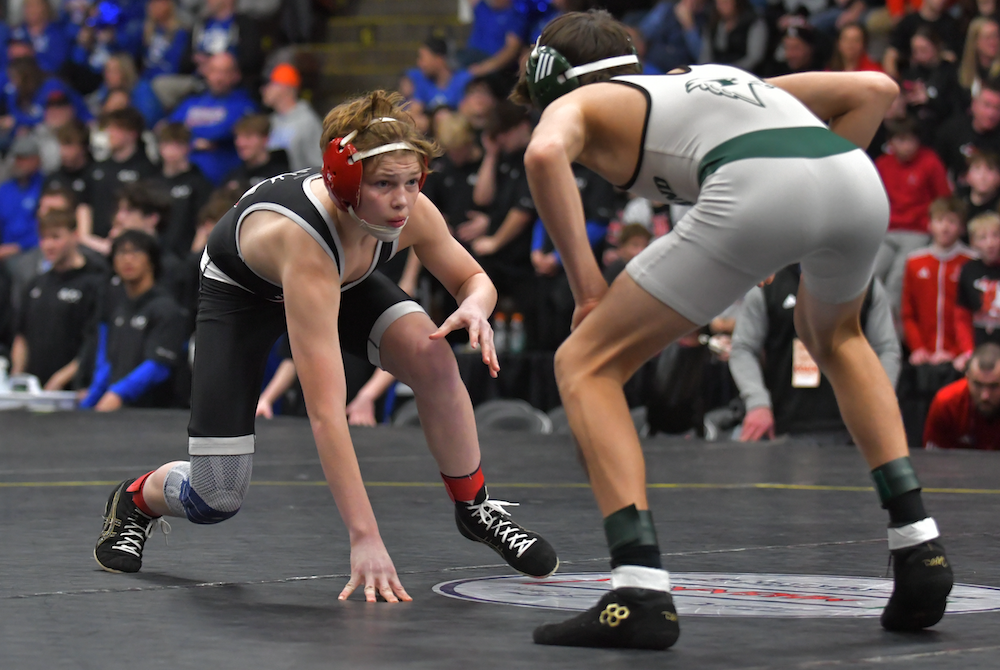
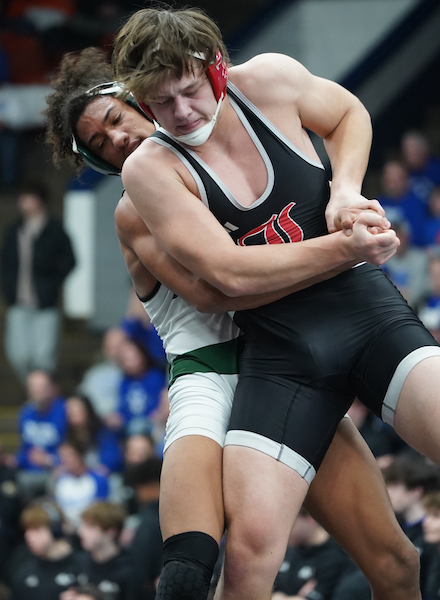
PHOTOS (Top) Lowell’s Cole Cichocki, left, lines up against Freeland’s Michael Wilson at 113 pounds Saturday. (Middle) The Falcons’ Elijah Murphy, left, locks up Lowell’s Ari McFarland at 215. (Click for more from High School Sports Scene.)