

Add, Subtract, Divide, Multiply: MHSAA Not Alone
July 25, 2017
By Rob Kaminski
MHSAA benchmarks editor
This is the third part in a series on MHSAA tournament classification, past and present, that will be published over the next two weeks. This series originally ran in this spring's edition of MHSAA benchmarks.
As the MHSAA faces its most recent classification task with 8-Player Football, and opinions continue to swirl about as to the method, timeframe, location and other procedures, a look around the country provides plenty of company among state association brethren factoring variables into their own equations.
In the Pacific Northwest, the Oregon School Activities Association Football Playoffs are under public scrutiny as leadership ponders a five or six classification format beginning with the 2018-19 school year.
The OSAA has crowned six champions on the gridiron since 2006-07. Many of the state’s smaller schools would like to keep it that way, while larger schools lean toward a five-classification system, citing larger leagues, ease of travel and credibility to state championships as the advantages.
Still others would prefer more than six classes, pointing to safety issues and the opportunity to increase participation numbers as positives.
Moving southeast of Oregon, the Nevada Interscholastic Activities Association recently voted to hold serve on a classification proposal that was volleyed to the membership.
However, changes still could be forthcoming by as early as the 2018-19 season which would add a fifth classification in more populated southern Nevada while allowing northern schools to participate in four classifications. Such divisions could mean no state championship for the fifth class in southern Nevada.
Because of that, the NIAA wants equal numbers of schools in each classification on both ends of the state. Complicating the issue is the fact that the 24 largest schools in the state, by enrollment, are all in Clark County in Southern Nevada.
Across Nevada’s border into Arizona, charter schools are asking the Arizona Interscholastic Association to reconsider classification that was voted upon and approved in September 2015. That agreement called for the largest 33 percent of charter schools by enrollment to be placed in the state’s largest school classification, 3A, the middle 33 percent into 2A, and the smallest 33 percent into 1A.
Less than two years later the charter schools have had a change of heart and have asked to be considered the same as other Arizona public schools and be placed appropriately by enrollment beginning with the 2018-19 school year.
The situation in Arizona further illustrates how the public/private debate that all state associations have faced throughout existence now has the added dynamic of rapidly growing charter schools in today’s educational system, along with virtual school enrollment.
In the nation’s heartland, Nebraska has retooled its football classifications by using enrollment of boys students only in its schools rather than total enrollment. The Nebraska School Activities Association football-playing schools will kick off the 2018 season using this alignment.
Nebraska has three classes of 11-player football, with the smallest class divided in two, Class C-1 and C-2. The state also will have 8-player football for boys enrollments under 47, and the NSAA will sponsor a new 6-player tournament in 2018 for schools with 27 or fewer boys.
“This is a good proposal because some schools have a sizable imbalance between the number of boys and girls, and there’s a large gap (in enrollment) between the largest and smallest schools in Classes A and B,” NSAA executive director Jim Tenopir said. “I think this addresses both of those concerns.”
Swimmers in Georgia, meanwhile, will feel like they are moving with the current, rather than upstream in 2017-18, as the Georgia High School Association recently doubled the number of team championship events from two to four.
Swim enthusiasts can also count on longer days at the finals, as the top 30 finishers from the prelims will advance to the finals instead of 20, and all championship events will have three heats versus two.
Longtime Officials, Statistician Honored for Decades as 'Behind-the-Scenes' Heroes
By
Paul Costanzo
Special for MHSAA.com
February 23, 2024
BROWN CITY – Jerry Sauder thought he was going to be a presenter Thursday night, as his alma mater Brown City was honoring officials Curt Lowe and Joel Venia and school statistician Todd Vandewarker for their decades of service.
 But that was simply a ruse by fellow official Tom Mailloux and Brown City athletic director Tony Burton to get Sauder there to join the ceremony and receive his own award for 50 years as an official.
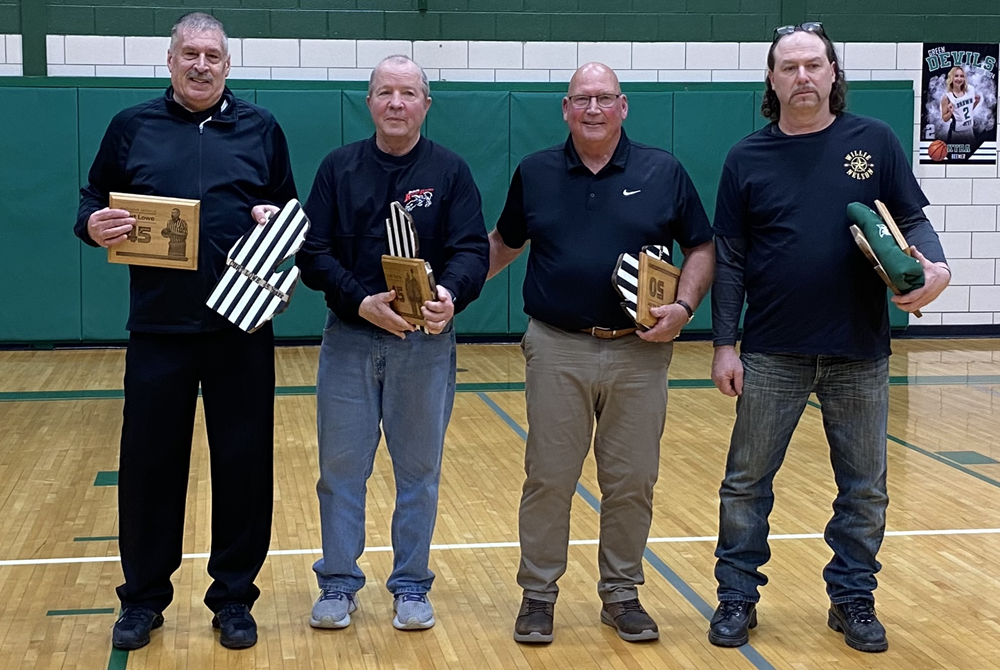
With Sauder on the court, 175 total years of involvement with athletics were honored between the JV and varsity Unionville-Sebewaing vs. Brown City girls basketball games. Sauder spent 50 years as an official, Lowe and Venia 45, and Vandewarker has spent 35 years as a statistician, all across multiple sports.
“Tonight, we gather to pay tribute to those whose steadfast dedication has woven the fabric of excellence into the tapestry of Michigan high school athletics,” Brown City principal Brad Hale said to kick off the ceremony. “It is with profound gratitude that we extend our heartfelt appreciation to the unsung heroes behind the scenes – the pillars whose tireless efforts ensure that each game unfolds seamlessly, each moment etched with the spirit of sportsmanship and fair play. … Tonight, we shine a spotlight on a few whose commitment spans decades, illuminating the path for generations of athletes to follow.”
Sauder’s 50 years as an official included 25 as a Division I college basketball referee. He is currently working in an administrative role with Elite Officiating, overseeing officials in the Michigan Intercollegiate Athletic Association, Great Lakes Intercollegiate Athletic Conference and Wolverine-Hoosier Athletic Conference. He’s officiated NCAA Tournament games and contests around the world after getting noticed at a camp at Western Michigan University.
“I’ve always said I’m the luckiest guy to put on a shirt,” he said. “I was fortunate enough to be selected to be given the opportunity. There’s a lot of guys that could have, but weren’t set up to do it at that time.”
During his time as a high school official, Sauder reffed MHSAA Finals for basketball and football. He also spent time officiating baseball and softball games.
He began officiating when his best friend Jim Seidell, a longtime coach and administrator in Brown City, convinced him to start. Sauder knows his path isn’t a common one, and that it’s not easy to convince people to get into officiating. But with perseverance, opportunities are available.
 “There’s a dire need right now,” Sauder said. “We’ve got to do something because if we don’t, high school sports as we know it is going to suffer. … I was fortunate to have good people around me that mentored me. Kids start, they last a couple years and they walk away from it. They don’t pay enough money to get yelled at like people go at you now. I don’t blame the young people.”
Lowe, who officiated Thursday night’s JV game before the ceremony, got his start thanks to Sauder and Seidell. Also a Brown City graduate, Lowe’s 45 years of officiating include multiple assignments at MHSAA Football and Basketball Finals. He’s also been on the court for women’s college basketball games.
“Officiating is like family,” Lowe said. “I have met so many people – wonderful people. And, over 45 years, it’s been a ton.”
While he’s worked plenty of games in the Thumb, much of Lowe’s time as an official was spent in the Saginaw and Flint area, where he was able to officiate games featuring some of the state’s greatest athletes, including Mateen Cleaves, Draymond Green, Mark Ingram and the late Charles Rogers.
“Those were the best games, and Jerry got me in there,” Lowe said. “That was the best ball ever. It was just amazing to watch.”
Lowe’s crew Thursday night included a pair of younger officials who later officiated the varsity game with Mailloux. Lowe thinks it’s a great opportunity for athletes who want to stay connected to sports.
Venia’s start in officiating was more by happenstance. He was working the scoreboard for rec basketball games in his hometown of Marysville, and one day needed to fill in as an official. After reffing the game, he made $10 as opposed to the $5 he got for running the scoreboard, and made the move.
He’s still doing football games but is no longer on the basketball court or softball or baseball diamonds.
“It’s probably the contacts you make in the little towns,” Venia said about what has kept him in the officiating business. “I go down to the Macomb area and do that. In football, we always take five games up in the Thumb. I know so many people up here. With the kids, it keeps you younger, keeps you moving.”
Like Sauder and Lowe, Venia has officiated multiple MHSAA Football and Basketball Finals.
 He played football, basketball and baseball in high school, and thinks that experience can be “tremendous” for future officials. But he was quick to point out that those who don’t have that experience can also thrive.
“I’ve worked with a couple guys that never played,” Venia said. “(Mailloux) never played football, but he’s a good football official. I mentored a guy that never played basketball, Jordan Stevens, who is the softball coach at South Dakota State. He never played basketball, never played football, but he was a very good official. I think it gives you an advantage, but by no means is it a barrier if you haven’t played.”
The person with the best seat in the house as Sauder, Lowe and Venia have run up and down the court or football field in Brown City has been Vandewarker, who was celebrated for his decades of service as a statistician.
When asked how he got started, he pointed at Burton.
“That guy suckered me into it,” Vandewarker said with a laugh.
Vandewarker was himself a Brown City athlete, competing in football, basketball and track. Over his more than three decades keeping stats, he’s seen several great Green Devils and opposing athletes – so many that he couldn’t narrow them down.
“A couple thousand (games),” he said. “I’ve seen some stuff, I’ve seen some good stuff. A lot of good players. Too many memorable ones to mention, I guess. I’ve seen the best of the coaches and heard everything they have to say. Best of the refs – I was in high school and Jerry Sauder was reffing my games.”
At that point, Vandewarker had to step away and start the pregame clock for varsity warm-ups. But when he came back, he had an idea of how long he may remain at the center of Brown City athletics.
“I always said as long as Tony and Cindy (Burton, Brown City’s assistant AD) were around,” he said. “But I don’t know. I’ll probably go for another 10-15, put a good 50 in. I think I got that in me, still.”
 Paul Costanzo served as a sportswriter at The Port Huron Times Herald from 2006-15, including three years as lead sportswriter, and prior to that as sports editor at the Hillsdale Daily News from 2005-06. He can be reached at [email protected] with story ideas for Genesee, Lapeer, St. Clair, Sanilac, Huron, Tuscola, Saginaw, Bay, Arenac, Midland and Gladwin counties.
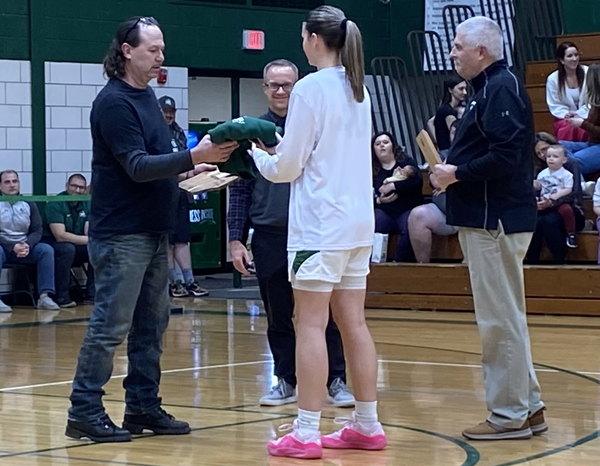
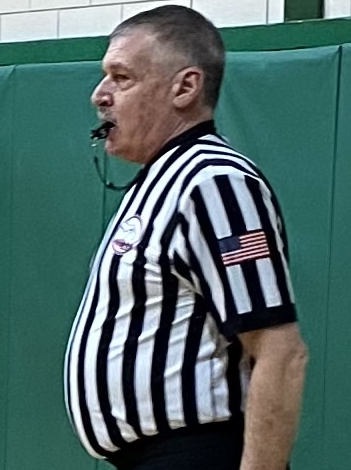
PHOTOS (Top) From left: MHSAA-registered officials Curt Lowe, Joel Venia and Jerry Sauder and Brown City statistician Todd Vandewarker stand together as they are celebrated Thursday at Brown City. (Middle) Vanderwarker receives his award for 35 years as a school statistician. (Below) Lowe refs the junior varsity game before the recognition ceremony. (Photos by Paul Costanzo.)