

Add, Subtract, Divide, Multiply: MHSAA Not Alone
July 25, 2017
By Rob Kaminski
MHSAA benchmarks editor
This is the third part in a series on MHSAA tournament classification, past and present, that will be published over the next two weeks. This series originally ran in this spring's edition of MHSAA benchmarks.
As the MHSAA faces its most recent classification task with 8-Player Football, and opinions continue to swirl about as to the method, timeframe, location and other procedures, a look around the country provides plenty of company among state association brethren factoring variables into their own equations.
In the Pacific Northwest, the Oregon School Activities Association Football Playoffs are under public scrutiny as leadership ponders a five or six classification format beginning with the 2018-19 school year.
The OSAA has crowned six champions on the gridiron since 2006-07. Many of the state’s smaller schools would like to keep it that way, while larger schools lean toward a five-classification system, citing larger leagues, ease of travel and credibility to state championships as the advantages.
Still others would prefer more than six classes, pointing to safety issues and the opportunity to increase participation numbers as positives.
Moving southeast of Oregon, the Nevada Interscholastic Activities Association recently voted to hold serve on a classification proposal that was volleyed to the membership.
However, changes still could be forthcoming by as early as the 2018-19 season which would add a fifth classification in more populated southern Nevada while allowing northern schools to participate in four classifications. Such divisions could mean no state championship for the fifth class in southern Nevada.
Because of that, the NIAA wants equal numbers of schools in each classification on both ends of the state. Complicating the issue is the fact that the 24 largest schools in the state, by enrollment, are all in Clark County in Southern Nevada.
Across Nevada’s border into Arizona, charter schools are asking the Arizona Interscholastic Association to reconsider classification that was voted upon and approved in September 2015. That agreement called for the largest 33 percent of charter schools by enrollment to be placed in the state’s largest school classification, 3A, the middle 33 percent into 2A, and the smallest 33 percent into 1A.
Less than two years later the charter schools have had a change of heart and have asked to be considered the same as other Arizona public schools and be placed appropriately by enrollment beginning with the 2018-19 school year.
The situation in Arizona further illustrates how the public/private debate that all state associations have faced throughout existence now has the added dynamic of rapidly growing charter schools in today’s educational system, along with virtual school enrollment.
In the nation’s heartland, Nebraska has retooled its football classifications by using enrollment of boys students only in its schools rather than total enrollment. The Nebraska School Activities Association football-playing schools will kick off the 2018 season using this alignment.
Nebraska has three classes of 11-player football, with the smallest class divided in two, Class C-1 and C-2. The state also will have 8-player football for boys enrollments under 47, and the NSAA will sponsor a new 6-player tournament in 2018 for schools with 27 or fewer boys.
“This is a good proposal because some schools have a sizable imbalance between the number of boys and girls, and there’s a large gap (in enrollment) between the largest and smallest schools in Classes A and B,” NSAA executive director Jim Tenopir said. “I think this addresses both of those concerns.”
Swimmers in Georgia, meanwhile, will feel like they are moving with the current, rather than upstream in 2017-18, as the Georgia High School Association recently doubled the number of team championship events from two to four.
Swim enthusiasts can also count on longer days at the finals, as the top 30 finishers from the prelims will advance to the finals instead of 20, and all championship events will have three heats versus two.
Several Officials Give Time, Talents to Grant $21,000 in Scholarships at 22nd LMCCOA Meet
By
Steve Vedder
Special for MHSAA.com
February 14, 2024
Jane Plaisted thinks it's one of those rare high school sporting events where scores and winners are secondary.
Instead, the focus of the recent Lake Michigan Competitive Cheer Officials Association meet is what the event could do for 75 seniors who competed in the sprawling 45-team meet at Byron Center.
All proceeds from the event went to fund scholarships for seniors who opted to write essays and then competed in the annual 22-year-old, three-division meet. The competition, which was completely run by LMCCOA judges, raised $21,000 to up its fundraising total to over $200,000 since the meet originated in 2001.
"It was a glorious day," said Plaisted, an LMCCOA member who has participated in 15 of the competitions. "The girls are happy, we're happy to give our time and it's such a positive day. We love being a part of it."
The event drew teams from as far away as St. Johns, DeWitt, Kalamazoo and Howard City Tri County. The chance to earn scholarship money was open to all 190 seniors who competed, and 75 chose to write an essay about "talking to their younger self and determining how competitive cheer has helped the athlete," said Stacy Smith, the president of the Michigan Cheer Judges Association. Smith said much of the event's dual goal is to promote competitive cheer while helping senior athletes wherever there is a financial need.
 The meet started with just five teams and a few hundred dollars in scholarships in 2001, but has blossomed into one of the largest single-day high school sports fundraisers in the state. The meet, which has been held at Byron Center three times as well as schools such as Caledonia and East Kentwood, reached a peak of raising $25,000 a year ago.
What makes the day particularly special, Smith said, is that between 50 and 70 members of the LMCCOA annually show up to donate their time without knowing how their abilities will be put to use. In addition to judging the meet, members handle virtually every other aspect of the competition, from taking tickets, working the concession stand, filling water bottles, scoring, running a 50/50 raffle and whatever else organizers can find for them to do.
"Cheer athletes aren't always recognized a lot for their work, but it's a sport where (Michigan) colleges have gained notoriety at the national level and now offer scholarships," Smith said. "It's become a big deal in the state. Division I and II schools and NAIA schools all offer scholarships now. This can help."
Seniors who choose to participate write their essay prior to the meet, and then a committee of judges pore over the writings during the meet. Winners are announced following the competition. Twenty-one seniors were awarded scholarship money.
Smith said few parents probably grasp how much detail goes into running a long, grueling Saturday event.
"I'm not sure if people realize all the hands that have to make this happen," she said. "We've been doing it for 20 years, and for us it's like riding a bike. You never forget. It's just a wonderful day.
"I'm not surprised people want to be part of it and step up wherever they're needed."
Plaisted said judges sign up for jobs when they arrive at the meet. A judge can be officiating an event one minute and selling hot dogs moments later. The 'work wherever needed' attitude of judges, she said, is what makes the event a popular destination for participating schools.
"As officials, we emphasize young women participating," she said. "That old concept of the dumb blonde cheerleader doesn't exist anymore. This is an accomplished group of girls who we support. If you talk to any of (the judges), this meet is one of the most fun things we're going to do all season.
 "It's become so popular. We gave away like $50 the first year, and since then we've grown from one long day to two sessions so we could increase the number of teams. Everyone goes home with a smile on their face, which for officials doesn't always happen."
Paw Paw cheer coach Stefanie Miller, whose team won the Division 3 portion of the meet, said coaches look forward to taking their teams to the meet.
"Absolutely because it's all about community," she said. "We talk to the girls about service and giving back. It's definitely a teachable moment, not only for the kids but for the adults, too, knowing what goes to the seniors."
"What I like best is that it promotes the athletes and all the work they put in. It's about giving back to them," added Brighton coach Christina Wilson, whose team won the Division 1 competition. "So many teams want to attend, and the coaches want the players to have a chance at a scholarship.
"I'm just in awe of seeing so many people there who are willing to give their energy for the kids."
One of Miller's favorite parts of the meet is watching fathers do a cheer "jump off" of their own tongue-in-cheek cheering skills while waiting for the final scores. She also loves volunteers making nearly 200 bows for participants to wear during the meet.
"Fathers do these cheerleader-type (routines) while there is a lull and it's just great," she said. "It's fun stuff like that that makes the day so special. It's all about giving back."
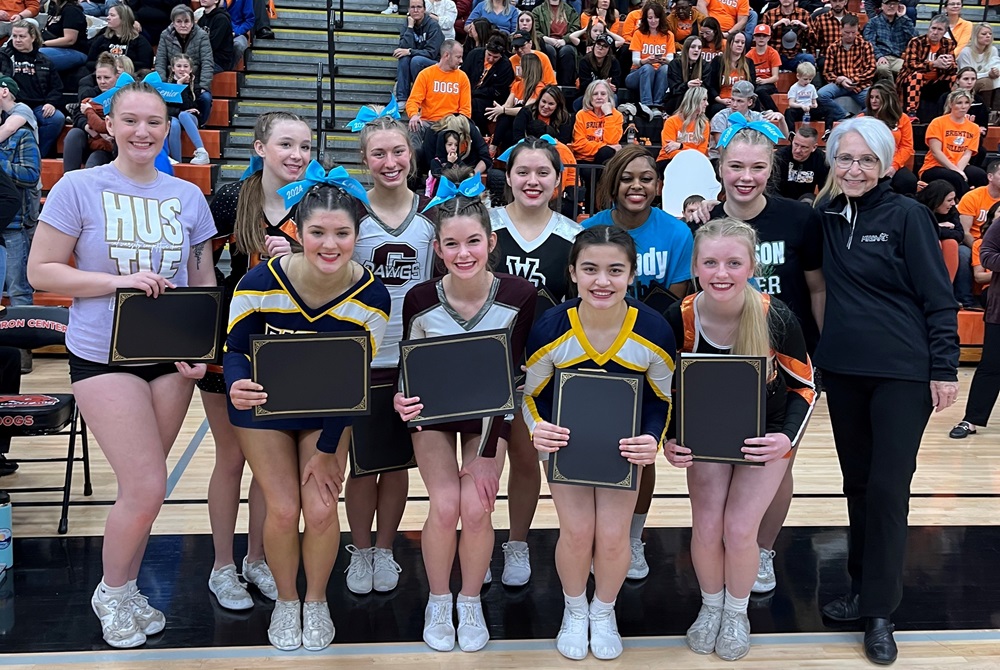
PHOTOS (Top) MHSAA official Jane Plaisted takes a photo with this year’s LMCCOA Division 1 scholarship winners. (Middle) Several officials contribute to making the meet an unforgettable experience. (Below) The LMCCOA also awarded scholarships to seniors from Division 2 and 3 schools. (Photos courtesy of Stacy Smith.)