

Add, Subtract, Divide, Multiply: MHSAA Not Alone
July 25, 2017
By Rob Kaminski
MHSAA benchmarks editor
This is the third part in a series on MHSAA tournament classification, past and present, that will be published over the next two weeks. This series originally ran in this spring's edition of MHSAA benchmarks.
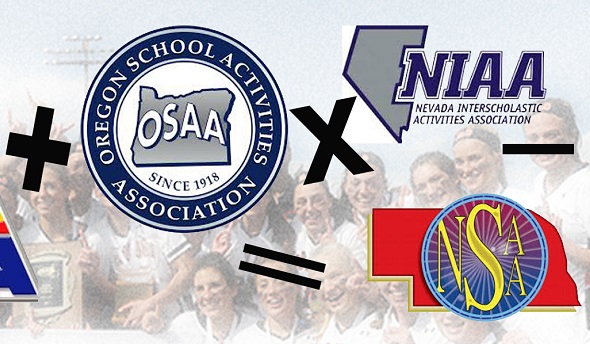
As the MHSAA faces its most recent classification task with 8-Player Football, and opinions continue to swirl about as to the method, timeframe, location and other procedures, a look around the country provides plenty of company among state association brethren factoring variables into their own equations.
In the Pacific Northwest, the Oregon School Activities Association Football Playoffs are under public scrutiny as leadership ponders a five or six classification format beginning with the 2018-19 school year.
The OSAA has crowned six champions on the gridiron since 2006-07. Many of the state’s smaller schools would like to keep it that way, while larger schools lean toward a five-classification system, citing larger leagues, ease of travel and credibility to state championships as the advantages.
Still others would prefer more than six classes, pointing to safety issues and the opportunity to increase participation numbers as positives.
Moving southeast of Oregon, the Nevada Interscholastic Activities Association recently voted to hold serve on a classification proposal that was volleyed to the membership.
However, changes still could be forthcoming by as early as the 2018-19 season which would add a fifth classification in more populated southern Nevada while allowing northern schools to participate in four classifications. Such divisions could mean no state championship for the fifth class in southern Nevada.
Because of that, the NIAA wants equal numbers of schools in each classification on both ends of the state. Complicating the issue is the fact that the 24 largest schools in the state, by enrollment, are all in Clark County in Southern Nevada.
Across Nevada’s border into Arizona, charter schools are asking the Arizona Interscholastic Association to reconsider classification that was voted upon and approved in September 2015. That agreement called for the largest 33 percent of charter schools by enrollment to be placed in the state’s largest school classification, 3A, the middle 33 percent into 2A, and the smallest 33 percent into 1A.
Less than two years later the charter schools have had a change of heart and have asked to be considered the same as other Arizona public schools and be placed appropriately by enrollment beginning with the 2018-19 school year.
The situation in Arizona further illustrates how the public/private debate that all state associations have faced throughout existence now has the added dynamic of rapidly growing charter schools in today’s educational system, along with virtual school enrollment.
In the nation’s heartland, Nebraska has retooled its football classifications by using enrollment of boys students only in its schools rather than total enrollment. The Nebraska School Activities Association football-playing schools will kick off the 2018 season using this alignment.
Nebraska has three classes of 11-player football, with the smallest class divided in two, Class C-1 and C-2. The state also will have 8-player football for boys enrollments under 47, and the NSAA will sponsor a new 6-player tournament in 2018 for schools with 27 or fewer boys.
“This is a good proposal because some schools have a sizable imbalance between the number of boys and girls, and there’s a large gap (in enrollment) between the largest and smallest schools in Classes A and B,” NSAA executive director Jim Tenopir said. “I think this addresses both of those concerns.”
Swimmers in Georgia, meanwhile, will feel like they are moving with the current, rather than upstream in 2017-18, as the Georgia High School Association recently doubled the number of team championship events from two to four.
Swim enthusiasts can also count on longer days at the finals, as the top 30 finishers from the prelims will advance to the finals instead of 20, and all championship events will have three heats versus two.
Sullivan Returns to Court After Coaching, Sees Game In New Ways as Official
By
Doug Donnelly
Special for MHSAA.com
February 6, 2024
Gary Sullivan is getting a whole new perspective on basketball.
 After 25 years of coaching the game on several levels – including the last six as the boys varsity coach at Blissfield Community Schools – Sullivan has replaced his school logo with stripes and a whistle. He’s enjoying his second basketball career, this time as a referee.
“I’m having a good time,” said Sullivan, who will retire this month as a teacher at Blissfield. “I’ve had fantastic experiences so far. I hope it stays that way.”
Sullivan is an Ohio native, having grown up just across the state line and attended Evergreen High School. After graduating from the University of Toledo, he landed a teaching job at Blissfield. Early on, he took a stab at officiating basketball.
“(Former Blissfield baseball coach) Larry Tuttle got me into it,” he said. “I did a few middle school and some junior varsity games. Then, when I became an athletic director pretty early in my career, I gave officiating up.”
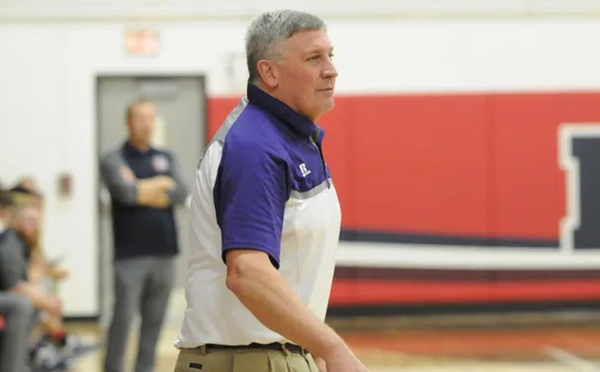
He started coaching along the way, from youth sports to middle school basketball. He took over as the Blissfield varsity coach in 2016-17
After winning seven games over two seasons with an experienced roster, Blissfield rebounded with 12 wins in 2018-19 and 19 in 2019-20 – the most for Blissfield since 1992.
The Royals won Lenawee County Athletic Association and Division 2 District titles in 2021. The LCAA title was the first for the Royals since 2003, and the District championship was the first for the school since 2004. He won 60 games in all and earned two county Coach of the Year awards.
He stepped down as basketball coach two years ago.
It wasn’t long and he was being courted to help tackle the referee shortage in Michigan and across the country. His brother, Terry, is a basketball official in the Jackson area.
“When I was finished coaching, I started thinking about it again,” Sullivan said. “My brother does a ton of officiating in the Jackson area. He told me, ‘Just do it. It will be fun. What else are you going to do in the middle of the winter? You might as well referee.’ It gives you a chance to still be involved in the game.”
Initially, Sullivan figured he’d officiate a few middle school and junior varsity games. Once he got his feet wet and adjusted to life with the whistle, however, he was hooked.
 “Last year was my first year – that was my intention, do middle school and some JV, maybe a couple of days a week,” he said. “Before I knew it, they were assigning me games left and right. The more I did it, the more I liked it. By the end of the year, they had the chance to assign a couple of varsity games. No one complained too awful bad, and they gave me a few more.”
With his basketball background, Sullivan found being a referee an outlet for his competitive nature.
“Being around basketball has made it much easier for me than someone who just comes in and, ‘Hey, I’ll try to do this,’ he said. “You are competing with yourself a little to make the right call and keep the game flowing along.”
There have been a few unexpected moments in the transition from coach to referee.
For one, Sullivan said, being on the court is a completely different perspective than being on the sidelines.
“It is so much faster when you have to run and follow that person than it is when you sit there and watch it,” Sullivan said. “When you have to run, get to your primary spot, then keep the peripheral vision going to watch everything, it's much faster, more difficult than I ever anticipated.”
Sullivan said certain aspects of the game are different, too.
“As a coach, I always anticipated what I thought was going to happen,” he said. “In your mind you know someone is going to travel, then as soon as they travel, you are yelling ‘Travel!’ As an official, it is better to be a second late and be correct than a second early and be wrong.
“To me, the toughest transition has been to slow down, wait for the actual play to let itself run its course. Make sure it really was a foul. Think about it. Don’t get in a rush to make the call.”
He’s grateful to other area officials who have helped him learn the tricks of the trade during either formal training sessions or by example. He’s had the chance to review some of his games on film, which has helped him dissect the game from a new angle. He’s also learned from coaching to block out fans and people from the crowd who might disagree with a call.
“I have not had a negative experience yet from a fan,” he said. “As a former coach, I put myself on double probation – I dished out enough that maybe I’m a little more tolerant than some other officials. That’s just my personality at this point.”
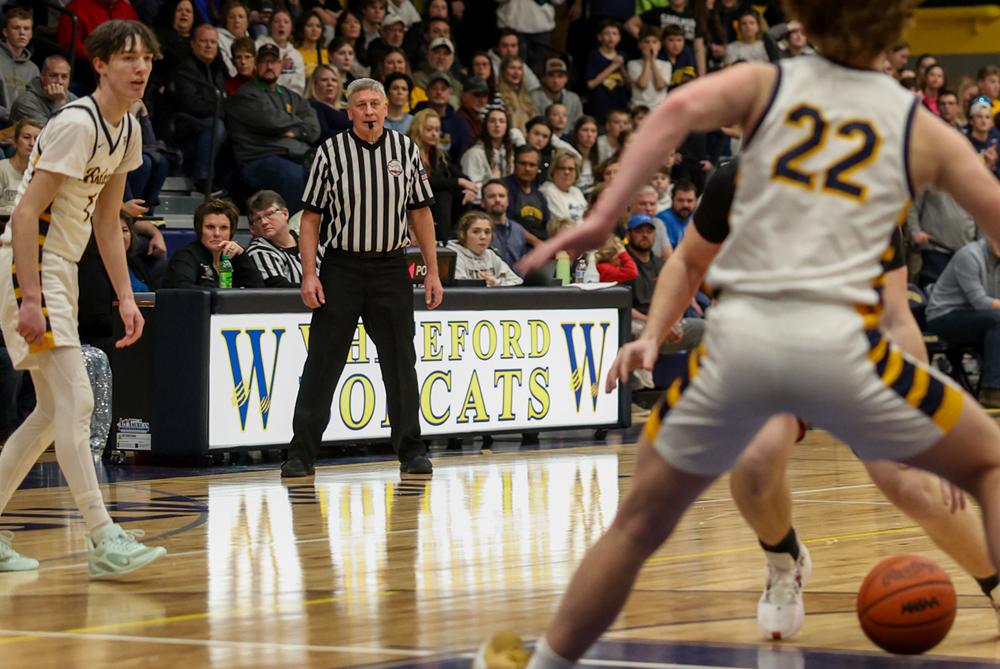
This year Sullivan has had a full schedule of middle school games plus about a dozen girls varsity basketball games and a handful of boys varsity games. The most recent was Friday in Ottawa Lake in front of a big crowd watching rivals Whiteford and Summerfield.
“That was a ton of fun – full house, competitive game. I was glad to be a part of it,” Sullivan said.
There’s another bonus to being an official. When the game is over, he can go home and sleep. No more late nights watching film or scouting for the upcoming opponent.
“My cats are much happier,” he said. “I’m not waking up at 4:30 in the morning and watching a film, then going back to bed. It’s fun. I’m enjoying it.”
 Doug Donnelly has served as a sports and news reporter and city editor over 25 years, writing for the Daily Chief-Union in Upper Sandusky, Ohio from 1992-1995, the Monroe Evening News from 1995-2012 and the Adrian Daily Telegram since 2013. He's also written a book on high school basketball in Monroe County and compiles record books for various schools in southeast Michigan. E-mail him at [email protected] with story ideas for Jackson, Washtenaw, Hillsdale, Lenawee and Monroe counties.
PHOTOS (Top) Official Gary Sullivan monitors the action while working a boys basketball game at Ottawa Lake Whiteford. (Middle) Sullivan directs his team from the sideline during his tenure as Blissfield’s boys basketball coach. (Top photo by Mike Doughty; middle photo courtesy of the Adrian Daily Telegram.)