

Add, Subtract, Divide, Multiply: MHSAA Not Alone
July 25, 2017
By Rob Kaminski
MHSAA benchmarks editor
This is the third part in a series on MHSAA tournament classification, past and present, that will be published over the next two weeks. This series originally ran in this spring's edition of MHSAA benchmarks.
As the MHSAA faces its most recent classification task with 8-Player Football, and opinions continue to swirl about as to the method, timeframe, location and other procedures, a look around the country provides plenty of company among state association brethren factoring variables into their own equations.
In the Pacific Northwest, the Oregon School Activities Association Football Playoffs are under public scrutiny as leadership ponders a five or six classification format beginning with the 2018-19 school year.
The OSAA has crowned six champions on the gridiron since 2006-07. Many of the state’s smaller schools would like to keep it that way, while larger schools lean toward a five-classification system, citing larger leagues, ease of travel and credibility to state championships as the advantages.
Still others would prefer more than six classes, pointing to safety issues and the opportunity to increase participation numbers as positives.
Moving southeast of Oregon, the Nevada Interscholastic Activities Association recently voted to hold serve on a classification proposal that was volleyed to the membership.
However, changes still could be forthcoming by as early as the 2018-19 season which would add a fifth classification in more populated southern Nevada while allowing northern schools to participate in four classifications. Such divisions could mean no state championship for the fifth class in southern Nevada.
Because of that, the NIAA wants equal numbers of schools in each classification on both ends of the state. Complicating the issue is the fact that the 24 largest schools in the state, by enrollment, are all in Clark County in Southern Nevada.
Across Nevada’s border into Arizona, charter schools are asking the Arizona Interscholastic Association to reconsider classification that was voted upon and approved in September 2015. That agreement called for the largest 33 percent of charter schools by enrollment to be placed in the state’s largest school classification, 3A, the middle 33 percent into 2A, and the smallest 33 percent into 1A.
Less than two years later the charter schools have had a change of heart and have asked to be considered the same as other Arizona public schools and be placed appropriately by enrollment beginning with the 2018-19 school year.
The situation in Arizona further illustrates how the public/private debate that all state associations have faced throughout existence now has the added dynamic of rapidly growing charter schools in today’s educational system, along with virtual school enrollment.
In the nation’s heartland, Nebraska has retooled its football classifications by using enrollment of boys students only in its schools rather than total enrollment. The Nebraska School Activities Association football-playing schools will kick off the 2018 season using this alignment.
Nebraska has three classes of 11-player football, with the smallest class divided in two, Class C-1 and C-2. The state also will have 8-player football for boys enrollments under 47, and the NSAA will sponsor a new 6-player tournament in 2018 for schools with 27 or fewer boys.
“This is a good proposal because some schools have a sizable imbalance between the number of boys and girls, and there’s a large gap (in enrollment) between the largest and smallest schools in Classes A and B,” NSAA executive director Jim Tenopir said. “I think this addresses both of those concerns.”
Swimmers in Georgia, meanwhile, will feel like they are moving with the current, rather than upstream in 2017-18, as the Georgia High School Association recently doubled the number of team championship events from two to four.
Swim enthusiasts can also count on longer days at the finals, as the top 30 finishers from the prelims will advance to the finals instead of 20, and all championship events will have three heats versus two.
Hastings Among Statewide Pacesetters as Girls Wrestling Enjoys Rapid Growth
By
Steve Vedder
Special for MHSAA.com
January 12, 2024
Sophia Sunior thought the mat might be the perfect place to learn something new about herself.
 So after hanging around a handful of Hastings boys wrestling practices a year ago, the Saxons senior opted to join the school's fledging girls team. As a former swimmer and current softball player, Sunior considered herself competitive. But the real attraction to wrestling, said Sunior, was to test her own mental and physical boundaries.
At first, Sunior struggled with the decision as she met with little success against more experienced wrestlers. But little by little, Sunior began to improve. And that's when she began to discover critical pieces about herself.
"For me, a lot of it was mental," Sunior said. "But I became stronger mentally and physically. Wrestling is probably one of hardest sports there is. It's almost legalized fighting, and I've learned so much about myself. My motto is if I can wrestle, I can do anything. You can learn some of the best (teaching) tools about yourself you can get."
While Sunior started last season slowly, she finished with a bang, placing eighth at MHSAA Individual Finals at 190 pounds. She's started this season with seven wins over her first eight matches.
Sunior is part of what Hastings coach Mike Goggins believes is the largest girls wrestling team in the state with 16 athletes. Goggins, who coached the Hastings boys team for 38 years, switched over to the girls program two years ago. Hastings had five Finals qualifiers and three placers last season.
Goggins isn't necessarily surprised that girls wrestling has caught on at Hastings, which has long had a quality boys program with Goggins' teams winning 11 league championships, 10 Districts and one Regional title and totaling 28 Individual Finals placers under his guidance.
The ability to build a program has carried over to the girls. The team had 14 wrestlers a year ago, and this season’s competitors have come from a variety of backgrounds. Of the 16 total, seven are first-year wrestlers. Three are first-year varsity letter winners, while two play basketball, two tennis, two softball, and one is a volleyball player.
“It's really kind of taken off," Goggins said of the sport. "A lot of the girls had shown interest in boys wrestling, and then when we offered wrestling for the girls, we began to get numbers. I'm not terribly surprised by that. Just the experience of what the girls saw with the boys, I just think they wanted an opportunity."
 MHSAA participation surveys show 100-150 girls regularly participating in wrestling during the end of the first decade of the 2000s, but numbers began growing substantially to match the introduction of a state individual tournament by the Michigan Wrestling Association (the state coaches association) during the 2018-19 season and then the addition of a girls-only division to the MHSAA Individual Finals in 2022. Goggins said the vast majority of girls would much rather compete against girls. “I'd say 10 to 12 of our wrestlers will say no thanks to wrestling against boys, and that's absolutely fine,” he said.
MHSAA assistant director Dan Hutcheson noted girls wrestling has nearly tripled from 495 athletes who completed an Alpha weigh-in in 2019-20 to 1,332 this winter.
"The goal is we hope it keeps growing to where schools have complete lineups," Hutcheson said. "Wrestling is a sport you can do on your own and if you put in the work, you can be successful.
"We don't know how or to what point it grows, but it's been at a nice clip."
Goggins said the sport's next hurdle indeed will be fielding enough teams for dual meets. Hastings has gone to three tournaments, which included plenty of travel to East Jackson, Grayling and Montague. The Montague event had 52 competitors, but weekend tournaments can be a numbers struggle as most teams are never able to field a complete lineup. That leaves organizers with the challenge of organizing brackets to fit the participants.
When there are enough girls for more teams to fill the standard 14 weight classes, the sport will likely grow even more, Goggins contends.
One of his first decisions as girls coach was to hire a female assistant in his daughter, Erin Slaughter, also the school's volleyball coach. Goggins, the school's athletic director, said the move means girls don't have to turn to a male coach for advice. "It's added a certain comfort level," he said.
While Sunior is one of the most experienced wrestlers, first-year senior Skylar Fenstemaker said she has her own reasons for joining the program.
"It's a challenge," she said. "Just the physical commitment and how hard (you) have to work. And I wrestle because I like being part of a team and the bond you have with the other girls. You learn that you have to work hard to get what you want."
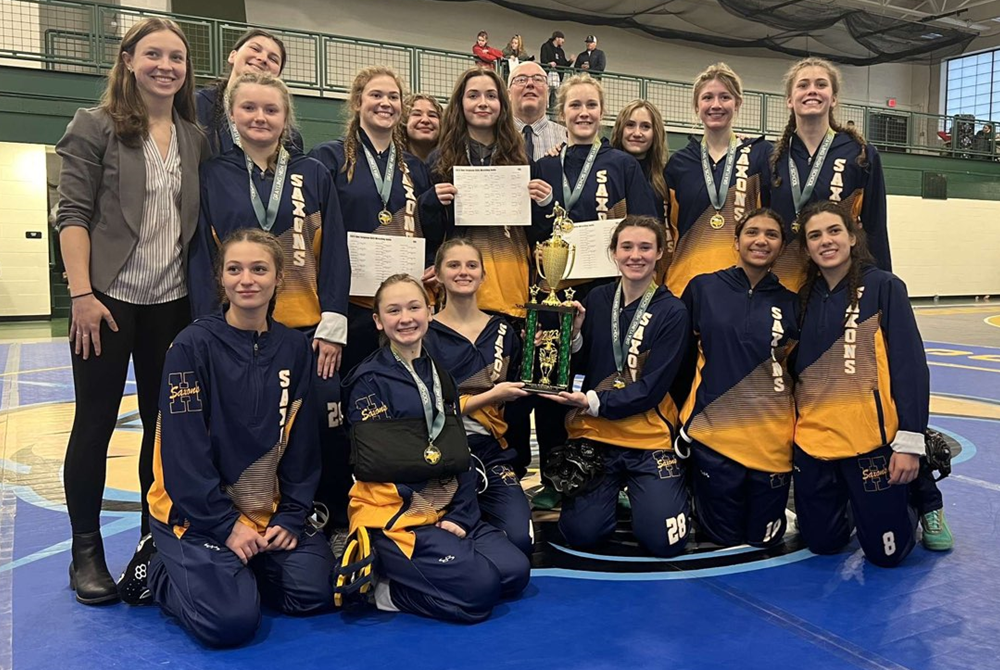
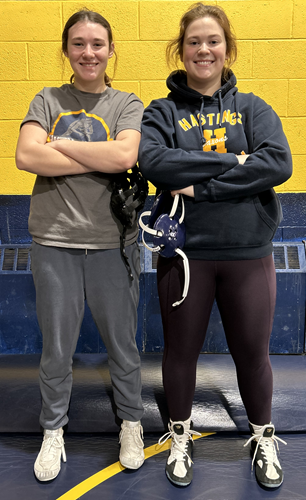
PHOTOS (Top) The Hastings girls wrestling team celebrates its team championship at the Grayling Invitational this season. (Middle) First-year wrestler Skylar Fenstemaker, left, and returning Finals placer Sophia Sunior are two of 16 athletes on the team. (Photos courtesy of the Hastings girls wrestling program.)