

Add, Subtract, Divide, Multiply: MHSAA Not Alone
July 25, 2017
By Rob Kaminski
MHSAA benchmarks editor
This is the third part in a series on MHSAA tournament classification, past and present, that will be published over the next two weeks. This series originally ran in this spring's edition of MHSAA benchmarks.
As the MHSAA faces its most recent classification task with 8-Player Football, and opinions continue to swirl about as to the method, timeframe, location and other procedures, a look around the country provides plenty of company among state association brethren factoring variables into their own equations.
In the Pacific Northwest, the Oregon School Activities Association Football Playoffs are under public scrutiny as leadership ponders a five or six classification format beginning with the 2018-19 school year.
The OSAA has crowned six champions on the gridiron since 2006-07. Many of the state’s smaller schools would like to keep it that way, while larger schools lean toward a five-classification system, citing larger leagues, ease of travel and credibility to state championships as the advantages.
Still others would prefer more than six classes, pointing to safety issues and the opportunity to increase participation numbers as positives.
Moving southeast of Oregon, the Nevada Interscholastic Activities Association recently voted to hold serve on a classification proposal that was volleyed to the membership.
However, changes still could be forthcoming by as early as the 2018-19 season which would add a fifth classification in more populated southern Nevada while allowing northern schools to participate in four classifications. Such divisions could mean no state championship for the fifth class in southern Nevada.
Because of that, the NIAA wants equal numbers of schools in each classification on both ends of the state. Complicating the issue is the fact that the 24 largest schools in the state, by enrollment, are all in Clark County in Southern Nevada.
Across Nevada’s border into Arizona, charter schools are asking the Arizona Interscholastic Association to reconsider classification that was voted upon and approved in September 2015. That agreement called for the largest 33 percent of charter schools by enrollment to be placed in the state’s largest school classification, 3A, the middle 33 percent into 2A, and the smallest 33 percent into 1A.
Less than two years later the charter schools have had a change of heart and have asked to be considered the same as other Arizona public schools and be placed appropriately by enrollment beginning with the 2018-19 school year.
The situation in Arizona further illustrates how the public/private debate that all state associations have faced throughout existence now has the added dynamic of rapidly growing charter schools in today’s educational system, along with virtual school enrollment.
In the nation’s heartland, Nebraska has retooled its football classifications by using enrollment of boys students only in its schools rather than total enrollment. The Nebraska School Activities Association football-playing schools will kick off the 2018 season using this alignment.
Nebraska has three classes of 11-player football, with the smallest class divided in two, Class C-1 and C-2. The state also will have 8-player football for boys enrollments under 47, and the NSAA will sponsor a new 6-player tournament in 2018 for schools with 27 or fewer boys.
“This is a good proposal because some schools have a sizable imbalance between the number of boys and girls, and there’s a large gap (in enrollment) between the largest and smallest schools in Classes A and B,” NSAA executive director Jim Tenopir said. “I think this addresses both of those concerns.”
Swimmers in Georgia, meanwhile, will feel like they are moving with the current, rather than upstream in 2017-18, as the Georgia High School Association recently doubled the number of team championship events from two to four.
Swim enthusiasts can also count on longer days at the finals, as the top 30 finishers from the prelims will advance to the finals instead of 20, and all championship events will have three heats versus two.
Clarkston Eying Postseason Possibilities with Challenging Regular-Season Schedule
By
Keith Dunlap
Special for MHSAA.com
December 20, 2023
It might not be January just yet, but the Clarkston hockey team has probably already felt like it has competed in the MHSAA Tournament for the 2023-24 season.
 The Wolves have gone through a gauntlet of a nonleague schedule, with two games against last season’s Division 1 runner-up Brighton, a game against reigning Division 3 ion Flint Powers Catholic and a contest against Grand Rapids Forest Hills Central, a Division 1 semifinalist last winter.
However, there has been a method to the madness for a Clarkston team that’s normally not so ambitious with nonleague scheduling.
The Wolves saw a 20-win season end with a 6-1 Regional Final loss to Hartland in March, and the idea is that playing some of the state’s best so early will toughen Clarkston up further for when this season’s playoffs arrive.
“I think we’ve already kind of went through hard times and had moments of adversity,” Clarkston head coach Nathan Bryer said. “We’re already a team that has faced a lot more hardship than our team last year at this point. I think last year at this point, we were still undefeated and had an easier time with it.”
So far, Clarkston has done a good job navigating the tough early slate, with wins over Powers and Forest Hills Central and close defeats to Brighton (4-3 and 3-1).
It’s all in an effort to eventually do something no team in school history or any squad in the Oakland Activities Association has done – win a Division 1 Finals championship.
No OAA squad has reached the championship game in Division 1 since Clarkston did so in 2005, and only two have reached the Division 1 Semifinal round since 2011 (Lake Orion in 2011 and Rochester United in 2019).
Farmington is the only OAA school to ever win a Finals hockey title, doing so in Division 3 in 2014.
 Based on who returns from last year’s team, Clarkston likely will be in the conversation and could represent the OAA’s best chance in recent years to have a team make it back to Plymouth and the season’s final weekend, and perhaps do some winning there also.
The Wolves return 15 players off a team that dominated the OAA last season, finishing 8-1-1 in league play.
Junior forward Ron Wade was a first-team all-state performer in Division 1, while defenseman Evan Adams was named second-team all-state.
Those two along with forward Owen Croston are the team’s captains this winter.
The Wolves are 7-2 going into a Thursday night contest against league rival Rochester Hills Stoney Creek.
With so much familiarity among players and coaches, not as much time needed to be spent during the offseason getting to know one another.
“The team is already pretty bonded this year,” Adams said. “We didn’t really have to worry that much about being a big group, or chemistry, this year.”
In January, the toughening-up process won’t end for Clarkston, given the Wolves will have a game against four-time reigning Division 1 champion Detroit Catholic Central.
“We haven’t had a hard (nonleague) schedule before until this year,” Croston said. “We just have to be ready for those games.”
When the MHSAA Tournament does roll around, Clarkston will have to jump over the same hurdles it usually must in its Regional – Hartland and Lake Orion.
Wade said the team still has lessons learned from the playoff loss to Hartland on its mind.
“We just learned that we really have to stick to our identity in those games,” he said. “This year, we have to rely on our forecheck and all of us pushing for the same thing.”
Indeed, it might not be 2024 yet, but Clarkston already has found out a lot about itself as it tries to replicate the postseason in November and December before the real one arrives.
“I think those teams who play a rigorous schedule all year, they are a little bit more battle-tested when Regionals come around,” Bryer said. “That was our goal this year, to have a team that’s played against top-10 opponents consistently all year. I think we’ll be better for it throughout the regular season, and better for it in Regionals.”
 Keith Dunlap has served in Detroit-area sports media for more than two decades, including as a sportswriter at the Oakland Press from 2001-16 primarily covering high school sports but also college and professional teams. His bylines also have appeared in USA Today, the Washington Post, the Detroit Free Press, the Houston Chronicle and the Boston Globe. He served as the administrator for the Oakland Activities Association’s website from 2017-2020. Contact him at [email protected] with story ideas for Oakland, Macomb and Wayne counties
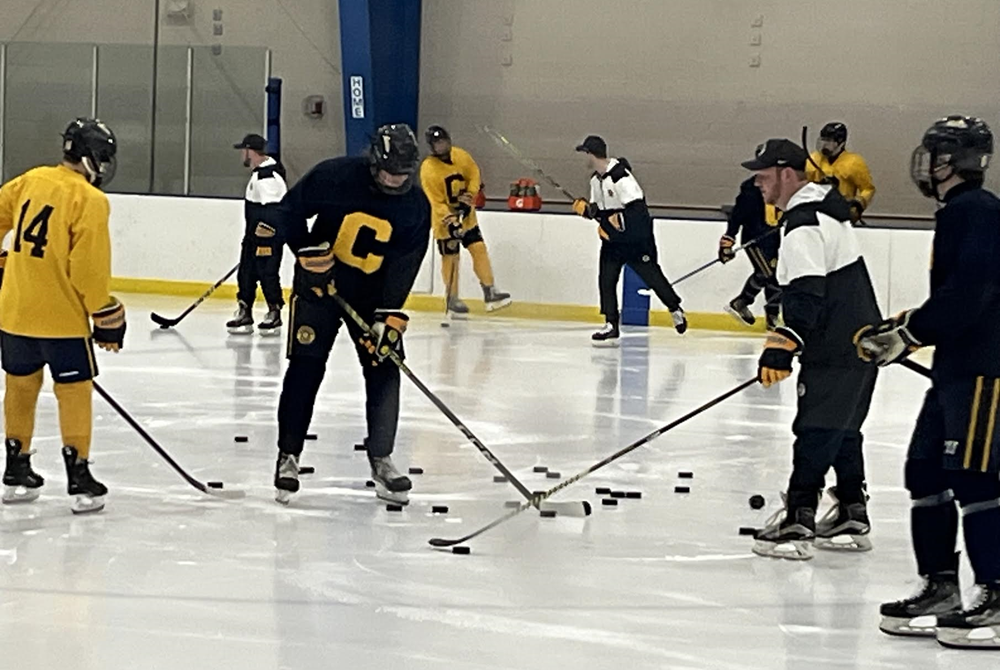
PHOTOS (Top) Clarkston warms up before a recent practice at Detroit Skate Club. (Middle) Clarkston warms up before a recent practice at Detroit Skate Club. (Photos by Keith Dunlap.)