

Add, Subtract, Divide, Multiply: MHSAA Not Alone
July 25, 2017
By Rob Kaminski
MHSAA benchmarks editor
This is the third part in a series on MHSAA tournament classification, past and present, that will be published over the next two weeks. This series originally ran in this spring's edition of MHSAA benchmarks.
As the MHSAA faces its most recent classification task with 8-Player Football, and opinions continue to swirl about as to the method, timeframe, location and other procedures, a look around the country provides plenty of company among state association brethren factoring variables into their own equations.
In the Pacific Northwest, the Oregon School Activities Association Football Playoffs are under public scrutiny as leadership ponders a five or six classification format beginning with the 2018-19 school year.
The OSAA has crowned six champions on the gridiron since 2006-07. Many of the state’s smaller schools would like to keep it that way, while larger schools lean toward a five-classification system, citing larger leagues, ease of travel and credibility to state championships as the advantages.
Still others would prefer more than six classes, pointing to safety issues and the opportunity to increase participation numbers as positives.
Moving southeast of Oregon, the Nevada Interscholastic Activities Association recently voted to hold serve on a classification proposal that was volleyed to the membership.
However, changes still could be forthcoming by as early as the 2018-19 season which would add a fifth classification in more populated southern Nevada while allowing northern schools to participate in four classifications. Such divisions could mean no state championship for the fifth class in southern Nevada.
Because of that, the NIAA wants equal numbers of schools in each classification on both ends of the state. Complicating the issue is the fact that the 24 largest schools in the state, by enrollment, are all in Clark County in Southern Nevada.
Across Nevada’s border into Arizona, charter schools are asking the Arizona Interscholastic Association to reconsider classification that was voted upon and approved in September 2015. That agreement called for the largest 33 percent of charter schools by enrollment to be placed in the state’s largest school classification, 3A, the middle 33 percent into 2A, and the smallest 33 percent into 1A.
Less than two years later the charter schools have had a change of heart and have asked to be considered the same as other Arizona public schools and be placed appropriately by enrollment beginning with the 2018-19 school year.
The situation in Arizona further illustrates how the public/private debate that all state associations have faced throughout existence now has the added dynamic of rapidly growing charter schools in today’s educational system, along with virtual school enrollment.
In the nation’s heartland, Nebraska has retooled its football classifications by using enrollment of boys students only in its schools rather than total enrollment. The Nebraska School Activities Association football-playing schools will kick off the 2018 season using this alignment.
Nebraska has three classes of 11-player football, with the smallest class divided in two, Class C-1 and C-2. The state also will have 8-player football for boys enrollments under 47, and the NSAA will sponsor a new 6-player tournament in 2018 for schools with 27 or fewer boys.
“This is a good proposal because some schools have a sizable imbalance between the number of boys and girls, and there’s a large gap (in enrollment) between the largest and smallest schools in Classes A and B,” NSAA executive director Jim Tenopir said. “I think this addresses both of those concerns.”
Swimmers in Georgia, meanwhile, will feel like they are moving with the current, rather than upstream in 2017-18, as the Georgia High School Association recently doubled the number of team championship events from two to four.
Swim enthusiasts can also count on longer days at the finals, as the top 30 finishers from the prelims will advance to the finals instead of 20, and all championship events will have three heats versus two.
Rogers City Teams Eager to Begin, Aiming to Add to Bowling Tradition
By
Tom Spencer
Special for MHSAA.com
December 15, 2023
Rogers City’s bowling team is on a roll. And the Hurons haven’t even had their first competition of the season.
 Rogers City has a decorated past, including winning the first state bowling championship in 1999, organized by the Bowling Center Association of Michigan, against a field including schools of all sizes and five years before the addition of MHSAA Finals in the sport. The boys team also was the Division 4 team runner-up at the first Class C-D Finals hosted by the MHSAA in 2004.
The Hurons hope to return to those glory days by bringing back experienced bowlers on both the boys and girls teams. Rogers City last qualified teams for the Finals in 2020 – when both the boys and girls advanced – and both teams hope to make a run at the Northern Michigan Conference title and land a spot at this season’s Finals in March.
The boys did find success last year — with just four bowlers — placing ahead of a handful of teams at its Regional. This year, Rogers City has a full boys team, and more, including junior Gavin Rhode, who qualified for the Singles Finals last year. The Hurons also are returning senior Conner Muller and sophomore Gabe Mina; Muller narrowly missed qualifying for the Finals last winter. And they are excited to see how first-year bowlers Blaise Szatkowski, Cooper Heinzel, George Karsten, Jacob Wickersham and Ryan Morgan perform.
 The girls are returning seniors Arianna Anderson and Sophia Mina and sophomore Olivia Reyes. First-year bowlers Ruby Svay – an exchange student – and freshman Brooke Crawford compose the rest of the squad.
Both the boys and the girls have added strong bowlers with incoming freshmen, including Wickersham, a 180-average bowler.
“With a small school you kind of know what is coming along,” long-time coach Brian Bannasch said. “Even with our limited numbers last year, we were still competitive.”
The Hurons will open their season Jan. 6. As has been the case for years, matches will take place on Saturdays for optimal lane availability.
“After the success previous to COVID, the last couple years have really been a letdown just not having enough bodies,” Bannasch acknowledged. “We still sent kids to the state finals individually, but team-wise were just lacking numbers with a small school that has under 175 in the high school.
“When you lose any number of kids, it is tough to replace them,” he continued. “We are really excited to have numbers this year.”
The bowling program has been battling lower overall school enrollment and competing with basketball and wrestling teams for roster numbers.
Long hours in the alley for practice, traveling for matches and competing are paying off for the Hurons. Those long hours are the same for the coaches, forcing absence from the family business.
But it’s being done with a focus on a road trip to the Division 4 Finals in March, at Northway Lanes in Muskegon.
The boys and girls Regionals, hosted by Traverse City Christian, will be held at Lucky Jacks in Traverse City.
“We definitely have individuals expecting to qualify as individuals on the boys side,” Bannasch said. “We have three girls that have bowled before and fewer teams in each Regional.
“We had a pretty powerful Regional,” he continued. “Maybe with fewer teams, it could work to our advantage.”
 Bannasch, whose family owns the local bowling alley Nautical Lanes, has been the boys and girls bowling coach from the beginning at Rogers City. The school started with a club team prior to making it a varsity sport.
Bannasch has seen a lot of talented bowlers develop through his youth programs and then vie for championships in high school. The Hurons often have had more than a dozen bowlers on the boys team.
Bannasch points to every bowler in Rogers City history competing in at least one varsity match every year as key to the team’s historical success. His unique philosophy of participation often has paid dividends.
“One of the things that has helped us be successful is that I have a little different philosophy than most coaches,” Bannasch noted. “We’ve had years where we’ve had 12 or 14 boys and 10 girls.
“We had JV matches, but we never consider it JV – they were all part of the varsity bowling team,” he continued. “In the next year, they have experienced that and know what the varsity match is all about.”
Bannasch also has watched other conference schools win or contend for Finals titles, something he points to with pride.
Bannasch spotlighted Cheboygan’s boys having won the Division 2 title in 2009 and Boyne City’s boys — as a newer program — finishing Division 3 runners-up in 2020 and 2021. Cheboygan’s girls finished Division 3 runners-up in 2022.
“Our success has been great, but I take just as much pride in the success of our conference,” Bannasch said. “We’re such a close-knit conference, it is great to see anybody up here be successful at it.”
 Tom Spencer is a longtime MHSAA-registered basketball and soccer official, and former softball and baseball official, and he also has coached in the northern Lower Peninsula area. He previously has written for the Saginaw News, Bay County Sports Page and Midland Daily News. He can be reached at [email protected] with story ideas for Manistee, Wexford, Missaukee, Roscommon, Ogemaw, Iosco, Alcona, Oscoda, Crawford, Kalkaska, Grand Traverse, Benzie, Leelanau, Antrim, Otsego, Montmorency, Alpena, Presque Isle, Cheboygan, Charlevoix and Emmet counties.
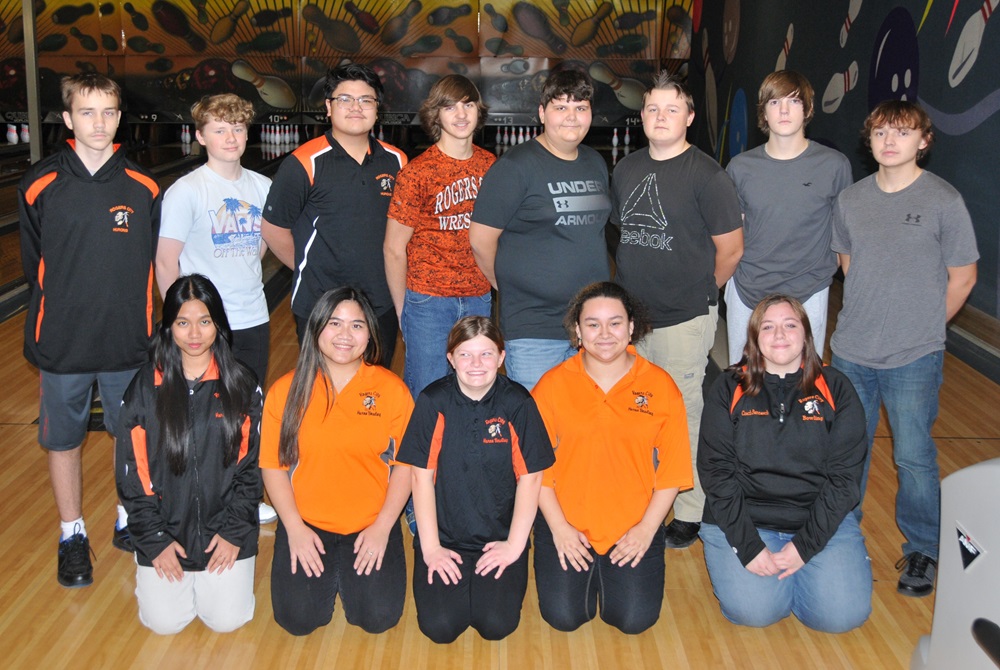
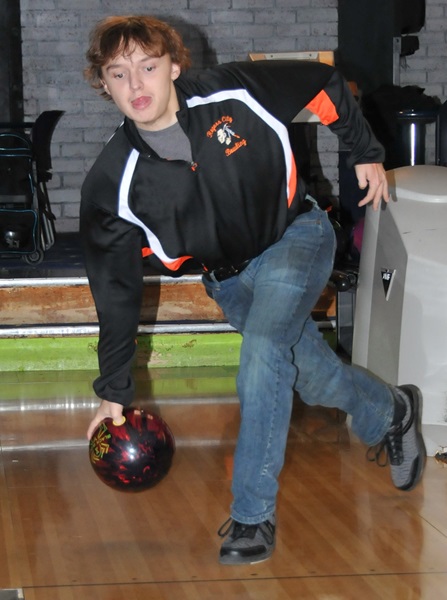
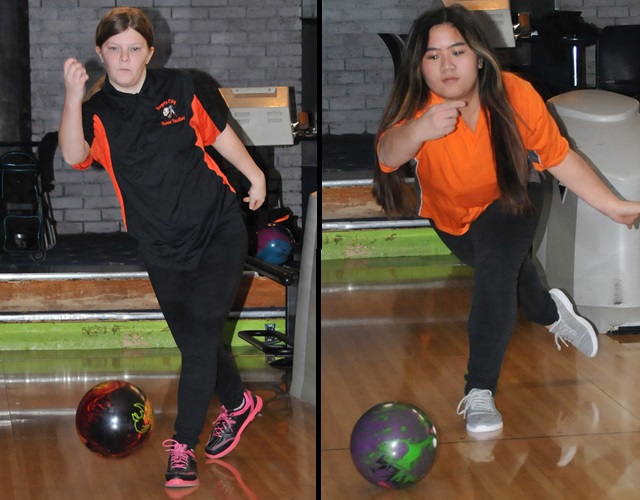
PHOTOS (Top) Rogers City’s bowling teams have high aspirations this winter with their first competitions coming up next month. (Middle) Gavin Rhode, a Finals qualifier last season, practices recently. (Below) Arianna Anderson, left, and Sophia Mina are seniors on the girls team. (Photos by Richard Lamb/Presque Isle Newspapers.)