

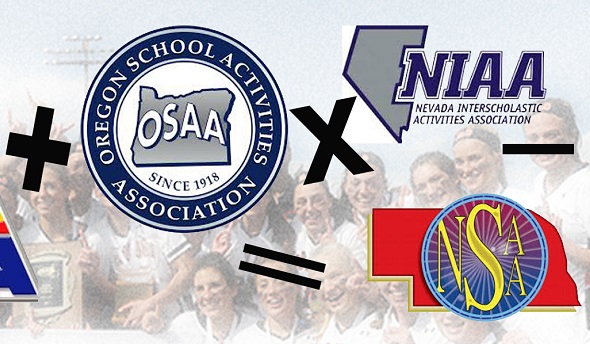
Add, Subtract, Divide, Multiply: MHSAA Not Alone
July 25, 2017
By Rob Kaminski
MHSAA benchmarks editor
This is the third part in a series on MHSAA tournament classification, past and present, that will be published over the next two weeks. This series originally ran in this spring's edition of MHSAA benchmarks.
As the MHSAA faces its most recent classification task with 8-Player Football, and opinions continue to swirl about as to the method, timeframe, location and other procedures, a look around the country provides plenty of company among state association brethren factoring variables into their own equations.
In the Pacific Northwest, the Oregon School Activities Association Football Playoffs are under public scrutiny as leadership ponders a five or six classification format beginning with the 2018-19 school year.
The OSAA has crowned six champions on the gridiron since 2006-07. Many of the state’s smaller schools would like to keep it that way, while larger schools lean toward a five-classification system, citing larger leagues, ease of travel and credibility to state championships as the advantages.
Still others would prefer more than six classes, pointing to safety issues and the opportunity to increase participation numbers as positives.
Moving southeast of Oregon, the Nevada Interscholastic Activities Association recently voted to hold serve on a classification proposal that was volleyed to the membership.
However, changes still could be forthcoming by as early as the 2018-19 season which would add a fifth classification in more populated southern Nevada while allowing northern schools to participate in four classifications. Such divisions could mean no state championship for the fifth class in southern Nevada.
Because of that, the NIAA wants equal numbers of schools in each classification on both ends of the state. Complicating the issue is the fact that the 24 largest schools in the state, by enrollment, are all in Clark County in Southern Nevada.
Across Nevada’s border into Arizona, charter schools are asking the Arizona Interscholastic Association to reconsider classification that was voted upon and approved in September 2015. That agreement called for the largest 33 percent of charter schools by enrollment to be placed in the state’s largest school classification, 3A, the middle 33 percent into 2A, and the smallest 33 percent into 1A.
Less than two years later the charter schools have had a change of heart and have asked to be considered the same as other Arizona public schools and be placed appropriately by enrollment beginning with the 2018-19 school year.
The situation in Arizona further illustrates how the public/private debate that all state associations have faced throughout existence now has the added dynamic of rapidly growing charter schools in today’s educational system, along with virtual school enrollment.
In the nation’s heartland, Nebraska has retooled its football classifications by using enrollment of boys students only in its schools rather than total enrollment. The Nebraska School Activities Association football-playing schools will kick off the 2018 season using this alignment.
Nebraska has three classes of 11-player football, with the smallest class divided in two, Class C-1 and C-2. The state also will have 8-player football for boys enrollments under 47, and the NSAA will sponsor a new 6-player tournament in 2018 for schools with 27 or fewer boys.
“This is a good proposal because some schools have a sizable imbalance between the number of boys and girls, and there’s a large gap (in enrollment) between the largest and smallest schools in Classes A and B,” NSAA executive director Jim Tenopir said. “I think this addresses both of those concerns.”
Swimmers in Georgia, meanwhile, will feel like they are moving with the current, rather than upstream in 2017-18, as the Georgia High School Association recently doubled the number of team championship events from two to four.
Swim enthusiasts can also count on longer days at the finals, as the top 30 finishers from the prelims will advance to the finals instead of 20, and all championship events will have three heats versus two.

Stretching Done Right: Easy Tips To Stay Limber
By
Christina Chapski, Ed.D., AT, ATC
Henry Ford Health
November 7, 2023
Stretching is more than just a workout suggestion – it's a vital way to avoid injury and get the most out of your activity. You wouldn’t take your car on a long drive without making sure it’s in tip-top shape, right? So before you work up a sweat, work up a stretch.
 One important thing to keep in mind is that dynamic stretching is best. It uses momentum to propel your muscles into an extended range of motion. Unlike static stretching, where you remain in an almost still position, a dynamic warm up is the best way to get your blood flowing and your heart rate pumping.
To get your muscles primed for activity, high knees, "butt kicks" and side shuffling are more effective than standing quad stretches. If you are doing an upright quad stretch, it's best to lean back a little to get the full benefit, since your quads originate from above the hip. Also, remember to always grab the ankle and not the toe.
Here are some other helpful hints on how to warm up the right way:
- For hamstrings: The hamstring muscle attaches to your bones below the knee at the back of the leg, so you want to avoid bending them (which ultimately shortens the muscle you’re trying to stretch). When bending at your back, make sure to keep your spine straight like a table to elongate those muscles. Keep your chin up. If you bend down to touch your toes, there’s no need to hover closer than six inches above the ground – unless you’re able to comfortably do so.
- For pectoral muscles: "Door stretches” offer the best stretch. Simply place your arms out on either side of you as if you were making a “T” with your body. Then, bend your arms up at your elbows so they each form a 90-degree angle. In this position, put your arms on either side of a door frame, with your body within the frame’s opening and walk forward slowly to open up the chest.
- For triceps: Make a gesture like you’re scratching your upper back and be sure to keep your elbows in for maximum benefit.
- For the torso: The iron cross stretch involves putting your arms out at your sides like a “T” and then rotating at your waist side to side. You can also drop down toward the floor and reach for your toes, one side at a time.
Other great tips to add to your stretching repertoire include:
- Don’t forget to keep breathing throughout your stretch. It will help keep your muscle tissue oxygenated.
- Hold each stretch for 10 to 20 seconds, aiming for three repetitions of each. If you prefer, you can split up your stretching throughout the day, or use props like foam rollers to help ease tension in your muscles and break up knots.
- Listen to your body while stretching. Slight pain is acceptable, but if your muscles start shaking, it's a warning for you to stop.
- Don't give up. Stretching progress can be slow, so comparing your progress to that of others will only discourage you. Pay attention to your own progress. Seeing your body become more flexible when you previously weren’t limber will help keep you motivated and is the ultimate reward.
To find a sports medicine doctor or athletic trainer at Henry Ford, visit henryford.com/athletes. Christina Chapski, Ed.D., AT, ATC, is the director of athletic training and community outreach at Henry Ford Health. Read more of Chapski's articles.