

Add, Subtract, Divide, Multiply: MHSAA Not Alone
July 25, 2017
By Rob Kaminski
MHSAA benchmarks editor
This is the third part in a series on MHSAA tournament classification, past and present, that will be published over the next two weeks. This series originally ran in this spring's edition of MHSAA benchmarks.
As the MHSAA faces its most recent classification task with 8-Player Football, and opinions continue to swirl about as to the method, timeframe, location and other procedures, a look around the country provides plenty of company among state association brethren factoring variables into their own equations.
In the Pacific Northwest, the Oregon School Activities Association Football Playoffs are under public scrutiny as leadership ponders a five or six classification format beginning with the 2018-19 school year.
The OSAA has crowned six champions on the gridiron since 2006-07. Many of the state’s smaller schools would like to keep it that way, while larger schools lean toward a five-classification system, citing larger leagues, ease of travel and credibility to state championships as the advantages.
Still others would prefer more than six classes, pointing to safety issues and the opportunity to increase participation numbers as positives.
Moving southeast of Oregon, the Nevada Interscholastic Activities Association recently voted to hold serve on a classification proposal that was volleyed to the membership.
However, changes still could be forthcoming by as early as the 2018-19 season which would add a fifth classification in more populated southern Nevada while allowing northern schools to participate in four classifications. Such divisions could mean no state championship for the fifth class in southern Nevada.
Because of that, the NIAA wants equal numbers of schools in each classification on both ends of the state. Complicating the issue is the fact that the 24 largest schools in the state, by enrollment, are all in Clark County in Southern Nevada.
Across Nevada’s border into Arizona, charter schools are asking the Arizona Interscholastic Association to reconsider classification that was voted upon and approved in September 2015. That agreement called for the largest 33 percent of charter schools by enrollment to be placed in the state’s largest school classification, 3A, the middle 33 percent into 2A, and the smallest 33 percent into 1A.
Less than two years later the charter schools have had a change of heart and have asked to be considered the same as other Arizona public schools and be placed appropriately by enrollment beginning with the 2018-19 school year.
The situation in Arizona further illustrates how the public/private debate that all state associations have faced throughout existence now has the added dynamic of rapidly growing charter schools in today’s educational system, along with virtual school enrollment.
In the nation’s heartland, Nebraska has retooled its football classifications by using enrollment of boys students only in its schools rather than total enrollment. The Nebraska School Activities Association football-playing schools will kick off the 2018 season using this alignment.
Nebraska has three classes of 11-player football, with the smallest class divided in two, Class C-1 and C-2. The state also will have 8-player football for boys enrollments under 47, and the NSAA will sponsor a new 6-player tournament in 2018 for schools with 27 or fewer boys.
“This is a good proposal because some schools have a sizable imbalance between the number of boys and girls, and there’s a large gap (in enrollment) between the largest and smallest schools in Classes A and B,” NSAA executive director Jim Tenopir said. “I think this addresses both of those concerns.”
Swimmers in Georgia, meanwhile, will feel like they are moving with the current, rather than upstream in 2017-18, as the Georgia High School Association recently doubled the number of team championship events from two to four.
Swim enthusiasts can also count on longer days at the finals, as the top 30 finishers from the prelims will advance to the finals instead of 20, and all championship events will have three heats versus two.
Cranbrook Kingswood Wins 6 Flights to Regain LPD3 Championship Reign
By
Scott Hassinger
Special for MHSAA.com
October 22, 2023
KALAMAZOO – By winning six of the eight flights, Bloomfield Hills Cranbrook Kingswood can once again call itself the Michigan Lower Peninsula Division 3 boys tennis champion.
One year after relinquishing its title to Ann Arbor Greenhills, Cranbrook totaled 37 points to finish first Saturday in completing the two-day tournament at Kalamazoo College.
Detroit Country Day took the runner-up honor with 28 followed by East Grand Rapids (20), Holland Christian (17) and St. Joseph (15) to round out the top five.
The top-ranked Cranes earned titles at Nos. 2, 3 and 4 singles and won three of the four doubles flights to clinch their second team championship in three seasons.
"Last year's Finals came down to the wire, and Greenhills ended up getting us by a point. That was an absolute gut-wrencher,” said Cranbrook head coach Steve Herdoiza. “All the flights we lost last year were ones we came back and won this time. I'm really proud of our boys. All of them found a way to play their best tennis on the last day of the season when it mattered the most."
After Friday's matches were suspended around midnight, play resumed at 8:30 a.m. Saturday with No. 3 and No. 4 singles at the Portage YMCA and a few doubles matches at Stowe Stadium on the K-College campus.
Rain, however, chased all those flights playing outdoors back inside shortly after to the Markin Racquet Center for the remainder of the day.
Play in all four singles flights picked up again Saturday in the quarterfinal round.
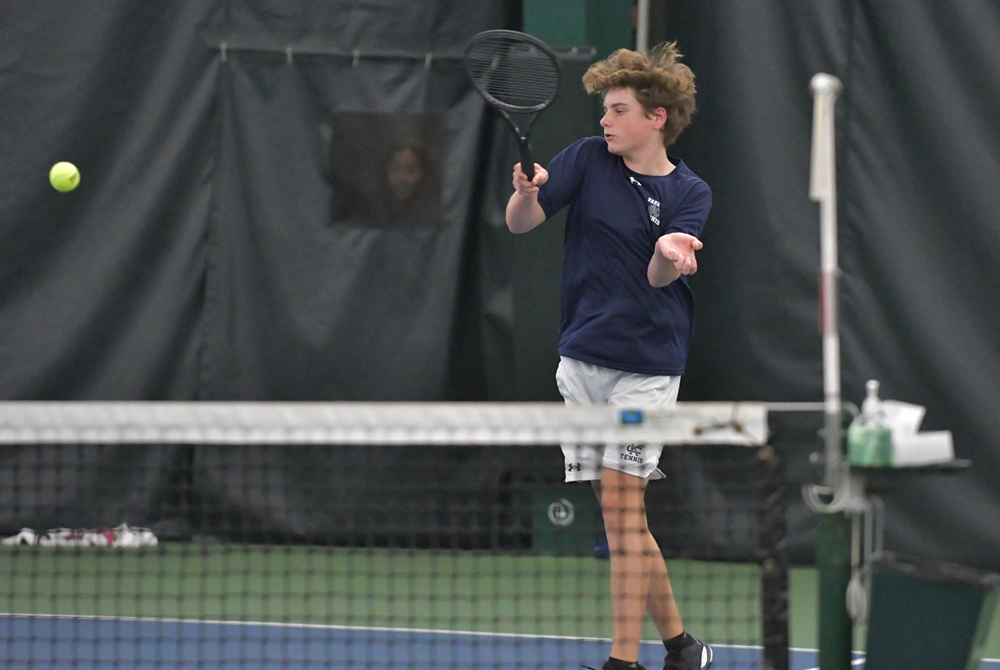
Top-seeded Saahitth Reddy, Detroit Country Day's junior and No. 1 singles player, outlasted Cranbrook junior Ryan Michaels 6-3, 4-6, 7-5 in the finals.
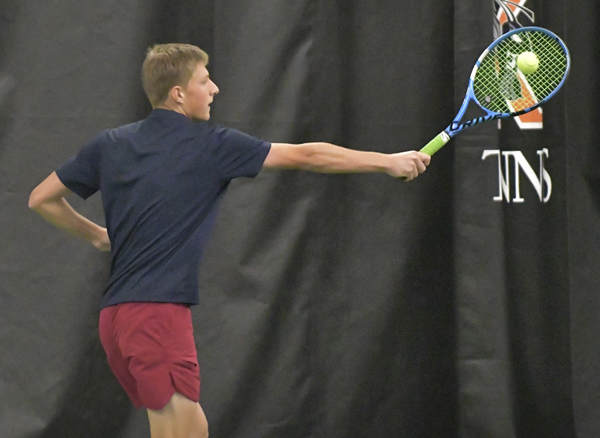 The match fell just a few minutes short of taking three hours to complete.
Reddy also defeated Michaels in straight sets in a regular-season dual between the two schools this fall.
Cranbrook won that match with Country Day 5-3.
There were moments in Saturday's match when it looked like Michaels would best Reddy this time around.
"Saahitth is a such a great player. You do what you can to win, and sometimes it just doesn't work out for you," Michaels said.
Michaels held a 4-1 lead at one point during the second set.
"I should've won that set comfortably. We were holding serve and then I broke to love. A real turning point for him in the third was when he broke me and then he had serve after going up 4-3," Michaels added.
Reddy said it was the emotional support of his teammates during the match that carried him through.
"I just didn't want to give up. When my teammates started cheering me on, I kind've got emotional and that usually helps me. My forehand and down-the-line shots are my biggest weapons. (Michaels) was playing really well in that third set, so I just had to stick it out," Reddy said.
Herdoiza commended Michaels for his effort.
"The heart and tenacity that he showed is Ryan in a nutshell. You are never going to find an ounce of effort missing from that young man's game. It's all just will power and desire," Herdoiza said.
Cranbrook senior Caden Che defeated top-seeded Dan Marin from Country Day 6-4, 6-4, at No. 2.
Top-seeded Jace Bernard from Cranbrook lived up to his pre-tournament seed with a 6-3, 6-4, win over East Grand Rapids' Mikey Beusse in the No. 3 finale.
No. 1 seeded junior Amaan Khan from Cranbrook downed St. Joseph freshman Eeshaan Ale 6-2, 6-1 in the final at No. 4 singles.
Herdoiza also praised Khan's performance.
"I haven't seen Amaan's stats or anything yet, but he might've had one of the more dominant seasons. He wasn't just winning matches, but in some of those he was giving up only 10 points or less. That's real dominance," Herdoiza said.
Devin Kozal and Jace Konwinski from Ada Forest Hills Eastern defeated Country Day's No. 1 doubles unit of Achyut Reddy and Charlie Khaghany 6-3, 6-3.
"Country Day had good ground strokes and are kind've shifty, but Devin and I stuck together and got it done," Konwinski said.
Kozal and Konwinksi, who are cousins and live next door to one another, controlled the net throughout the match.
"We do drills in practice where our No. 1 and No. 2 singles players hit with us, and that really helps us prepare for matches like these," Kozal said.
Cranbrook sophomores Cole Kirschenbaum and Kenneth Hu pulled off a 6-1, 4-6, 6-1 finals win over East Grand Rapids' No. 2 tandem of Charlie Lentz and Luke Lentz. The Cranes' No. 3 doubles unit of freshman Ryan VanDyke and senior Ben Stevenson were champions at No. 3 doubles. Stevenson and VanDyke were victorious over Country Day's Thomas Bresson and John McKany 6-1, 6-3.
"In the first set we played very smart by getting to short balls, the net and by finishing off points," Stevenson said.
VanDyke felt it was him and Stevenson's aggression from the onset of the match that was the difference.
"I thought we attacked early and asserted our dominance at the net," VanDyke said.
Cranbrook seniors Ketan Swami and Kevin Guo defeated Joe Mulder and Tommy Rosmarin from East Grand Rapids 6-2, 6-2 at No. 4 doubles.
(Click for more photos from High School Sports Scene.)