

Add, Subtract, Divide, Multiply: MHSAA Not Alone
July 25, 2017
By Rob Kaminski
MHSAA benchmarks editor
This is the third part in a series on MHSAA tournament classification, past and present, that will be published over the next two weeks. This series originally ran in this spring's edition of MHSAA benchmarks.
As the MHSAA faces its most recent classification task with 8-Player Football, and opinions continue to swirl about as to the method, timeframe, location and other procedures, a look around the country provides plenty of company among state association brethren factoring variables into their own equations.
In the Pacific Northwest, the Oregon School Activities Association Football Playoffs are under public scrutiny as leadership ponders a five or six classification format beginning with the 2018-19 school year.
The OSAA has crowned six champions on the gridiron since 2006-07. Many of the state’s smaller schools would like to keep it that way, while larger schools lean toward a five-classification system, citing larger leagues, ease of travel and credibility to state championships as the advantages.
Still others would prefer more than six classes, pointing to safety issues and the opportunity to increase participation numbers as positives.
Moving southeast of Oregon, the Nevada Interscholastic Activities Association recently voted to hold serve on a classification proposal that was volleyed to the membership.
However, changes still could be forthcoming by as early as the 2018-19 season which would add a fifth classification in more populated southern Nevada while allowing northern schools to participate in four classifications. Such divisions could mean no state championship for the fifth class in southern Nevada.
Because of that, the NIAA wants equal numbers of schools in each classification on both ends of the state. Complicating the issue is the fact that the 24 largest schools in the state, by enrollment, are all in Clark County in Southern Nevada.
Across Nevada’s border into Arizona, charter schools are asking the Arizona Interscholastic Association to reconsider classification that was voted upon and approved in September 2015. That agreement called for the largest 33 percent of charter schools by enrollment to be placed in the state’s largest school classification, 3A, the middle 33 percent into 2A, and the smallest 33 percent into 1A.
Less than two years later the charter schools have had a change of heart and have asked to be considered the same as other Arizona public schools and be placed appropriately by enrollment beginning with the 2018-19 school year.
The situation in Arizona further illustrates how the public/private debate that all state associations have faced throughout existence now has the added dynamic of rapidly growing charter schools in today’s educational system, along with virtual school enrollment.
In the nation’s heartland, Nebraska has retooled its football classifications by using enrollment of boys students only in its schools rather than total enrollment. The Nebraska School Activities Association football-playing schools will kick off the 2018 season using this alignment.
Nebraska has three classes of 11-player football, with the smallest class divided in two, Class C-1 and C-2. The state also will have 8-player football for boys enrollments under 47, and the NSAA will sponsor a new 6-player tournament in 2018 for schools with 27 or fewer boys.
“This is a good proposal because some schools have a sizable imbalance between the number of boys and girls, and there’s a large gap (in enrollment) between the largest and smallest schools in Classes A and B,” NSAA executive director Jim Tenopir said. “I think this addresses both of those concerns.”
Swimmers in Georgia, meanwhile, will feel like they are moving with the current, rather than upstream in 2017-18, as the Georgia High School Association recently doubled the number of team championship events from two to four.
Swim enthusiasts can also count on longer days at the finals, as the top 30 finishers from the prelims will advance to the finals instead of 20, and all championship events will have three heats versus two.
Lansing Catholic Finishes Title Climb, Greenhills' Melendez Joins Elite Few
By
Tim Robinson
Special for MHSAA.com
October 21, 2023
BATTLE CREEK — While clutching the championship trophy that had eluded her during her first three high school golf seasons, Lansing Catholic’s Sophie Hauser was open to suggestions on how to celebrate.
What if, it was suggested, each member of the Cougars got to have the trophy in their possession for a day, like NHL hockey players whose team wins the Stanley Cup?
“I like that idea,” she said, her smile getting even brighter.
If that’s the case, the Cougars’ MHSAA Lower Peninsula Division 4 championship trophy will be out of sight for a while.
The reason: Lansing Catholic has 20 golfers on its roster, all competing for playing spots.
“We have 16 players who want to compete,” Cougars coach Kim Johnson said. “From freshmen to seniors. It keeps everyone sharp when you have 20 people competing, and it’s a team thing because the younger ones are pushing the older ones because if they don't (compete), they’re going to lose their spot, and it’s worked out well.”
It was the Cougars’ first title since 2010, which was the last of three consecutive titles won by the Cougars at that time. They finished third last year after second-place finishes the previous two seasons.
Lansing Catholic got off to a blazing start, ending Friday’s first round with a 15-stroke lead and adding to it Saturday, finishing with a 705 score that was 24 strokes better than second-place Kalamazoo Christian.
“We got out front early and stayed out,” Johnson said. “Everyone knew that we were 15 strokes up, and we knew we had to keep the pedal on the metal because there were all these great teams behind us. We didn’t want to lose it, so we knew we had to keep working hard.”
 The Cougars came out Saturday determined not to let the moment, or the weather, get to them.
Hauser led Lansing Catholic by shooting 74 on Saturday and 150 for the weekend, both personal bests.
“I struggled on the front nine,” she said, “but I pulled it together on the back nine, and I thought to myself that I have to play my game and not think about anyone else.”
Johnson said assistant Mary Fineis plays a key role in the Cougars’ mental approach.
“She works on skills with them, and she helps them keep their minds sharp,” Johnson said.
Mia Melendez of Ann Arbor Greenhills became the seventh girl in state history to three-peat as a Finals individual champion, firing a 69 to edge Brooklyn Columbia Central’s Logan Bentley by two strokes.
“I made a lot of pars and three great birdies,” she said. “It was a really steady round overall.”
Melendez, a junior, hopes to make it four-for-four in state titles next year. That would make her the first to do so in the Lower Peninsula and first statewide since Paxton Johnson of Escanaba won four consecutive titles in UP Finals from 2016-19.
The weather was a factor both days, forcing the contestants off the course for a time Friday due to heavy rain. Saturday saw drizzle and occasional showers.
“Conditions were really tough for playing golf today,” Melendez said. “There was a lot of rain, the ground was wet, and it was super cold. But I’m glad I have some experience playing in tough weather.”
Meanwhile, Hauser and her teammate were savoring their team title.
“I don't think it’s really hit me yet,” said Hauser, who finished third overall as an individual. “It feels like a dream. And it’s finally come true.”
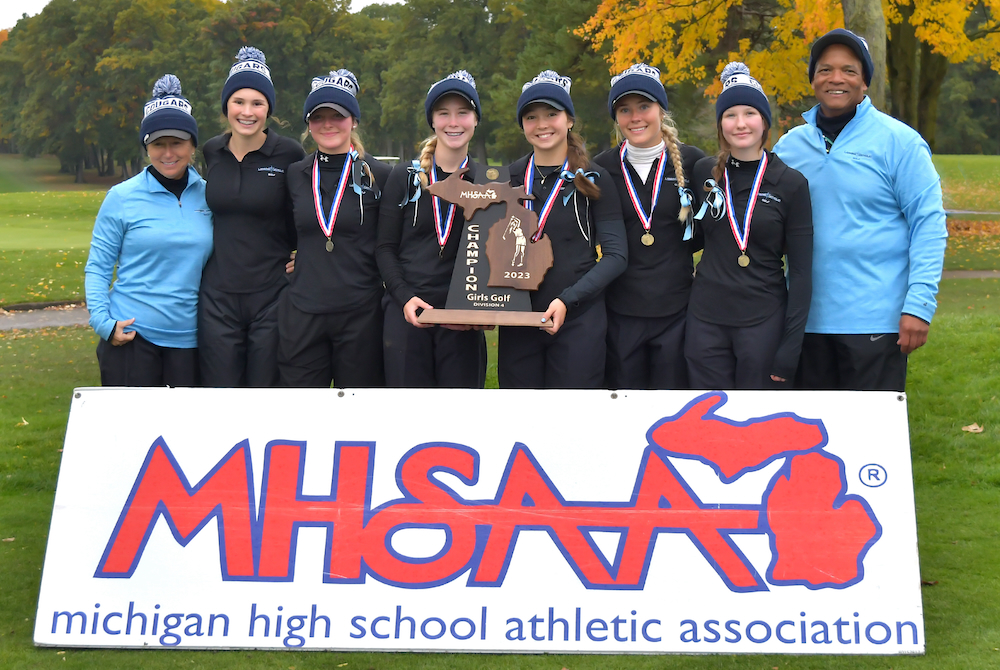
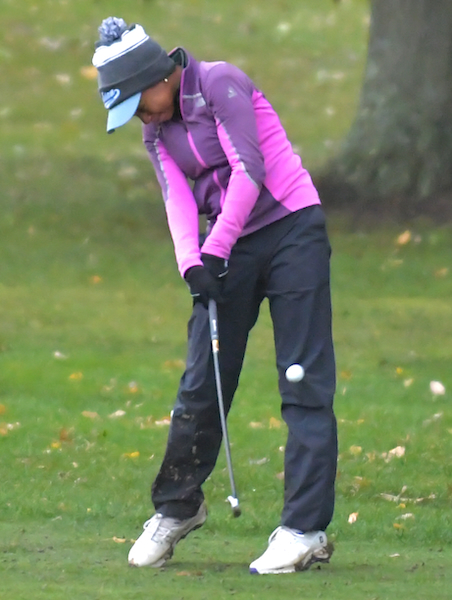
PHOTOS (Top) Lansing Catholic celebrates its first Finals team championship since 2010 on Saturday. (Middle) Ann Arbor Greenhills’ Mia Melendez sends an approach on the way to winning her third individual championship. (Click for more from High School Sports Scene.)