

Add, Subtract, Divide, Multiply: MHSAA Not Alone
July 25, 2017
By Rob Kaminski
MHSAA benchmarks editor
This is the third part in a series on MHSAA tournament classification, past and present, that will be published over the next two weeks. This series originally ran in this spring's edition of MHSAA benchmarks.
As the MHSAA faces its most recent classification task with 8-Player Football, and opinions continue to swirl about as to the method, timeframe, location and other procedures, a look around the country provides plenty of company among state association brethren factoring variables into their own equations.
In the Pacific Northwest, the Oregon School Activities Association Football Playoffs are under public scrutiny as leadership ponders a five or six classification format beginning with the 2018-19 school year.
The OSAA has crowned six champions on the gridiron since 2006-07. Many of the state’s smaller schools would like to keep it that way, while larger schools lean toward a five-classification system, citing larger leagues, ease of travel and credibility to state championships as the advantages.
Still others would prefer more than six classes, pointing to safety issues and the opportunity to increase participation numbers as positives.
Moving southeast of Oregon, the Nevada Interscholastic Activities Association recently voted to hold serve on a classification proposal that was volleyed to the membership.
However, changes still could be forthcoming by as early as the 2018-19 season which would add a fifth classification in more populated southern Nevada while allowing northern schools to participate in four classifications. Such divisions could mean no state championship for the fifth class in southern Nevada.
Because of that, the NIAA wants equal numbers of schools in each classification on both ends of the state. Complicating the issue is the fact that the 24 largest schools in the state, by enrollment, are all in Clark County in Southern Nevada.
Across Nevada’s border into Arizona, charter schools are asking the Arizona Interscholastic Association to reconsider classification that was voted upon and approved in September 2015. That agreement called for the largest 33 percent of charter schools by enrollment to be placed in the state’s largest school classification, 3A, the middle 33 percent into 2A, and the smallest 33 percent into 1A.
Less than two years later the charter schools have had a change of heart and have asked to be considered the same as other Arizona public schools and be placed appropriately by enrollment beginning with the 2018-19 school year.
The situation in Arizona further illustrates how the public/private debate that all state associations have faced throughout existence now has the added dynamic of rapidly growing charter schools in today’s educational system, along with virtual school enrollment.
In the nation’s heartland, Nebraska has retooled its football classifications by using enrollment of boys students only in its schools rather than total enrollment. The Nebraska School Activities Association football-playing schools will kick off the 2018 season using this alignment.
Nebraska has three classes of 11-player football, with the smallest class divided in two, Class C-1 and C-2. The state also will have 8-player football for boys enrollments under 47, and the NSAA will sponsor a new 6-player tournament in 2018 for schools with 27 or fewer boys.
“This is a good proposal because some schools have a sizable imbalance between the number of boys and girls, and there’s a large gap (in enrollment) between the largest and smallest schools in Classes A and B,” NSAA executive director Jim Tenopir said. “I think this addresses both of those concerns.”
Swimmers in Georgia, meanwhile, will feel like they are moving with the current, rather than upstream in 2017-18, as the Georgia High School Association recently doubled the number of team championship events from two to four.
Swim enthusiasts can also count on longer days at the finals, as the top 30 finishers from the prelims will advance to the finals instead of 20, and all championship events will have three heats versus two.
Marquette Carrying Confidence Into Finals After Downstate, Out-of-State Successes
By
John Vrancic
Special for MHSAA.com
October 20, 2023
MARQUETTE — Marquette’s cross country teams are both seeking to continue championship runs at Saturday’s Upper Peninsula Finals at Farmhouse Cross Country Course in Gladstone – the girls for the second-straight season and the boys attempting a fifth-straight title.
 Their travels far and wide this fall have the teams confident that success will continue.
The Marquette girls did something Sept. 15 no other Upper Peninsula team had been able to do, winning the Green division race at the Spartan Invitational at Michigan State University by edging Novi 142-143.
That was the first of multiple successful trips downstate, and Marquette also ran exceptionally closer to home and in Wisconsin against some of that state’s elite.
“I think we’re just really excited,” junior Monet Argeropoulos said. “We’re really looking forward to pushing each other as a team. That’s what keeps us strong. We just need to go down there and take care of business.”
Sophomore Ella Fure was seventh individually at MSU, and senor Abby Harma ran ninth against a field of Lower Peninsula Division 1 schools.
“That’s probably the highlight of the season from a team standpoint,” Fure said during Tuesday’s practice at the Marquette High School track. “We were all crying. At first they announced Novi had won from the unofficial results. We were a little disappointed, although we gave our best effort. Then they found a scoring error and discovered we had won. I think a lot of people were really excited. The car ride home was very good. It kind of flew by.”
After dominating the El Harger Invite at Munising on Sept. 26, Marquette traveled downstate and ran in the Shepherd Bluejay Invitational four days later where the boys placed fifth and the girls were 16th in the Elite division.
 “It’s real different running downstate. We needed to get used to that situation and become more comfortable. I think our athletes know what to expect down there now,” Marquette coach Derek Marr said. “(The girls’) confidence really grew after winning at MSU, and a lot of that carried over into Shepherd.
“Many coaches believed the U.P. teams couldn’t compete downstate, and that upset me. I think we can compete with anybody if we believe in ourselves. We’ve trying to break that limitation.”
Marquette opened this season with two victories at home, dominating the Queen City Invitational on Aug. 18 and edging Macomb Dakota for the title in the Wildcat Invite on Aug. 26.
“I think that set the tone,” Harma said. “Downstate runners come up here for camps. They’re very fast. It’s easier to run fast with faster people. Winning the Spartan Invitational was very exciting, and three of us going under 20 minutes at Shepherd was a highlight. It has been a long time since a team from Marquette has done that.”
“I would say we had an exceptional season,” added junior Seppi Camilli, who covered the 3.1-mile course at Shepherd in a personal-best 16 minutes, two seconds. “Derek and Paige (assistant coach DuBois) did a great job preparing us. The girls winning by one point at Spartan was definitely the highlight. Competing downstate allowed us to exemplify our depth and talent. I think it makes us execute to show our skills.”
Senior Cullen Papin had similar thoughts about the early-season meets.
“Everybody showed up and really worked hard in our first meet,” Papin said. “In the Wildcat meet it was good to get pushed by the biggest school in the state, and it came down to a sixth-runner tie-breaker. That’s what it’s all about. It shows every runner is important.”
The Marquette boys were runners-up to nationally-ranked Stevens Point, Wis., at Neenah, and the girls placed fourth.
“That was definitely a confidence builder going down to Neenah,” Papin said. “It was exciting to see all the hard work the girls put in really pay off against some of the D-1 powers in the state at Spartan, and all seven of us going under 16:50 at Shepherd was cool. There’s lots of good teams down there.
“The atmosphere in practice is pretty good.”
 John Vrancic has covered high school sports in the Upper Peninsula since joining the Escanaba Daily Press staff in 1985. He is known most prominently across the peninsula for his extensive coverage of cross country and track & field that frequently appears in newspapers from the Wisconsin border to Lake Huron. He received the James Trethewey Award for Distinguished Service in 2015 from the Upper Peninsula Sportswriters and Sportscasters Association.
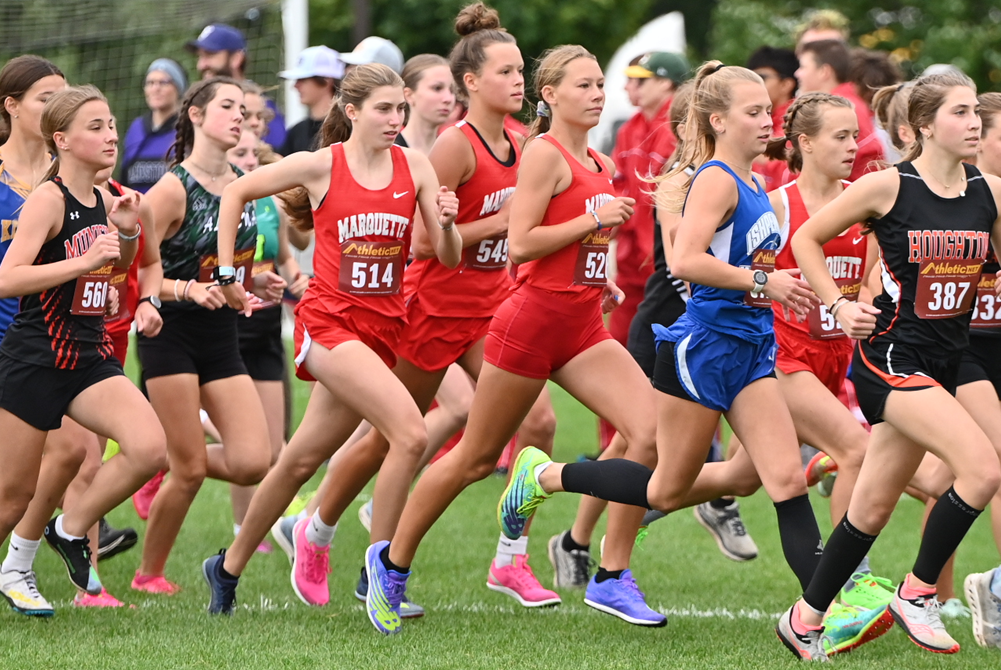
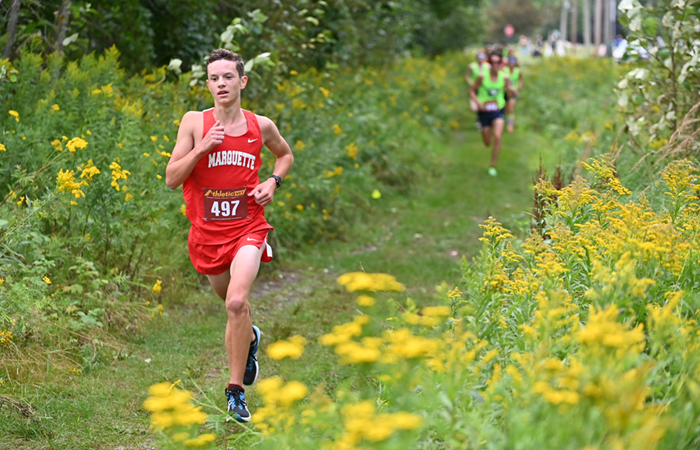
PHOTOS (Top) Marquette's Ella Fure (526), Monet Argeropoulos (514) and Abby Harma (527) make up part of an early pack during the Wildcat Invitational. (Middle) Marquette's Seppi Camilli (497) runs to first place in the boys Wildcat race held on the campus of Northern Michigan University. (Photos by Cara Kamps.)