

Add, Subtract, Divide, Multiply: MHSAA Not Alone
July 25, 2017
By Rob Kaminski
MHSAA benchmarks editor
This is the third part in a series on MHSAA tournament classification, past and present, that will be published over the next two weeks. This series originally ran in this spring's edition of MHSAA benchmarks.
As the MHSAA faces its most recent classification task with 8-Player Football, and opinions continue to swirl about as to the method, timeframe, location and other procedures, a look around the country provides plenty of company among state association brethren factoring variables into their own equations.
In the Pacific Northwest, the Oregon School Activities Association Football Playoffs are under public scrutiny as leadership ponders a five or six classification format beginning with the 2018-19 school year.
The OSAA has crowned six champions on the gridiron since 2006-07. Many of the state’s smaller schools would like to keep it that way, while larger schools lean toward a five-classification system, citing larger leagues, ease of travel and credibility to state championships as the advantages.
Still others would prefer more than six classes, pointing to safety issues and the opportunity to increase participation numbers as positives.
Moving southeast of Oregon, the Nevada Interscholastic Activities Association recently voted to hold serve on a classification proposal that was volleyed to the membership.
However, changes still could be forthcoming by as early as the 2018-19 season which would add a fifth classification in more populated southern Nevada while allowing northern schools to participate in four classifications. Such divisions could mean no state championship for the fifth class in southern Nevada.
Because of that, the NIAA wants equal numbers of schools in each classification on both ends of the state. Complicating the issue is the fact that the 24 largest schools in the state, by enrollment, are all in Clark County in Southern Nevada.
Across Nevada’s border into Arizona, charter schools are asking the Arizona Interscholastic Association to reconsider classification that was voted upon and approved in September 2015. That agreement called for the largest 33 percent of charter schools by enrollment to be placed in the state’s largest school classification, 3A, the middle 33 percent into 2A, and the smallest 33 percent into 1A.
Less than two years later the charter schools have had a change of heart and have asked to be considered the same as other Arizona public schools and be placed appropriately by enrollment beginning with the 2018-19 school year.
The situation in Arizona further illustrates how the public/private debate that all state associations have faced throughout existence now has the added dynamic of rapidly growing charter schools in today’s educational system, along with virtual school enrollment.
In the nation’s heartland, Nebraska has retooled its football classifications by using enrollment of boys students only in its schools rather than total enrollment. The Nebraska School Activities Association football-playing schools will kick off the 2018 season using this alignment.
Nebraska has three classes of 11-player football, with the smallest class divided in two, Class C-1 and C-2. The state also will have 8-player football for boys enrollments under 47, and the NSAA will sponsor a new 6-player tournament in 2018 for schools with 27 or fewer boys.
“This is a good proposal because some schools have a sizable imbalance between the number of boys and girls, and there’s a large gap (in enrollment) between the largest and smallest schools in Classes A and B,” NSAA executive director Jim Tenopir said. “I think this addresses both of those concerns.”
Swimmers in Georgia, meanwhile, will feel like they are moving with the current, rather than upstream in 2017-18, as the Georgia High School Association recently doubled the number of team championship events from two to four.
Swim enthusiasts can also count on longer days at the finals, as the top 30 finishers from the prelims will advance to the finals instead of 20, and all championship events will have three heats versus two.
Wagner Transforming Kalkaska Into Lake Michigan Conference Challenger
By
Tom Spencer
Special for MHSAA.com
October 6, 2023
Figuratively speaking, there is a new boys soccer sheriff in the Lake Michigan Conference. And Kalkaska is making big changes in the league’s competitiveness and results.
 The Blazers are 11-5-4 overall and have shown to be a formidable challenger for perennial champion Elk Rapids.
They are coached by a sheriff, literally — actually the undersheriff of Kalkaska County. David Wagner II took over the Blazers program four years ago, inheriting a team that went winless the year before.
This week they almost stopped Elk Rapids from clinching its 17th title in the league’s 21 years of existence. The Blazers ended up falling only 1-0 to the Elks after suffering a 2-1 loss earlier in the season, giving up two penalty kick goals.
The challenge by the new sheriff is welcomed by the league, especially Nate Plum, now in is 16th season at the helm of Elk Rapids. When Plum first took over the Elks, they usually played conference games with their junior varsity squad and the varsity team took on as many strong nonconference teams as they could schedule.
The Blazers had been an easy win for Lake Michigan Conference teams, often the victim of the MHSAA goal-differential rule.
All that has changed with Kalkaska producing high scorers like Cooper Swikoski last year and Wagner taking over, Plum noted.
“You can see kids that have been in that program the last four years and they get on the ball and they can move it, putting you in difficult spots,” Plum said. “They have been dangerous this year.
“They have been consistently harder to play,” he continued. “Dave sees the game the right way at the high school level as another avenue besides school to teach boys lessons — he’s a class act.”
Kalkaska earned two wins in Wagner’s first season, which was also his son Tripp’s first in high school soccer. The Blazers earned four wins the next year and 10 last fall.
Coach Wagner points more to life’s lessons than wins though and keeps soccer in perspective as just a game as he faces the challenges in his professional life.
Wagner came to Northern Michigan in 2002 as a deputy in Kalkaska County. He worked as a corrections officer, road patrol deputy, Traverse Narcotics Team officer, member of the emergency response team, road patrol sergeant and dispatch sergeant before being named undersheriff in 2018.
“To be honest with you, I don’t even look at our record – I don’t get hung up on it,” Wagner said. “I think boys soccer is very important, but from my line of work it’s a boys soccer game.
“I put in it in perspective,” he continued. “I am just trying to make these kids hopefully a little better adults.”
The Blazers have been led by strong defense, in particular in the middle of the field and at goal.
Adam Williams in normally the first line of defense with Ryan Perry playing more back. And then stellar goalkeeper Kayden Dueweke-Gonzales wraps things up. He has four shutouts this season.
“The defenders can’t pile up stats,” Wagner pointed out. “They are our rock.”
The three seniors leading the defense are among the six Blazers seniors who started playing soccer around the age of 5 under Wagner, who was their youth coach in Kalkaska for nine years before taking over the high school program. The rest of the Blazers seniors started playing for Wagner at 10 years of age.
Wagner had hopes the boys would have a different coach in high school but found himself needing to step into the vacancy. His seniors all played their last game at home Thursday on Senior Night, earning a 2-2 tie with Grayling.
Senior Night provided Wagner a nice chance to go down memory road.
“I had to dig up some old pictures for Senior Night because they wanted to do the young pictures and the current pictures,” he said.
Jose Saez is leading the team scoring with 11 goals and two assists. Tripp Wagner is next with six goals and six assists. Cade Ponstien has eight goals and two assists.
“Kalkaska has guys on the field that make a difference,” Plum said. “They definitely started to compete at higher level last year and an even higher level this year making the game extra difficult, and it made the conference even better — we can only hope that continues.”
 Wagner, though, knows the Blazers will have to get stronger to wrestle the league crown away from the previous champions. The list includes Charlevoix and Harbors Springs along with Elks’ title accomplishments.
“We’re still not at the level of the Elks or the Traverse City teams,” Wagner acknowledged. “At least we’re in the running for competitiveness.”
Wagner grew up playing soccer in the Kalamazoo area and became a soccer referee while he was in college at Ferris State. He is viewed by many referees and former coaches as the best referee Northern Michigan has ever seen.
He started high school refereeing in Northern Michigan 20 years ago and achieved national referee certification in the United States Soccer Referee Association.
Wagner has noticed a lot more disparity among high school soccer teams in the north than the south of Michigan. For example, he had never refereed a game ending in a mercy before moving north.
He’s also noticed many of the same referees on the pitch today he worked with two decades ago.
“It’s aging,” he said with a laugh. “But it is the coaches and parents’ fault. (Potential referees) stop and ask themselves, ‘Why would I want to go out there?’
“I have utmost respect for all the officials – even the ones I don’t agree with,” he continued. “At the end of the day, it is always about the kids.”
Jerry Grieve, a retired forester and veteran soccer referee, is one of many referees who recall working with Wagner as an official. He is also the father of three former Kalkaska athletes and graduates — Abigail, 2005, Paul, 2007, and Alex, 2009.
Grieve is extremely proud of Wagner’s affiliation and success with the Blazers.
“I first met Undersheriff Dave Wagner more than 20 years ago at a Cadillac/TC Central game, in which he was the center. “I have always thought he was the best soccer referee I have ever officiated with.
“And in the past few years he has been the coach of the Kalkaska high school boys team and they are the highest-quality team I have yet to see from that school,” Grieve continued. “But more importantly, as coach he has always treated referees with dignity and poise — which is a great teaching moment for his players.”
Kalkaska will now try to continue its growing success in the playoffs.
“It’s just one day at a time,” Wagner said of the Blazers’ motto. “We are not a soccer super powerhouse up here yet.
“I do like talking about giving credit to the team – they deserve it.”
The Blazers will travel to Cheboygan for the first round of the postseason. They will have to win that game and knock off the winner of Grayling/Boyne City in the second round to earn a possible rematch with Elk Rapids. The Elk have a first-round bye as the top seed and then play the winner of Kingsford and Iron Mountain.
 Tom Spencer is a longtime MHSAA-registered basketball and soccer official, and former softball and baseball official, and he also has coached in the northern Lower Peninsula area. He previously has written for the Saginaw News, Bay County Sports Page and Midland Daily News. He can be reached at [email protected] with story ideas for Manistee, Wexford, Missaukee, Roscommon, Ogemaw, Iosco, Alcona, Oscoda, Crawford, Kalkaska, Grand Traverse, Benzie, Leelanau, Antrim, Otsego, Montmorency, Alpena, Presque Isle, Cheboygan, Charlevoix and Emmet counties.
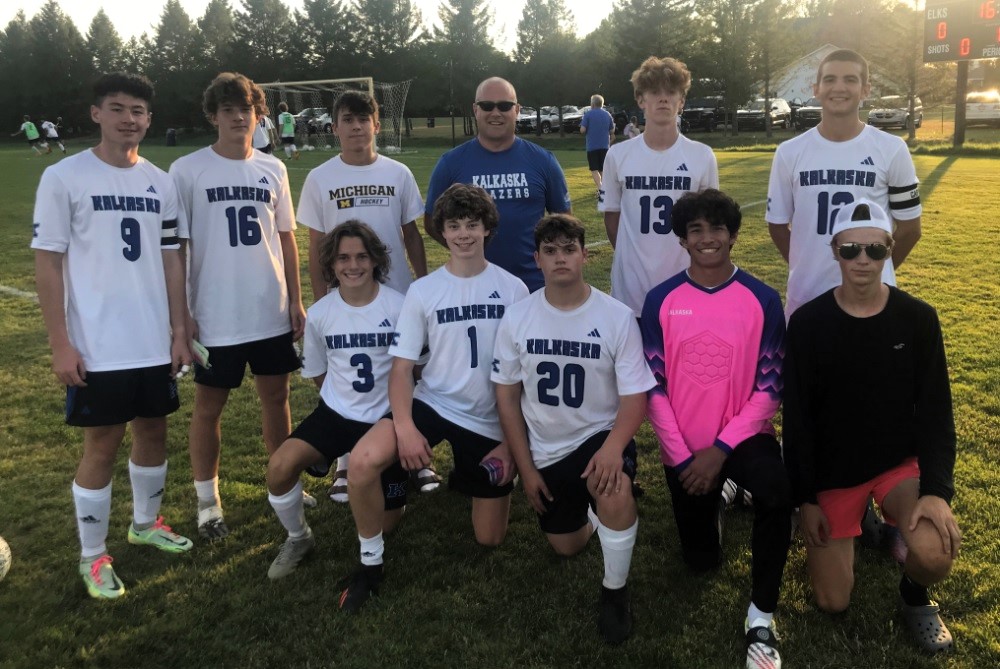
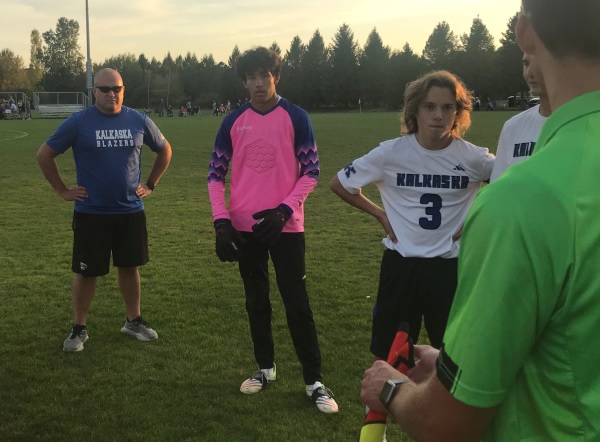
PHOTOS (Top) Kalkaska coach David Wagner II stands among his many seniors last week. (Middle) Wagner and his players meet with an official for the coin flip before playing Elk Rapids. (Photos by Tom Spencer.)