

Add, Subtract, Divide, Multiply: MHSAA Not Alone
July 25, 2017
By Rob Kaminski
MHSAA benchmarks editor
This is the third part in a series on MHSAA tournament classification, past and present, that will be published over the next two weeks. This series originally ran in this spring's edition of MHSAA benchmarks.
As the MHSAA faces its most recent classification task with 8-Player Football, and opinions continue to swirl about as to the method, timeframe, location and other procedures, a look around the country provides plenty of company among state association brethren factoring variables into their own equations.
In the Pacific Northwest, the Oregon School Activities Association Football Playoffs are under public scrutiny as leadership ponders a five or six classification format beginning with the 2018-19 school year.
The OSAA has crowned six champions on the gridiron since 2006-07. Many of the state’s smaller schools would like to keep it that way, while larger schools lean toward a five-classification system, citing larger leagues, ease of travel and credibility to state championships as the advantages.
Still others would prefer more than six classes, pointing to safety issues and the opportunity to increase participation numbers as positives.
Moving southeast of Oregon, the Nevada Interscholastic Activities Association recently voted to hold serve on a classification proposal that was volleyed to the membership.
However, changes still could be forthcoming by as early as the 2018-19 season which would add a fifth classification in more populated southern Nevada while allowing northern schools to participate in four classifications. Such divisions could mean no state championship for the fifth class in southern Nevada.
Because of that, the NIAA wants equal numbers of schools in each classification on both ends of the state. Complicating the issue is the fact that the 24 largest schools in the state, by enrollment, are all in Clark County in Southern Nevada.
Across Nevada’s border into Arizona, charter schools are asking the Arizona Interscholastic Association to reconsider classification that was voted upon and approved in September 2015. That agreement called for the largest 33 percent of charter schools by enrollment to be placed in the state’s largest school classification, 3A, the middle 33 percent into 2A, and the smallest 33 percent into 1A.
Less than two years later the charter schools have had a change of heart and have asked to be considered the same as other Arizona public schools and be placed appropriately by enrollment beginning with the 2018-19 school year.
The situation in Arizona further illustrates how the public/private debate that all state associations have faced throughout existence now has the added dynamic of rapidly growing charter schools in today’s educational system, along with virtual school enrollment.
In the nation’s heartland, Nebraska has retooled its football classifications by using enrollment of boys students only in its schools rather than total enrollment. The Nebraska School Activities Association football-playing schools will kick off the 2018 season using this alignment.
Nebraska has three classes of 11-player football, with the smallest class divided in two, Class C-1 and C-2. The state also will have 8-player football for boys enrollments under 47, and the NSAA will sponsor a new 6-player tournament in 2018 for schools with 27 or fewer boys.
“This is a good proposal because some schools have a sizable imbalance between the number of boys and girls, and there’s a large gap (in enrollment) between the largest and smallest schools in Classes A and B,” NSAA executive director Jim Tenopir said. “I think this addresses both of those concerns.”
Swimmers in Georgia, meanwhile, will feel like they are moving with the current, rather than upstream in 2017-18, as the Georgia High School Association recently doubled the number of team championship events from two to four.
Swim enthusiasts can also count on longer days at the finals, as the top 30 finishers from the prelims will advance to the finals instead of 20, and all championship events will have three heats versus two.

Jones' Motto Inspires 'Get To' Foundation's Work to Provide Opportunities
By
Tom Kendra
Special for MHSAA.com
October 4, 2023
Ben Jones always had the same, simple message, even if it was 100 degrees and sunny or 35 degrees and raining sideways, and whether he was playing for a powerhouse like Muskegon Catholic Central or coaching a program trying to establish itself at Bloomfield Hills Cranbrook Kingswood.
 “We get to play football today,” Jones would say, as many of those around him were complaining and grumbling.
It was never “have to” for Jones, but always “get to.”
Jones, who was about to start his second year as head coach at Cranbrook, had his life tragically cut short by a drunk driver who crashed into his vehicle as he was traveling home from work in Detroit on Aug. 19, 2020. He was just 30 years old.
While Jones is gone, leaving a hole as large and painful as the 6-foot-2, 260-pound frame he carried as a tight end in his senior year at Hillsdale College, that “Get To” mentality is alive and well, and thriving and growing – thanks in large part to the efforts of his football teammates from Muskegon Catholic and later at Hillsdale.
The Get To Foundation, a 501(c)3 non-profit organization, was formed in Jones’ honor and has grown exponentially in less than three years, providing grants to sports organizations and scholarships to student-athletes.
“There is a core group of about 10 of them that have worked on (the foundation), and it’s been amazing,” said Theresa Jones, Ben’s mother, who with her husband Bruce has worked with the foundation. “It started small, and then it caught fire.”
The president of the foundation is Tim Hornak, Jones’ best friend and teammate in the trenches at both Muskegon Catholic and Hillsdale. Hornak returned to deliver a pre-game speech before the Crusaders’ home game on Sept. 15 against Kalamazoo United, where he talked about the man who is the inspiration behind the rapidly-growing Get To movement.
“You don’t have to, you get to – that simple difference can change your lives,” said Hornak, who teamed with Jones when both were seniors to help the Crusaders to a 14-0 record and the Division 8 championship in 2008. “You get to play football tonight and continue the tradition that started here in the 1950s.
“You get a chance to line up and play a great game with your best friends.”
Inspired by Hornak’s words and Jones’ legacy, the Crusaders downed Kalamazoo United 27-7 that night, the team’s second-straight win after an 0-2 start, which put them back in the Division 8 playoff picture.
 A tailgate party was held before the game as a fundraiser for the Get To Foundation, and it happened to coincide with the 15th anniversary of the Crusaders’ 2008 championship team – arguably one of the best teams in the school’s storied history. MCC has won 12 state championships, trailing only Farmington Hills Harrison in state playoff history.
The phrase “get to,” according to Hornak, goes back to the whiteboard in the MCC locker room his sophomore year and perfectly captures Jones’ approach to life and to football, whether his team was unbeaten like at MCC or struggling like the Chargers did just after he and Hornak graduated.
Jones, who wore No. 62 at MCC, was a two-way starting lineman who also played on the Crusaders’ 2006 championship team as a sophomore. His best friends on the team were the Hornak twins, Tim and Jon, whose father Mike was an assistant coach.
After his funeral service on Aug. 24, 2020, Jones’ hearse made a stop at MCC’s Kehren Stadium on the way to the cemetery, taking a lap on the track around Mike Holmes Field.
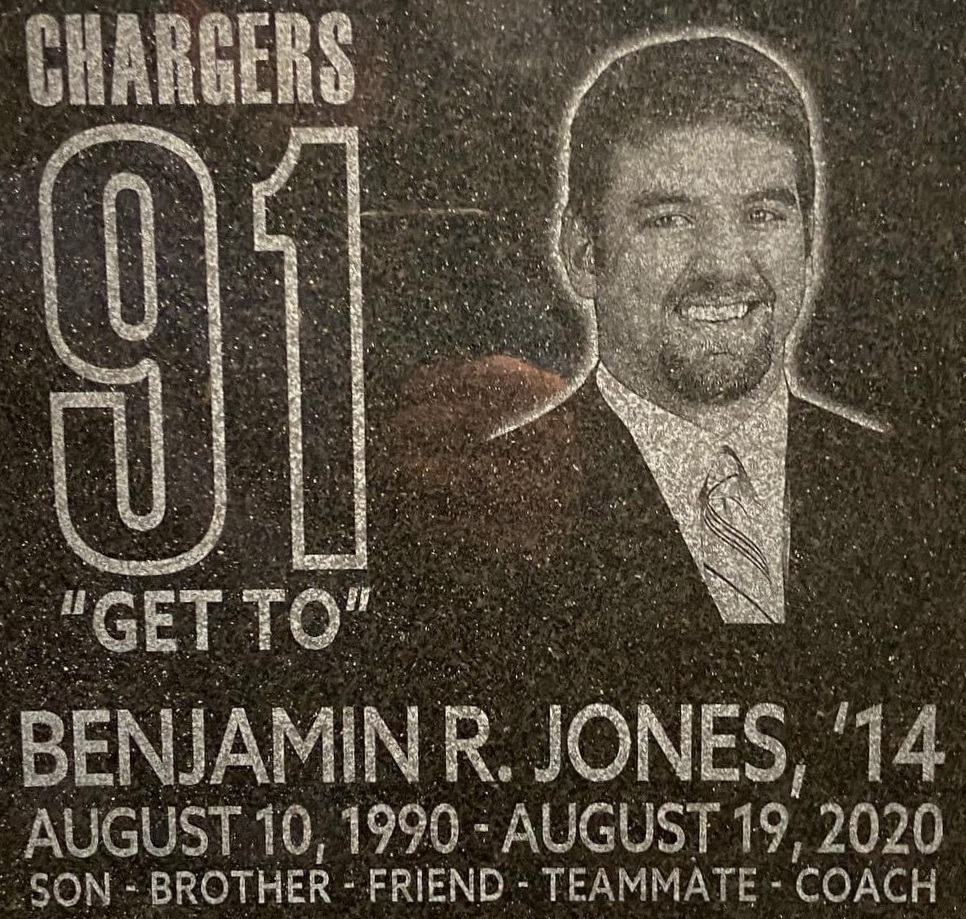
He went on to play on three teams which won or shared Great Lakes Interscholastic Athletic Conference titles at Hillsdale, where he wore No. 91 and played tight end and H-back.
“He had an inner self-confidence that you could tell right away when talking to him,” said Hillsdale coach Keith Otterbein. “He was very positive. He encouraged his teammates.”
Jones graduated from Hillsdale in 2013 with a degree in financial management and a minor in mathematics, moved to Royal Oak and took a job as a portfolio manager and financial planner at Schwartz & Co. Investment Advisors.
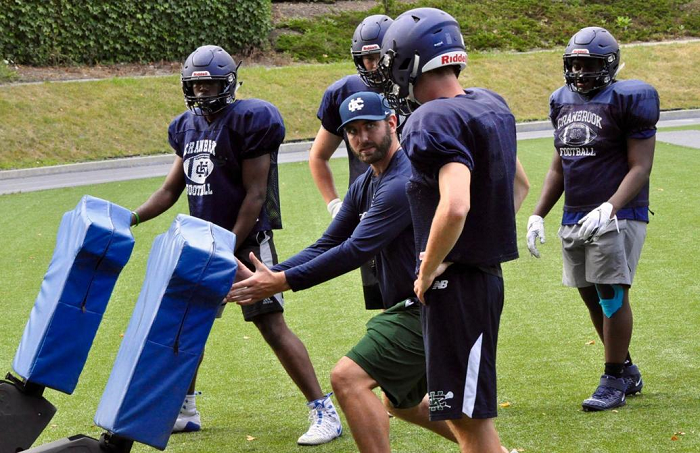
In his free time, he worked as an assistant varsity football coach at Cranbrook from 2015 to 2018, before being elevated to head coach in 2019 at the age of 28.
One of his first actions as head coach was getting Cranbrook football T-shirts printed with the message “Get To” on the back. Jones guided the Cranes to a 6-4 record and a Division 4 playoff berth in what would prove to be his only season as head coach.
 He died nine days before Cranbrook’s scheduled season opener in 2020, which ended up being delayed six weeks due to the COVID-19 pandemic.
In the immediate aftermath of Jones’ shocking death, the Hornak brothers and other former teammates vowed to do something to honor Ben and to help out his family. Out of that mission, the Get To Foundation was born.
Get To has awarded scholarships for the past three years. In 2023 alone, the foundation awarded $16,000 in scholarships to 22 student-athletes from around the state.
In addition, Get To has awarded $55,000 in grants to 17 organizations – including $3,000 to the Eaton Rapids High School football program for new shoulder pads and helmets and $2,500 to the Detroit Tigers Foundation’s Gloves for Kids program.
The next event on the foundation’s busy calendar is a speech by best-selling motivational author Jon Gordon at Lawrence Tech University on Oct. 17.
The foundation’s board has trademarked the phrase “Get To” and hopes to continue to grow the organization’s size and scope – in a way mirroring how big and impactful Ben’s life could have been if it wasn’t cut short.
For more information or to make a donation, go to the organization’s website at www.gettofoundation.org.
The relentless efforts of Ben’s ex-teammates to keep his memory alive means the world to his parents, as well as his two younger siblings – Alissa, a standout swimmer at Hillsdale who is now the school’s assistant women’s swimming coach; and Nate, who also played football for the Chargers and is now a foreign currency trader for Barclay’s, based in New York City.
Theresa Jones said coming together with all of Ben’s closest friends for Get To Foundation events has been a continuous blessing for the family.
“Every time we have an event for the foundation, it’s all of Ben’s friends and family members dressed up and having a good time,” his mother said. “It always feels like Ben’s wedding reception that he never got to have.”
 Tom Kendra worked 23 years at The Muskegon Chronicle, including five as assistant sports editor and the final six as sports editor through 2011. E-mail him at [email protected] with story ideas for Muskegon, Oceana, Mason, Lake, Oceola, Mecosta and Newaygo counties.
PHOTOS (Top) Ben Jones is shown before the 2008 Division 8 championship game at Ford Field during his senior year at Muskegon Catholic Central. The Crusaders defeated Crystal Falls Forest Park, 40-0. (Middle) Jones works with his linemen during his first year as head coach at Bloomfield Hills Cranbrook Kingswood in 2019. (Below) A plaque honoring Jones has been placed in the tunnel leading from the home locker room to the football field at Hillsdale College. (Top photo by Tim Reilly. Additional photos courtesy of the Get To Foundation.)