

Add, Subtract, Divide, Multiply: MHSAA Not Alone
July 25, 2017
By Rob Kaminski
MHSAA benchmarks editor
This is the third part in a series on MHSAA tournament classification, past and present, that will be published over the next two weeks. This series originally ran in this spring's edition of MHSAA benchmarks.
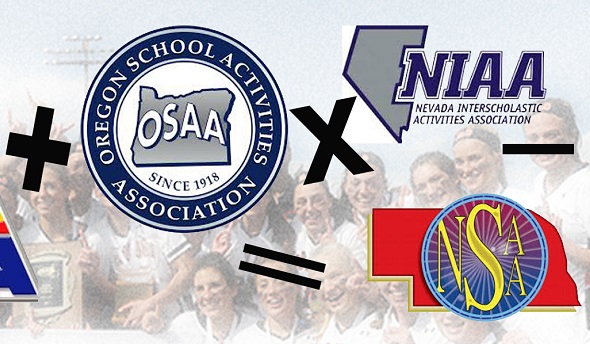
As the MHSAA faces its most recent classification task with 8-Player Football, and opinions continue to swirl about as to the method, timeframe, location and other procedures, a look around the country provides plenty of company among state association brethren factoring variables into their own equations.
In the Pacific Northwest, the Oregon School Activities Association Football Playoffs are under public scrutiny as leadership ponders a five or six classification format beginning with the 2018-19 school year.
The OSAA has crowned six champions on the gridiron since 2006-07. Many of the state’s smaller schools would like to keep it that way, while larger schools lean toward a five-classification system, citing larger leagues, ease of travel and credibility to state championships as the advantages.
Still others would prefer more than six classes, pointing to safety issues and the opportunity to increase participation numbers as positives.
Moving southeast of Oregon, the Nevada Interscholastic Activities Association recently voted to hold serve on a classification proposal that was volleyed to the membership.
However, changes still could be forthcoming by as early as the 2018-19 season which would add a fifth classification in more populated southern Nevada while allowing northern schools to participate in four classifications. Such divisions could mean no state championship for the fifth class in southern Nevada.
Because of that, the NIAA wants equal numbers of schools in each classification on both ends of the state. Complicating the issue is the fact that the 24 largest schools in the state, by enrollment, are all in Clark County in Southern Nevada.
Across Nevada’s border into Arizona, charter schools are asking the Arizona Interscholastic Association to reconsider classification that was voted upon and approved in September 2015. That agreement called for the largest 33 percent of charter schools by enrollment to be placed in the state’s largest school classification, 3A, the middle 33 percent into 2A, and the smallest 33 percent into 1A.
Less than two years later the charter schools have had a change of heart and have asked to be considered the same as other Arizona public schools and be placed appropriately by enrollment beginning with the 2018-19 school year.
The situation in Arizona further illustrates how the public/private debate that all state associations have faced throughout existence now has the added dynamic of rapidly growing charter schools in today’s educational system, along with virtual school enrollment.
In the nation’s heartland, Nebraska has retooled its football classifications by using enrollment of boys students only in its schools rather than total enrollment. The Nebraska School Activities Association football-playing schools will kick off the 2018 season using this alignment.
Nebraska has three classes of 11-player football, with the smallest class divided in two, Class C-1 and C-2. The state also will have 8-player football for boys enrollments under 47, and the NSAA will sponsor a new 6-player tournament in 2018 for schools with 27 or fewer boys.
“This is a good proposal because some schools have a sizable imbalance between the number of boys and girls, and there’s a large gap (in enrollment) between the largest and smallest schools in Classes A and B,” NSAA executive director Jim Tenopir said. “I think this addresses both of those concerns.”
Swimmers in Georgia, meanwhile, will feel like they are moving with the current, rather than upstream in 2017-18, as the Georgia High School Association recently doubled the number of team championship events from two to four.
Swim enthusiasts can also count on longer days at the finals, as the top 30 finishers from the prelims will advance to the finals instead of 20, and all championship events will have three heats versus two.
Macomb Lutheran North Standout on Mend After Knee Injury
October 3, 2023
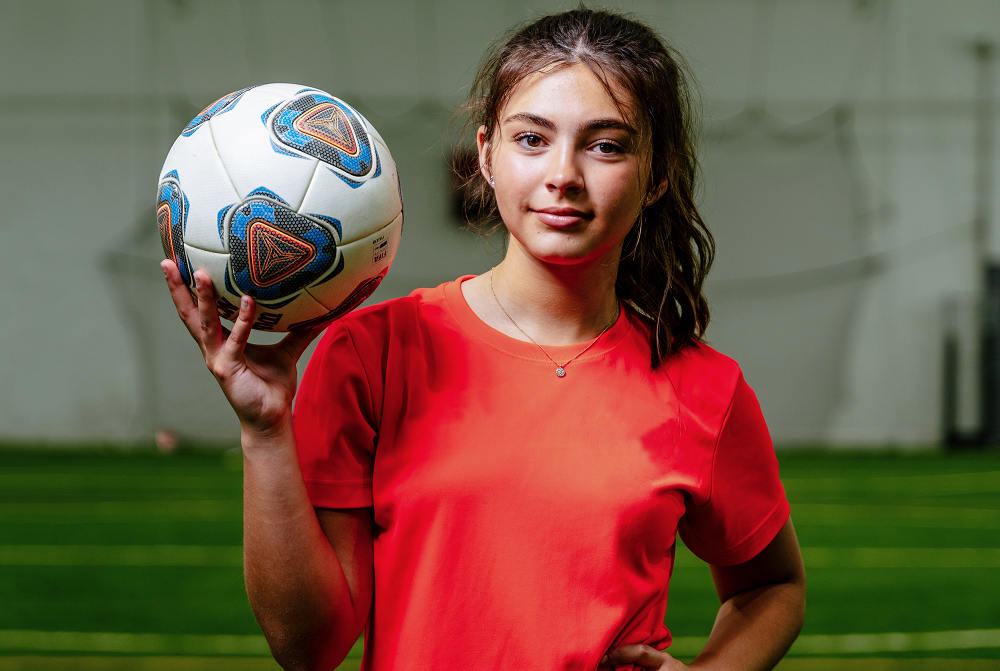
Macomb Lutheran North freshman Emiliana Manzo has already achieved a long list of accomplishments, including a 3.8 grade-point average while juggling two sports she loves.
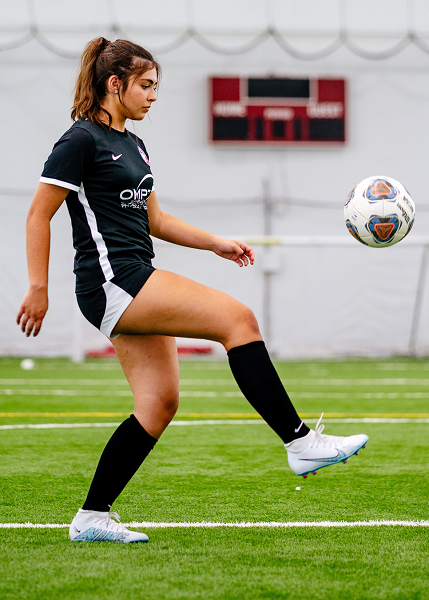
 As a point guard, she led her basketball team to an undefeated season in its division. She is also a center attacking midfielder, sometimes playing forward, on the 2009 Nationals Girls Academy Blue soccer team, ranked No. 1 in Michigan and 14th in the country.
In June of 2022, Emiliana hit a detour on her sports journey when she was participating in a club soccer national championship in Oceanside, Calif. With a few seconds left in the game and her team up 2-1, she ran 20 yards full speed to get to the ball. Hyperextending her left knee, she felt two pops. It was the first time she experienced an injury.
“I was screaming and crying and got taken off the field on a golf cart,” explains Emiliana. The trainer felt she was OK. Fortunately, she had the next day off and her knee was feeling better. The following day she played again, and 20 minutes into the game she knew there was an issue.
“Someone hit me from behind and I heard the pop again. I knew there was a problem.”
Emiliana’s father Vince Manzo said she experienced swelling, and the athletic trainer thought she may have a meniscus injury; however, she was able to continue to walk around during the championship in California before heading home.
Finding the Right Provider
Back in Michigan, Emiliana saw a few surgeons during her evaluation to seek treatment. When she met with Vasilios Bill Moutzouros, MD, chief of Sports Medicine at Henry Ford Health, she felt she met the right match.
“He treated me like an athlete and made me feel really comfortable,” she says.
 Vince adds that both he and Emiliana were also appreciative of something Dr. Moutzouros said during her evaluation: “He emphasized to Emiliana that she was an athlete before this injury, and she would be an athlete after the injury.”
A detailed evaluation by Dr. Moutzouros revealed Emiliana had a complete anterior cruciate ligament (ACL) tear and medial and lateral meniscal tears. The meniscus, a C-shaped piece of tough, rubbery cartilage, acts as a shock absorber between the shinbone and the thighbone. It is one of the most common knee injuries. The ACL, one of the strong bands of tissue that help connect the thigh bone (femur) to the shinbone (tibia), is also prone to injury during sports when there are sudden stops or changes in direction.
Emiliana required physical therapy to get the swelling down and increase mobility before surgical repair.
Dr. Moutzouros reconstructed her ACL with her own patellar tendon graft and repaired her medial meniscus.
“She handled the surgery well and has been working very hard in her rehabilitation,” he says. “Her high-level soccer experience likely helped in her recovery as her range of motion and strengthening advanced so quickly.”
Understandably, Emiliana was nervous and scared when she went into surgery but expressed appreciation for the little things from Henry Ford like hearing “great music” as she was entering surgery, which gave her a sense of calm.
“That’s when I knew I picked the right doctor,” she said.
The Road to Recovery
As part of her recovery, after surgery which took place in July of 2022, Emiliana has undergone six months of physical therapy to increase mobility and strength training to get her leg strong again.
She also participated in the Return to Sport Program at the Henry Ford Center for Athletic Medicine to optimize recovery.
“We loved it,” says Vince. “It gave us peace of mind.”
Dr. Moutzouros explains that ACL prevention and rehabilitation programs are critical, especially for women because they have a four times greater risk of ACL tear than men. He says performance training post-surgery, along with an injury prevention program for those playing cutting sports, can markedly reduce the likelihood of future ACL injury.
“At Henry Ford, we work with physical therapists across the Midwest as well as our own. They do a great job in following our Henry Ford specific post-ACL reconstruction protocol,” he says. “After therapy runs its course, we strongly encourage our athletes to undergo performance training to allow a smooth transition back to sport.”
Nick Parkinson, supervisor of Athletic Training and Sports Performance at Henry Ford Health, emphasizes that the return to sport program is designed to bridge the gap between rehabilitation and returning to full activity in your chosen sport.
“Many times, insurance limits rehabilitation to regaining activities of daily living and not necessarily rebuilding the skills needed to play a sport or return to activity,” Nick says. “This program provides an affordable option to fill this need and return athletes to competition at the highest level.”
As for Emiliana, who hopes to play soccer in college and pursue a career in the medical field, she says this experience has taught her to not be afraid of injuries and treatment. She has also used the experience to volunteer for a program through the Girls Academy which serves as an advisory board to come up with ideas to help with mental and physical issues girls her age may be facing.
“For other kids who experience injuries, I’ve learned that this does not define you,” she said. “You can push through it, recover from it and be way better than you even were before.”
To find a sports medicine doctor or athletic trainer at Henry Ford, visit henryford.com/athletes.