

Add, Subtract, Divide, Multiply: MHSAA Not Alone
July 25, 2017
By Rob Kaminski
MHSAA benchmarks editor
This is the third part in a series on MHSAA tournament classification, past and present, that will be published over the next two weeks. This series originally ran in this spring's edition of MHSAA benchmarks.
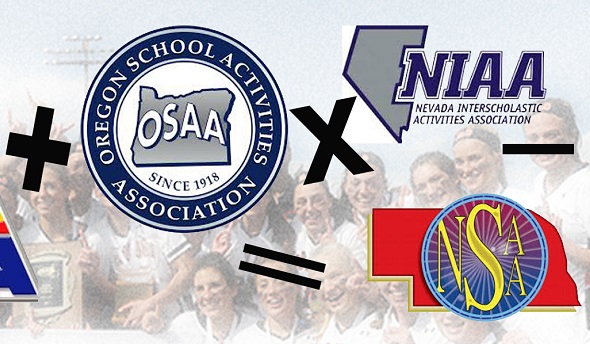
As the MHSAA faces its most recent classification task with 8-Player Football, and opinions continue to swirl about as to the method, timeframe, location and other procedures, a look around the country provides plenty of company among state association brethren factoring variables into their own equations.
In the Pacific Northwest, the Oregon School Activities Association Football Playoffs are under public scrutiny as leadership ponders a five or six classification format beginning with the 2018-19 school year.
The OSAA has crowned six champions on the gridiron since 2006-07. Many of the state’s smaller schools would like to keep it that way, while larger schools lean toward a five-classification system, citing larger leagues, ease of travel and credibility to state championships as the advantages.
Still others would prefer more than six classes, pointing to safety issues and the opportunity to increase participation numbers as positives.
Moving southeast of Oregon, the Nevada Interscholastic Activities Association recently voted to hold serve on a classification proposal that was volleyed to the membership.
However, changes still could be forthcoming by as early as the 2018-19 season which would add a fifth classification in more populated southern Nevada while allowing northern schools to participate in four classifications. Such divisions could mean no state championship for the fifth class in southern Nevada.
Because of that, the NIAA wants equal numbers of schools in each classification on both ends of the state. Complicating the issue is the fact that the 24 largest schools in the state, by enrollment, are all in Clark County in Southern Nevada.
Across Nevada’s border into Arizona, charter schools are asking the Arizona Interscholastic Association to reconsider classification that was voted upon and approved in September 2015. That agreement called for the largest 33 percent of charter schools by enrollment to be placed in the state’s largest school classification, 3A, the middle 33 percent into 2A, and the smallest 33 percent into 1A.
Less than two years later the charter schools have had a change of heart and have asked to be considered the same as other Arizona public schools and be placed appropriately by enrollment beginning with the 2018-19 school year.
The situation in Arizona further illustrates how the public/private debate that all state associations have faced throughout existence now has the added dynamic of rapidly growing charter schools in today’s educational system, along with virtual school enrollment.
In the nation’s heartland, Nebraska has retooled its football classifications by using enrollment of boys students only in its schools rather than total enrollment. The Nebraska School Activities Association football-playing schools will kick off the 2018 season using this alignment.
Nebraska has three classes of 11-player football, with the smallest class divided in two, Class C-1 and C-2. The state also will have 8-player football for boys enrollments under 47, and the NSAA will sponsor a new 6-player tournament in 2018 for schools with 27 or fewer boys.
“This is a good proposal because some schools have a sizable imbalance between the number of boys and girls, and there’s a large gap (in enrollment) between the largest and smallest schools in Classes A and B,” NSAA executive director Jim Tenopir said. “I think this addresses both of those concerns.”
Swimmers in Georgia, meanwhile, will feel like they are moving with the current, rather than upstream in 2017-18, as the Georgia High School Association recently doubled the number of team championship events from two to four.
Swim enthusiasts can also count on longer days at the finals, as the top 30 finishers from the prelims will advance to the finals instead of 20, and all championship events will have three heats versus two.

Brother Rice Finals Hero Aiming to Ace Family Life, Financial World
By
Keith Dunlap
Special for MHSAA.com
July 6, 2023
Matt Conway said the 2008 Bloomfield Hills Brother Rice baseball team he played on wasn’t necessarily the most talented group to ever come through the state.
 But that squad was still plenty good, and there was one thing that became evident during the playoff run the Warriors went on 15 years ago.
“Nobody really stood a chance,” Conway said.
It was certainly hard to argue.
During the MHSAA Division 1 Tournament, Brother Rice outscored its opponents by a combined score of 74-8 and never trailed during its seven playoff games.
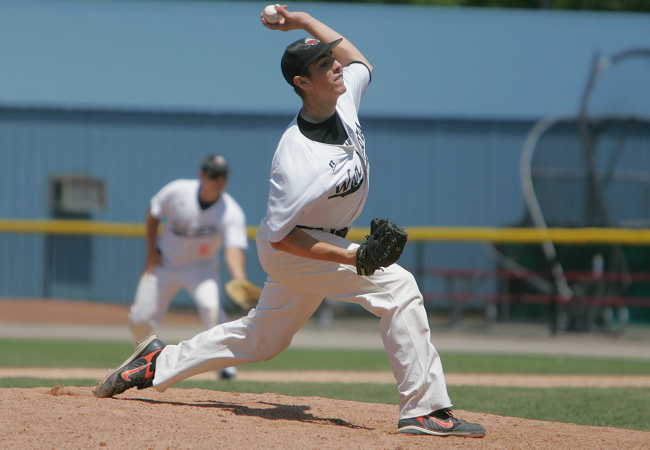
The run culminated with an 8-0 win over Saline in the Division 1 championship game at Battle Creek’s C.O. Brown Stadium, led by a four-hit shutout from Conway on the mound. The title was Brother Rice’s third in school history and remains its most recent.
“The team camaraderie we had and the willingness we had to play for each other really showed in the way we dominated the playoffs,” said Conway, who now works for Center Rock Capital Partners, a private equity industrial firm based in Bloomfield Hills.
While the Warriors that year had camaraderie and chemistry, one thing they also had that other teams didn’t was Conway, who at the time was arguably the best prep player in the state.
Not only was the 6-foot-7 Conway an ace pitcher, he was also a fearsome power hitter at or near the top of the lineup.
The shutout in the championship game as a junior was only one of his achievements in high school, given he was also named first-team all-state in 2008 and 2009.
During his junior year, Conway batted .429 at the plate and was 11-1 on the mound.
 Conway was an all-around force again for Brother Rice in 2009, but the Warriors fell short in their bid to repeat, losing in a Quarterfinal to Saline.
After graduating from Brother Rice in 2009, Conway went on to play baseball at Wake Forest, and his college career got off to a terrific start. He was named a freshman All-American at Wake Forest after leading the Demon Deacons with a .382 batting average during his first college season.
He went off during the summer after his sophomore year to play in the prestigious Cape Cod Baseball League in Massachusetts, arguably the nation’s premier summer league for college prospects and followed intensely by pro scouts.
Unfortunately, a knee injury made his time there short-lived.
“Unfortunately in the first game, I got hurt pretty bad,” Conway said. “I had to leave the Cape, and things weren’t really the same ever since.”
Conway eventually finished a nice college career at Wake Forest, but had to battle through more knee injuries.
He ultimately decided a professional baseball career wasn’t meant to be.
“At that point, I realized this is maybe not the path I was supposed to take,” Conway said. “I played through my senior year, and then took the uniform off and put on a suit. It was a little different, but I do believe things happen for a reason.”
Indeed, Conway has no complaints. He’s happily married to his wife Stephanie and has two children, an 18-month-old daughter and an infant son about a month old.
As an alum of Wake Forest, Conway was obviously thrilled to see the Demon Deacons advance to the College World Series semifinals and earn the No. 1 overall seed in the NCAA Tournament this season.
“I had a ticket booked to Omaha to go to the championship series if they made it,” he said.
Conway has worked for Center Rock Capital Partners since 2018 and has always had plenty of knowledge in the financial and business sectors, given his father, Van, is a renowned financial consultant who owns a firm in Birmingham.
While his baseball playing days have been over for a while, Matt Conway said the lessons he learned playing in high school for Brother Rice head coach Bob Riker, and at Wake Forest for head coach Tom Walter, prepared him well for his current career and will always be with him.
“Time management, prioritizing and making sure you are on top of what you need to get done,” Conway said. “It taught me more than I could ever think of.”
Made in Michigan is powered by Michigan Army National Guard.
2023 Made In Michigan
July 5: Lapeer West 4-Time Finals Winner Set to Build Champions at Oklahoma - Read
PHOTOS (Top) Brother Rice’s Matt Conway walks to the plate to accept his medal after the Warriors' Division 1 title-clinching win in 2008, and these days is building a family with wife Stephanie. (Middle) Conway makes his move toward the plate during that 2008 championship game. (Baseball photos from MHSAA archives; family photo courtesy of the Conway family.)