


Add, Subtract, Divide, Multiply: MHSAA Not Alone
July 25, 2017
By Rob Kaminski
MHSAA benchmarks editor
This is the third part in a series on MHSAA tournament classification, past and present, that will be published over the next two weeks. This series originally ran in this spring's edition of MHSAA benchmarks.
As the MHSAA faces its most recent classification task with 8-Player Football, and opinions continue to swirl about as to the method, timeframe, location and other procedures, a look around the country provides plenty of company among state association brethren factoring variables into their own equations.
In the Pacific Northwest, the Oregon School Activities Association Football Playoffs are under public scrutiny as leadership ponders a five or six classification format beginning with the 2018-19 school year.
The OSAA has crowned six champions on the gridiron since 2006-07. Many of the state’s smaller schools would like to keep it that way, while larger schools lean toward a five-classification system, citing larger leagues, ease of travel and credibility to state championships as the advantages.
Still others would prefer more than six classes, pointing to safety issues and the opportunity to increase participation numbers as positives.
Moving southeast of Oregon, the Nevada Interscholastic Activities Association recently voted to hold serve on a classification proposal that was volleyed to the membership.
However, changes still could be forthcoming by as early as the 2018-19 season which would add a fifth classification in more populated southern Nevada while allowing northern schools to participate in four classifications. Such divisions could mean no state championship for the fifth class in southern Nevada.
Because of that, the NIAA wants equal numbers of schools in each classification on both ends of the state. Complicating the issue is the fact that the 24 largest schools in the state, by enrollment, are all in Clark County in Southern Nevada.
Across Nevada’s border into Arizona, charter schools are asking the Arizona Interscholastic Association to reconsider classification that was voted upon and approved in September 2015. That agreement called for the largest 33 percent of charter schools by enrollment to be placed in the state’s largest school classification, 3A, the middle 33 percent into 2A, and the smallest 33 percent into 1A.
Less than two years later the charter schools have had a change of heart and have asked to be considered the same as other Arizona public schools and be placed appropriately by enrollment beginning with the 2018-19 school year.
The situation in Arizona further illustrates how the public/private debate that all state associations have faced throughout existence now has the added dynamic of rapidly growing charter schools in today’s educational system, along with virtual school enrollment.
In the nation’s heartland, Nebraska has retooled its football classifications by using enrollment of boys students only in its schools rather than total enrollment. The Nebraska School Activities Association football-playing schools will kick off the 2018 season using this alignment.
Nebraska has three classes of 11-player football, with the smallest class divided in two, Class C-1 and C-2. The state also will have 8-player football for boys enrollments under 47, and the NSAA will sponsor a new 6-player tournament in 2018 for schools with 27 or fewer boys.
“This is a good proposal because some schools have a sizable imbalance between the number of boys and girls, and there’s a large gap (in enrollment) between the largest and smallest schools in Classes A and B,” NSAA executive director Jim Tenopir said. “I think this addresses both of those concerns.”
Swimmers in Georgia, meanwhile, will feel like they are moving with the current, rather than upstream in 2017-18, as the Georgia High School Association recently doubled the number of team championship events from two to four.
Swim enthusiasts can also count on longer days at the finals, as the top 30 finishers from the prelims will advance to the finals instead of 20, and all championship events will have three heats versus two.
Hart Teammates Reunite After 80 Years Now as WWII Vets, Great-Grandfathers
By
Tom Kendra
Special for MHSAA.com
June 7, 2023
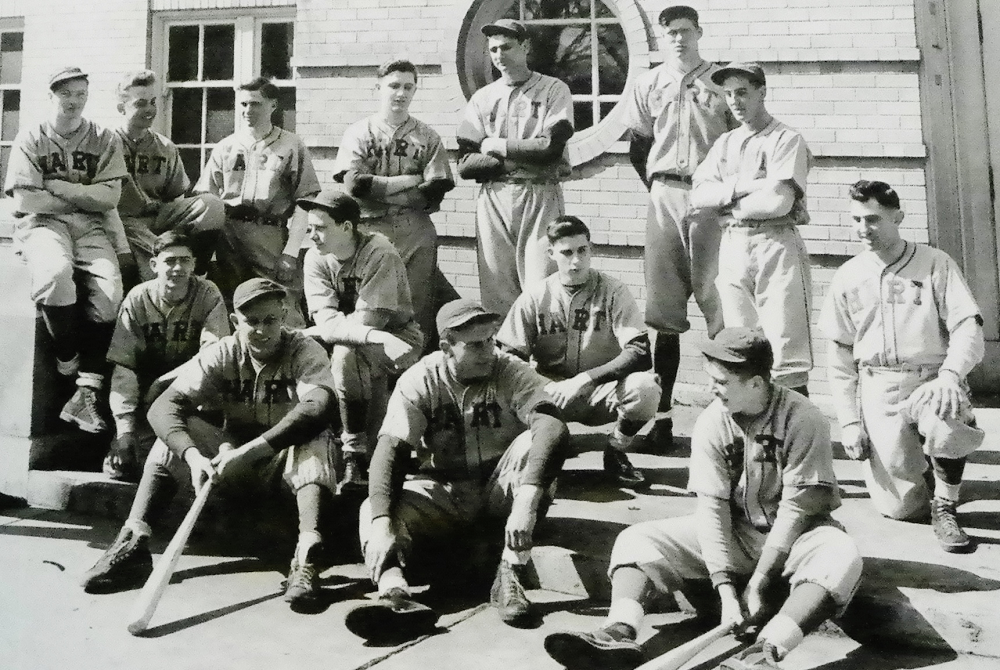
Walter “Stretch” Hansen and Harold Tate were good friends and high school basketball and baseball teammates at Hart High School, graduating in 1943.
 No one could have guessed that less than two months after graduation (on July 2, 1943), the two friends would head to Fort Custer in Battle Creek, the first stop on their way overseas to fight for their country in World War II.
No one could have imagined how many twists and turns their lives would take over the next 80 years – from the battlefields in the South Pacific, then back to West Michigan where they both were married with children, grandchildren, great-grandchildren and now Harold even has a great-great-grandchild.
And, certainly, no one would have believed that the two young boys from Hart – who forged a friendship through high school sports long before the days of computers, microwave ovens and cell phones – would still be alive at the age of 98 for an emotional reunion last month, on May 22, seeing each other for the first time in 80 years and, to cap it off, the reunion took place in their hometown of Hart.
“It was such a great day,” Hansen said about the meeting, which was set up by Muskegon-area World War II historian Richard Mullally.
“We picked right up, talking about sports and the service and everything else.”
The conversation came easy for the two old friends, who played for Hart during a “golden era” at the school – particularly in basketball, as the Pirates won 11 West Michigan Conference basketball titles between 1940 and 1954.
 Perhaps the best team during that time period was Hansen and Tate’s as seniors in 1943. That team lost only once, to rival Scottville (31-25), but more than made up for it with an 80-10 trouncing of the Spartans in the final regular-season game.
Hart then crushed Scottville and Newaygo to win the District championship, only to have Michigan’s prep basketball season stopped abruptly at that point because of World War II.
That 1943 team featured four starters over 6-0, led by the duo of Hansen and Stan Kapulak (both 6-6), Joe Mack (6-2), Lyle Burmeister (6-1) and Stanley Riley (the lone starter under 6-foot at 5-11).
“The newspapers called us ‘The Hart Skyscrapers,’” said Hansen, who will be 99 on Nov. 6. “We were taller than most college teams at that time.”
Hansen and Tate’s friendship continued to blossom on the baseball field, only to have their lives turned upside down shortly after graduation 80 years ago, when all Hart senior boys who had been drafted headed to Battle Creek as a brief staging area on their way to the battlefields of Europe and the South Pacific.
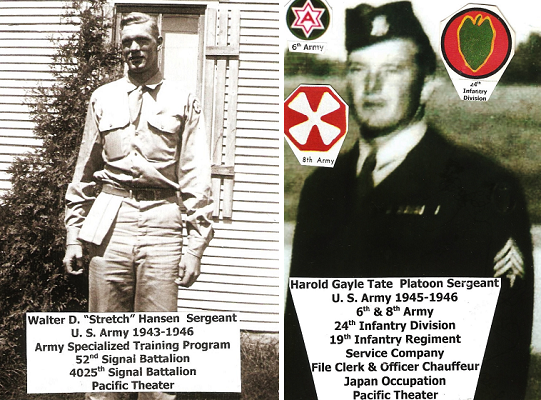
Hansen served in the Army Specialized Training Program and was part of the 52nd Signal Battalion and the 4025th Signal Battalion in the Pacific Theater.
“I had an all-expense paid tour of the South Pacific,” Hansen said with a chuckle. “The Philippines, New Guinea, Okinawa, Hawaii, all over the place.”
Tate did his service in the 24th Infantry Division and the 19th Infantry Regiment, and was stationed in Japan.
During their visit last month, Harold showed off the Japanese Samurai sword and Arisaka rifle which he had sent back from Japan to Hart. The week after their visit, both took part in Memorial Day parades – Hansen in the Lakeside parade in Muskegon and Tate in his 77th Memorial Day service in Hart.
Hansen, who still has a home on a small lake in Holton and lives at a senior care facility in Muskegon, played many years of semi-pro basketball and did some coaching. He worked at GTE and has five children and 10 grandchildren.
 “I have been so blessed,” Hansen said, sorting through one of his many scrapbooks. “All five of my kids are great and I have grandkids that are just amazing, everything they are doing. I don’t even know all of their names, but it’s sure been fun watching them.”
Tate returned to Hart after his military service and has been there ever since, at first working as a carpenter with his father and then becoming a rural mail carrier for the U.S. Postal Service, retiring 26 years ago at the age of 72. He has lived in the same home for 75 years and has three children, six grandchildren, seven great-grandkids and now one great-great-grandchild.
Tate laments the demise of his beloved American Legion post in Hart, a town with just over 2,000 residents, as the number of members has steadily declined.
One topic that brings a smile to both of their faces is the recent resurgence of the Hart High School athletic program, which drew media attention not too many years ago for all the wrong reasons – notably a football program which went 24 years without a winning record.
That string was snapped with a 6-3 mark and the school’s first earned playoff appearance last fall.
But that was just the start.
This winter, Hart’s boys basketball team finished the regular season 22-0, the girls basketball team made it to the Division 3 Semifinals at the Breslin Center, wrestling qualified for the Team Finals for the fourth-straight year and competitive cheer placed fourth in Division 4. This spring, the Hart girls track & field team won its second-straight Division 3 Finals team title, and the boys placed fourth.
“It’s a great place to call home, a great place to live, always has been,” said Hansen of his hometown, which got its name from its central position in the “heart” of Oceana County.
And who would have imagined that these two high school teammates could still come home again for a reunion at the age of 98?
 Tom Kendra worked 23 years at The Muskegon Chronicle, including five as assistant sports editor and the final six as sports editor through 2011. E-mail him at [email protected] with story ideas for Muskegon, Oceana, Mason, Lake, Oceola, Mecosta and Newaygo counties.
PHOTOS (Top) Members of the 1943 Hart High School varsity baseball team gather together, preparing for a team photo. Among those are Harold Gayle Tate (far left) and Walter "Stretch" Hansen, at 6-6 the tallest player in the back row. (Middle) Hansen, left, and Tate reunite for the first time in 80 years on Monday, May 22, 2023, in their hometown of Hart. (Below) Hansen served from 1943 to 1946 as a Sergeant in the Pacific Theater during World War II. Tate served from 1945 to 1946 as a Platoon Sergeant in the Pacific Theater during World War II. (Top photo courtesy of Stretch Hansen. Middle and below photos courtesy of Richard Mullally.)