


Add, Subtract, Divide, Multiply: MHSAA Not Alone
July 25, 2017
By Rob Kaminski
MHSAA benchmarks editor
This is the third part in a series on MHSAA tournament classification, past and present, that will be published over the next two weeks. This series originally ran in this spring's edition of MHSAA benchmarks.
As the MHSAA faces its most recent classification task with 8-Player Football, and opinions continue to swirl about as to the method, timeframe, location and other procedures, a look around the country provides plenty of company among state association brethren factoring variables into their own equations.
In the Pacific Northwest, the Oregon School Activities Association Football Playoffs are under public scrutiny as leadership ponders a five or six classification format beginning with the 2018-19 school year.
The OSAA has crowned six champions on the gridiron since 2006-07. Many of the state’s smaller schools would like to keep it that way, while larger schools lean toward a five-classification system, citing larger leagues, ease of travel and credibility to state championships as the advantages.
Still others would prefer more than six classes, pointing to safety issues and the opportunity to increase participation numbers as positives.
Moving southeast of Oregon, the Nevada Interscholastic Activities Association recently voted to hold serve on a classification proposal that was volleyed to the membership.
However, changes still could be forthcoming by as early as the 2018-19 season which would add a fifth classification in more populated southern Nevada while allowing northern schools to participate in four classifications. Such divisions could mean no state championship for the fifth class in southern Nevada.
Because of that, the NIAA wants equal numbers of schools in each classification on both ends of the state. Complicating the issue is the fact that the 24 largest schools in the state, by enrollment, are all in Clark County in Southern Nevada.
Across Nevada’s border into Arizona, charter schools are asking the Arizona Interscholastic Association to reconsider classification that was voted upon and approved in September 2015. That agreement called for the largest 33 percent of charter schools by enrollment to be placed in the state’s largest school classification, 3A, the middle 33 percent into 2A, and the smallest 33 percent into 1A.
Less than two years later the charter schools have had a change of heart and have asked to be considered the same as other Arizona public schools and be placed appropriately by enrollment beginning with the 2018-19 school year.
The situation in Arizona further illustrates how the public/private debate that all state associations have faced throughout existence now has the added dynamic of rapidly growing charter schools in today’s educational system, along with virtual school enrollment.
In the nation’s heartland, Nebraska has retooled its football classifications by using enrollment of boys students only in its schools rather than total enrollment. The Nebraska School Activities Association football-playing schools will kick off the 2018 season using this alignment.
Nebraska has three classes of 11-player football, with the smallest class divided in two, Class C-1 and C-2. The state also will have 8-player football for boys enrollments under 47, and the NSAA will sponsor a new 6-player tournament in 2018 for schools with 27 or fewer boys.
“This is a good proposal because some schools have a sizable imbalance between the number of boys and girls, and there’s a large gap (in enrollment) between the largest and smallest schools in Classes A and B,” NSAA executive director Jim Tenopir said. “I think this addresses both of those concerns.”
Swimmers in Georgia, meanwhile, will feel like they are moving with the current, rather than upstream in 2017-18, as the Georgia High School Association recently doubled the number of team championship events from two to four.
Swim enthusiasts can also count on longer days at the finals, as the top 30 finishers from the prelims will advance to the finals instead of 20, and all championship events will have three heats versus two.

Multi-Sprint Champ Racing to Finish Huron Career Ahead of the Rest Again
By
Keith Dunlap
Special for MHSAA.com
May 25, 2023
NEW BOSTON – If there was one thing Elizabeth Anderson took pride in elementary school, it was simply showing that she could outrun everyone in sight.
 In fact, Anderson has an explanation for all the success she had in those playground races.
“Dominance when you are in elementary school,” Anderson quipped. “I don’t think I ever had a nickname. I just think everyone knew I was fast.”
Years later, pretty much everyone who follows track & field in the state of Michigan can attest to that.
A senior for New Boston Huron, Anderson has been faster than most other competitors in the state during her three-year high school career (with her freshman season in 2020 canceled due to COVID-19).
Last year, Anderson won titles at the Lower Peninsula Division 2 Finals in the 200-meter (25.07) and 400-meter (56.28) dashes, and was runner-up in the 100-meter dash (12.23).
Often, top sprinters focus on one or two of those three races. But Anderson is certainly a different breed of sprinter because she does all three.
In fact, she holds school records in all three of those events, and if all that weren’t enough, Anderson is a part of all three sprint relay teams.
“It is hard to give her events off,” said New Boston Huron head girls track coach Danielle Lobato.
Despite the different styles the 100, 200 and 400-meter dashes present, Anderson said there usually isn’t much adjusting when she goes from one of those races to another.
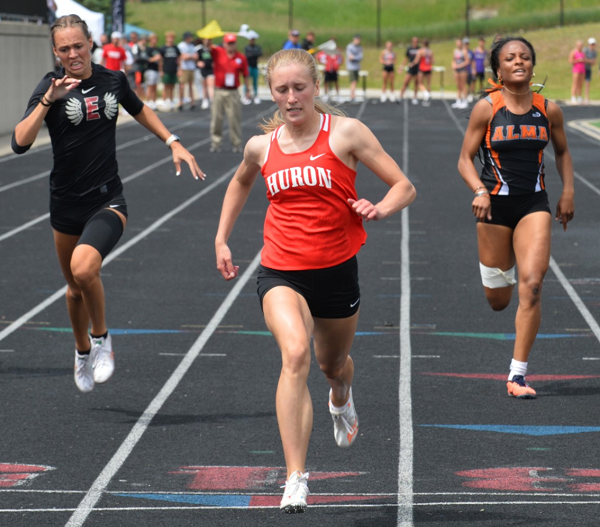 The strategy is simply, “Let’s beat the other girls to the finish line.”
“I don’t really go into each race changing up how I would run,” she said.
While enjoying and succeeding in all three races, Anderson said she actually does have a favorite among them.
“I would say the 400 is probably my favorite,” she said. “Even though it hurts, it’s satisfying to see how much you can get your time down in the 400 compared to any other race.”
Anderson said she started running track in sixth grade, but really got serious about it during the summer after her sophomore season, when she was invited to run for a local club.
Eventually, that led to her competing over the winter in indoor events.
She lived and breathed track so much that last fall, she decided to not run cross country so she could focus on a weightlifting regimen aimed at developing more leg strength.
“Once I started doing summer track, I realized I wanted to be doing this all the time,” she said.
Lobato said oftentimes in practice, Anderson is a de facto coach, given there is no better person she can think of for the younger runners on the team to learn from.
“I can’t always demonstrate these things I’m trying to teach,” she said. “You get to see it in real life (from Anderson), not in a YouTube video.”
After winning the 100, 200 and 400-meter dashes at her Regional meet last week, Anderson has her sights set on achieving the same trifecta of titles at next Saturday’s Finals in Grand Rapids.
Anderson has signed to run track at Michigan State, but has been plenty motivated to keep producing this spring in her final high school season.
“I’m really looking to defend my titles,” she said. “That is what is really motivating me to keep going. I want to keep in shape for the college season. I don’t want to lose any of the progress I have made. Ultimately, I just love running track.”
And since elementary school, Anderson has loved — and succeeded in — outrunning everyone else to the finish line.
“We knew we were getting something special,” Lobato said of when Anderson arrived in high school. “But you never expect this. All that she has accomplished is amazing.”
 Keith Dunlap has served in Detroit-area sports media for more than two decades, including as a sportswriter at the Oakland Press from 2001-16 primarily covering high school sports but also college and professional teams. His bylines also have appeared in USA Today, the Washington Post, the Detroit Free Press, the Houston Chronicle and the Boston Globe. He served as the administrator for the Oakland Activities Association’s website from 2017-2020. Contact him at [email protected] with story ideas for Oakland, Macomb and Wayne counties
PHOTOS (Top) New Boston Huron's Elizabeth Anderson clears the finish line during last season's LPD2 400 race. (Middle) Anderson, middle, outpaces the field to also win the 200. (Click for more from RunMichigan.com.)